
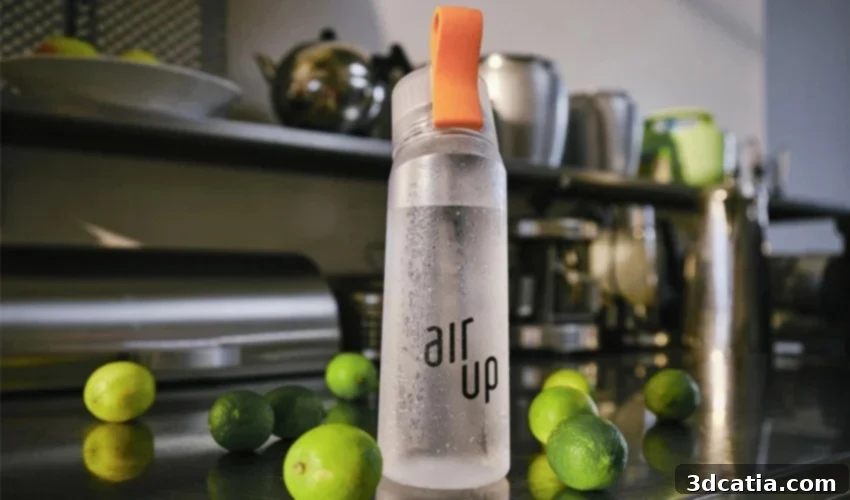
The Air Up Revolution: Pioneering Flavorful Hydration Through Advanced 3D Printing and Prototyping
The realm of additive manufacturing is continuously expanding, offering boundless and diverse possibilities across various industries. A compelling illustration of this innovation comes from Air Up, a Munich-based company that has successfully introduced a groundbreaking trend in healthy beverages. Their unique water bottles ingeniously flavor water using the principle of retro-olfaction, transforming the way people approach hydration. The genesis of Air Up stemmed from a common societal challenge: many individuals struggle to consume adequate amounts of water daily, despite widespread awareness of its critical importance for overall health and well-being. Recognizing this gap, the founders embarked on a mission to develop an original and appealing concept designed to significantly encourage greater water consumption among the general public.
In an era where many often resort to sugary drinks, caffeinated beverages, or herbal teas to satisfy their hydration needs, the fundamental truth remains: pure water is undeniably the body’s optimal source of liquid. It’s this core understanding that motivated the Air Up team to conceptualize and develop a water bottle system capable of imparting various flavors to plain water, thereby making drinking water a more enticing and enjoyable experience. This innovative approach has clearly resonated with consumers, as the company has achieved remarkable growth, reaching an impressive milestone of 1 million customers and building a dedicated team of 240 employees in a mere two years, as of March 2022. For us, Air Up’s story is particularly fascinating because 3D printing played an indispensable role throughout the critical development phases of their distinctive bottles. Additive manufacturing was leveraged extensively, not only for the direct printing of initial prototypes but also for the rapid manufacturing of molds essential for silicone casting, enabling the creation of food-grade prototypes. This strategic application of 3D printing proved instrumental in saving the startup considerable time and financial resources, ultimately accelerating their journey to market with a refined and consumer-ready product.
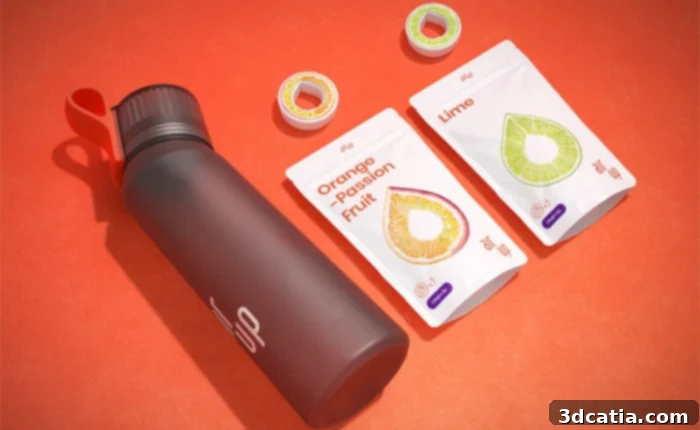
Air Up offers a wide variety of exciting flavors, including refreshing lime, zesty orange, and sweet strawberry, ensuring a diverse and appealing drinking experience for all (photo credits: Air Up).
Understanding the Air Up Bottle: The Science of Scent-Based Hydration
How an Air Up Bottle Works
The operational principle behind the Air Up bottle is elegantly simple yet scientifically sophisticated. Users begin by clipping a “Pod,” or a flavor capsule of their choosing, onto the bottle’s straw mechanism. As the individual takes a sip, a fascinating process unfolds: flavored air bubbles are generated and rise through these capsules, traveling directly into the oral cavity. From there, these aromatic air bubbles reach the olfactory receptors situated in the back of the throat. These specialized receptors are solely responsible for detecting and transmitting the smell signals to the brain. Crucially, because the scent originates from within the throat, our brain processes this smell but perceives it as an actual taste sensation. This ingenious mechanism tricks the brain into believing the water itself is flavored, making it significantly more appealing to drink, all while ensuring the water remains pure, healthy, and entirely free of added sugars, artificial sweeteners, or other additives. Moreover, each aromatic capsule is designed to effectively flavor a substantial volume of water, typically between five to seven liters, which inherently contributes to a significant reduction in the waste generated by single-use plastic bottles, aligning with sustainable consumption practices.
3D Printing: The Catalyst for Air Up’s Rapid Innovation and Market Success
The Pivotal Role of 3D Printing in Air Up’s Development
In the contemporary landscape of product design and engineering, 3D printing has firmly established itself as an indispensable tool for rapidly and economically transforming conceptual ideas into tangible final product designs. For Air Up’s founders, Jäger and Jüngst, the journey began with their Bachelor’s thesis. After deciding to bring their innovative hydration concept to life, they astutely recognized the immense potential of additive manufacturing. They meticulously selected the most appropriate 3D printing methods to construct the initial prototypes of their unique water bottle, ensuring these early iterations perfectly aligned with their visionary ideas. A cornerstone of their development strategy was the adoption of “rapid tooling,” a highly efficient technique that ingeniously combines the flexibility and speed of 3D printed tools with the robustness and scalability of traditional manufacturing processes like injection molding, thermoforming, and critically, silicone molding. This hybrid approach granted them unparalleled agility, allowing them to modify and refine their prototype designs with exceptional flexibility, remarkable cost-effectiveness, and astonishing speed. This iterative design capability was crucial for a startup aiming to introduce a novel product to a competitive market, enabling them to test, learn, and adapt without significant financial or time overheads.
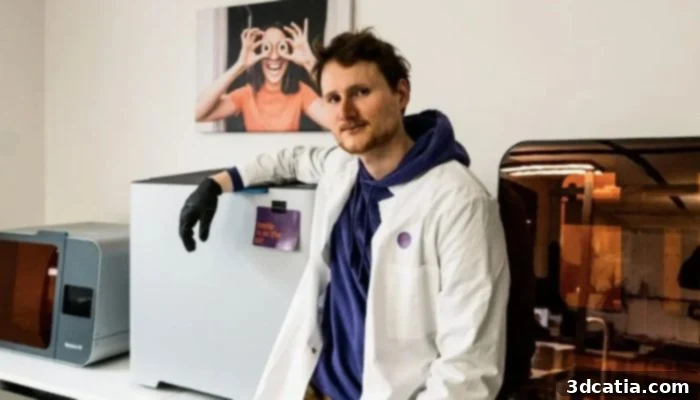
The advanced prototyping laboratory at Air Up is well-equipped with state-of-the-art Formlabs SLA 3D printers, including the large-format Form 3L and multiple desktop Form 3 units, facilitating rapid and precise iteration (photo credits: Formlabs).
Strategic Partnership and Advanced Additive Manufacturing Solutions
For this ambitious project, Air Up forged a crucial partnership with Beta2Shape, a distinguished Formlabs partner, who provided invaluable assistance and expert guidance to the Air Up team throughout the development process. The Air Up founders initially invested in a Form 2 3D printer, quickly recognizing its capabilities for precision prototyping. As their development needs evolved and production scaled, they significantly expanded their in-house printing capacity, upgrading to the more advanced Form 3 and subsequently integrating the larger-format Form 3L Stereolithography (SLA) 3D printers from Formlabs. These high-resolution SLA machines proved instrumental across multiple critical components of the Air Up bottle. Beyond their primary use for the intricate silicone molding of the complex mouthpieces – a component vital for the retro-olfaction mechanism – these printers were also extensively utilized for prototyping various other essential parts. This included the iterative design and testing of the bottle’s cap and the sophisticated straw mechanisms, ensuring every aspect of the bottle functioned seamlessly and ergonomically.
Precision Engineering for a Unique Drinking Experience
To successfully deliver a pure, varied, and genuinely engaging drinking experience based on their unique retro-olfaction feedback principle, the Air Up team faced stringent and highly specific design requirements, particularly concerning the mouthpiece. The intricate geometry and precise airflow dynamics necessary for effectively conveying scent demanded meticulous engineering. CEO Jäger vividly describes the innovative solution they devised: “I used 3D printing to create a mold into which I could pour the silicone. I tried hundreds of variations and was always able to evolve the prototypes into a truly finished material.” This statement underscores the power of additive manufacturing in facilitating rapid iteration and design refinement. The ability to quickly produce numerous variations of 3D printed molds allowed Jäger and his team to experiment extensively with different geometries and materials for the silicone mouthpiece. This iterative process, enabled by the speed and precision of 3D printing, was critical for fine-tuning the subtle nuances of the scent delivery system. By utilizing 3D printed molds for poured silicone, the team could work with extraordinary attention to detail and dimensional accuracy, without incurring significant delays or exorbitant costs typically associated with traditional mold-making techniques. This agile development cycle was paramount in transforming their innovative concept into a functionally perfect, market-ready product. For those eager to delve deeper into the technology and product offerings, more comprehensive information about these revolutionary water bottles can be found HERE.
The Broader Impact of Additive Manufacturing on Consumer Product Innovation
The remarkable success story of Air Up serves as a compelling testament to the transformative potential of additive manufacturing in accelerating product development and market entry for consumer goods. Air Up’s journey from a Bachelor’s thesis concept to a thriving company with millions of customers highlights how 3D printing empowers startups and established enterprises alike to innovate with unparalleled speed and efficiency. By facilitating rapid prototyping, cost-effective design iteration, and precision tooling for specialized components, 3D printing significantly lowers the barriers to entry for complex product innovations. This not only fosters a culture of creativity and experimentation but also enables companies to respond more swiftly to consumer demands and market trends. The ability to produce functional prototypes and molds in-house reduces reliance on external suppliers, shortens lead times, and ultimately drives faster time-to-market. Air Up’s adoption of Formlabs technology exemplifies how cutting-edge 3D printing solutions can be strategically integrated into a product development workflow to achieve high-quality, complex components essential for a unique user experience. This case study is a powerful reminder that the countless and varied possibilities of additive manufacturing are continually reshaping industries, pushing the boundaries of what is possible in design, engineering, and consumer product innovation.
We invite your thoughts and perspectives on the seamless integration of 3D printing within the developmental trajectory of Air Up. What are your impressions of how additive manufacturing has contributed to their groundbreaking product? Please share your insights in a comment below or connect with us on our various social media platforms, including LinkedIn, Facebook, and Twitter! Don’t miss out on the latest advancements and news in the world of 3D printing; remember to sign up for our free weekly Newsletter here, delivering the freshest updates directly to your inbox! Additionally, explore our extensive library of videos and insights on our dedicated YouTube channel.