
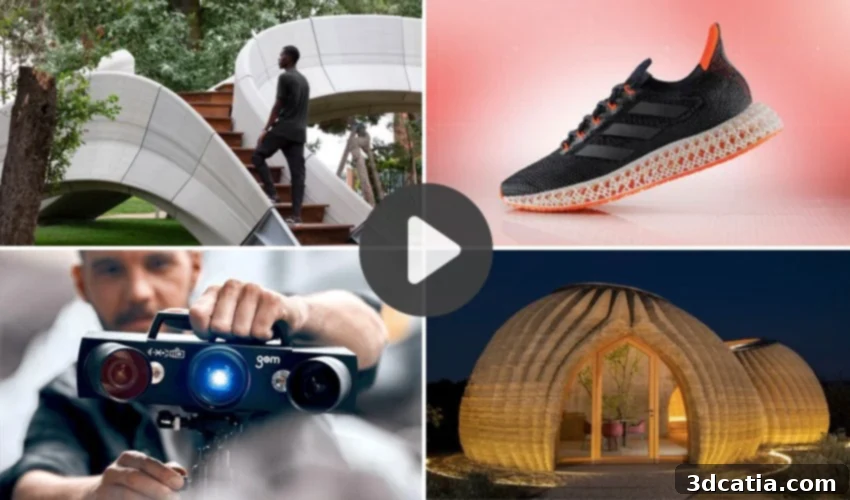
Top 3D Printing Innovations of 2021: A Retrospective Video Showcase
The year 2021 marked a pivotal period for additive manufacturing, showcasing remarkable progress and diverse applications across various industries. As the world navigated recovery and renewed innovation, 3D printing technology emerged as a key enabler for breakthroughs in fields ranging from medical prosthetics and sustainable construction to advanced robotics and aerospace exploration. From printing entire houses and intricate bridges to revolutionizing car parts and creating life-like human prostheses, the capabilities of 3D printing expanded dramatically. The return of significant physical events, such as Formnext, the world’s largest trade show dedicated to additive manufacturing, further catalyzed collaboration and unveiled cutting-edge solutions. This curated collection of 11 outstanding 3D printing videos offers a captivating look back at some of the most impactful innovations and developments of 2021, illustrating the technology’s transformative power and its promise for the future.
A 3D Printed Ocular Prosthesis: A Vision of the Future
One of the most heartwarming and medically significant breakthroughs of 2021 was the case of Steve Verze, a London resident who became the world’s first recipient of a fully 3D printed ocular prosthesis. This revolutionary development was the result of a collaborative effort involving researchers from UCL and Moorfields Eye Hospital NHS Foundation Trust, alongside various UK and European partners. Traditional prosthetic eyes require extensive manual labor and multiple appointments for fitting and painting, a process that can be both time-consuming and emotionally taxing for patients. The advent of 3D printing drastically streamlines this process, allowing for significantly faster production times and a more precise fit. Beyond the efficiency gains, the most striking aspect of this innovation is the ultra-realistic appearance of the prosthesis, which is custom-adapted to the unique shape and contours of the patient’s eye socket. This level of anatomical accuracy and aesthetic quality not only improves the patient’s physical appearance but, as Steve Verze’s story powerfully demonstrates, plays a crucial role in restoring self-confidence and improving quality of life. The video highlights how this advanced additive manufacturing technique is setting new standards for medical prosthetics, blending functionality with lifelike aesthetics.
Formnext 2021: Showcasing Large Format 3D Printing Machines
After a period dominated by virtual interactions, the return of Formnext in Frankfurt in November 2021 was a highly anticipated event for the 3D printing industry. This premier trade show served as a vital platform for industry leaders, innovators, and enthusiasts to reconnect, share insights, and unveil the latest advancements. Among the many exciting innovations showcased, large format 3D printers stood out, signaling a significant shift towards industrial-scale additive manufacturing. These machines are designed to produce much larger parts than traditional printers, opening up new possibilities for sectors like automotive, aerospace, and construction, where substantial components are often required. The 3Dnatives team meticulously covered the event, producing a series of videos that captured the most impressive machines, innovative applications, and groundbreaking technologies on display. This particular video offers an exclusive tour of five prominent large format 3D printers from leading manufacturers such as CMS, Triton, CEAD, Cubicure, and MX3D. It delves into their unique features, capabilities, and the potential impact they have on accelerating industrialization across various sectors, demonstrating how 3D printing is moving beyond prototyping into mainstream manufacturing of large, complex components.
The Striatus Bridge: Unreinforced Concrete 3D Printing Takes Center Stage
2021 also witnessed groundbreaking achievements in large-scale architectural 3D printing, most notably with the unveiling of the Striatus Bridge. This impressive pedestrian bridge is a testament to the innovative potential of combining architectural design with advanced additive manufacturing techniques. Developed through a collaboration between architects from ETH Zurich, Zaha Hadid Architects, and Incremental3D technology, the Striatus Bridge redefines possibilities for concrete construction. Spanning 12 by 16 meters, this remarkable structure was assembled in a park in Venice from numerous individual, 3D printed concrete blocks. What makes the Striatus Bridge truly revolutionary is its ability to be constructed entirely from unreinforced concrete. Unlike conventional concrete structures that rely on steel rebar for tensile strength, the Striatus uses a unique, optimized geometric design enabled by 3D printing. The concrete is strategically deposited at specific angles, creating a compressive arch system that distributes forces efficiently and naturally, eliminating the need for internal reinforcement. This approach not only reduces material consumption and waste but also offers a more sustainable and potentially longer-lasting structural solution. The video provides a fascinating insight into the design, printing, and assembly processes, highlighting how 3D printing can lead to more efficient, sustainable, and aesthetically striking infrastructure projects.
Adidas 4DFWD: Redefining Athletic Footwear with 3D Printing
The convergence of 3D printing, footwear innovation, and high-performance sport continued to evolve in 2021 with the launch of the Adidas 4DFWD running shoes. Introduced in May by the renowned German manufacturer in partnership with Carbon, a leader in digital light synthesis (DLS) additive manufacturing, these sneakers represent a significant leap forward in athletic footwear design. The most distinguishing feature of the Adidas 4DFWD is its uniquely engineered midsole, which is created using advanced resin additive manufacturing. Traditional midsoles are typically made from EVA foam, which absorbs vertical impact. In contrast, the 4DFWD’s lattice structure, precisely printed by Carbon, is designed to translate vertical pressure into forward motion. According to the developers, this innovative design allows athletes to experience greater thrust and energy return during exercise, enhancing running performance. The intricate geometric patterns within the midsole are impossible to achieve with conventional manufacturing methods, highlighting the unparalleled design freedom offered by 3D printing. This technology allows for the creation of incredibly complex, lightweight structures that can be fine-tuned to specific performance requirements. The video not only details the design philosophy behind these groundbreaking shoes but also showcases them in action, demonstrating the tangible benefits of 3D printed components in high-performance athletic gear.
The Ascendance of Additive Manufacturing in Construction
What once seemed confined to the realm of science fiction is now an undeniable reality: 3D printing is rapidly transforming the construction industry. The year 2021 saw a significant acceleration in the number of companies embracing additive manufacturing for building structures, from single-family homes to emergency shelters and even multi-story buildings. This technological shift addresses critical challenges in construction, including labor shortages, material waste, and the demand for more affordable and sustainable housing solutions. Leading companies such as WASP, ICON, Mighty Buildings, TAM, and many others have leveraged 3D printing to bring their innovative architectural visions to life, demonstrating scalability and efficiency. By automating much of the building process, 3D concrete printing significantly reduces construction time and labor costs, while also offering unprecedented design flexibility. Architects can now create complex geometries and customized structures that would be difficult or impossible with traditional methods. Furthermore, the precise deposition of material in 3D printing minimizes waste, contributing to greener building practices. This comprehensive video explores some of the most popular and impactful 3D printed housing projects from 2021, illustrating the diverse applications and growing maturity of the technology. It compels us to consider a future where additive manufacturing could become a primary method for constructing homes, reshaping our urban landscapes and addressing global housing needs.
Atlas, the Boston Dynamics Robots: Pushing Boundaries with 3D Printed Parts
Among the most viral and captivating 3D printing videos of 2021 was the demonstration featuring Boston Dynamics’ humanoid robots, Atlas. Known for their astonishing agility and balance, these robots captivated audiences worldwide by flawlessly navigating a challenging obstacle course. While not entirely 3D printed, the Atlas prototypes incorporate critical 3D printed components, such as parts of their legs and other structural elements. This strategic integration of additive manufacturing plays a crucial role in the robots’ advanced capabilities. Boston Dynamics aims to continuously test and expand the limits of what’s possible by merging cutting-edge robotics with advanced manufacturing techniques like 3D printing. The ability to 3D print custom parts allows for rapid prototyping, lightweighting of components, and the creation of complex internal geometries that contribute to the robots’ sophisticated hydraulics and movement systems. This iterative design process, facilitated by additive manufacturing, enables engineers to quickly refine designs and experiment with new functionalities, ultimately contributing to Atlas’s remarkable performance. The video is a testament to how 3D printing supports the development of highly complex and dynamic machines, enabling breakthroughs in robotics and autonomous systems that are truly astonishing to behold, as the robots perform incredible jumps and intricate maneuvers with unparalleled precision.
3D Printing Bones with Living Cells: A Medical Revolution
The medical sector continues to be one of the most exciting frontiers for additive manufacturing, witnessing incredible innovations ranging from custom prosthetics to the ambitious goal of 3D bioprinting functional organs. In 2021, significant progress was made in tissue engineering, highlighted by the work of Kris Kilian, a research doctor at the University of New South Wales in Sydney. His team developed a revolutionary new bioprinting ink with the potential to allow surgeons to create 3D printed bones using actual living cells. This breakthrough signifies a major step towards personalized regenerative medicine. Traditional bone grafts often involve complex surgeries, donor site morbidity, and the risk of rejection. Bioprinting, on the other hand, offers the promise of creating patient-specific bone structures that integrate seamlessly with the body. The specialized ink developed by Kilian’s team provides a scaffold that supports cell viability and growth, encouraging the formation of new bone tissue. This technology could dramatically improve outcomes for patients suffering from bone defects due to trauma, disease, or congenital conditions. The video provides a compelling explanation of this intricate process, detailing the science behind the bioprinting ink and discussing its profound implications for the future of orthopedic surgery and reconstructive medicine. It underscores how additive manufacturing is not just replicating existing structures but creating new biological solutions.
3D Printed Rockets for Space Exploration: Reaching for the Stars
The aerospace sector is increasingly harnessing the power of additive manufacturing to redefine space exploration. In 2021, the trend of integrating 3D printed components into rockets and spacecraft gained significant momentum, demonstrating tangible benefits in terms of weight reduction, production efficiency, and design complexity. From creating intricate engine components and specialized tooling to fabricating large-scale structural elements, 3D printing offers unparalleled advantages for the rigorous demands of space applications. By enabling the production of highly optimized, lightweight parts with complex geometries, additive manufacturing significantly reduces the overall weight of rockets, which directly translates to lower launch costs and increased payload capacity. Moreover, the technology dramatically shortens production times, accelerating the development cycle for new rockets and satellite systems. This video delves into the burgeoning role of 3D printing in space exploration, showcasing the activities of major players like Relativity Space, known for printing entire rocket engines and even full rockets; Hyperganic, with its AI-driven generative design for aerospace components; SpaceX, a pioneer in reusable rocket technology utilizing advanced manufacturing; and SPEE3D, recognized for its high-speed metal cold spray additive manufacturing. It highlights how these companies are pushing the boundaries of what’s possible, using additive manufacturing to build more efficient, reliable, and cost-effective vehicles that will take humanity further into the cosmos.
The TECLA Project: Sustainable Housing from Local Soil
While many construction projects using 3D printing emerged in 2021, the TECLA project stands out as one of the most impactful and visionary. Spearheaded by the innovative Italian company WASP, TECLA (Technology and Clay) represents a radical new approach to sustainable housing. These remarkable structures are not only 3D printed but are also created almost entirely from natural and locally sourced materials, primarily raw earth and soil, using WASP’s proprietary construction 3D printer. The core philosophy behind the TECLA project is to establish a new, circular housing model that is carbon-neutral, adaptable to any climate, and contextualized to its environment. By utilizing readily available local soil, WASP drastically reduces the ecological footprint associated with material transportation and industrial processing. The unique design of the TECLA habitats, with their flowing, organic forms, is optimized for thermal efficiency and structural integrity, requiring minimal energy for heating and cooling. This project demonstrates that 3D printing can be a powerful tool for creating aesthetically pleasing, robust, and environmentally responsible dwellings, addressing global challenges related to affordable housing and climate change. The video provides a fascinating glimpse into the construction process, showcasing how raw earth can be transformed into beautiful and functional homes with the help of advanced additive manufacturing.
3D Scanning of Difficult Surfaces: Overcoming Inspection Challenges
Beyond the realm of printing, 3D scanning also saw significant advancements and practical applications in 2021, particularly in solving complex measurement and inspection challenges. A compelling video from HandsOnMetrology addressed a common problem faced by professionals across various industries: accurately 3D scanning reflective, transparent, or otherwise difficult surfaces. Such surfaces can cause laser scattering or penetration, leading to incomplete or inaccurate scan data. The video highlighted a real-world scenario involving the IndyCar RLL racing team, which needed to precisely scan the highly reflective windshield of a racing car. Traditional 3D scanning methods often struggle with such materials, as the laser light passes through or reflects unpredictably. HandsOnMetrology’s solution showcased the effectiveness of a specialized 3D scanning mattifying spray. This innovative spray is applied to the difficult surface, creating a temporary, ultra-fine, non-reflective coating. This coating allows the 3D scanner’s laser to be absorbed and reflected uniformly, enabling the capture of much cleaner, more precise, and higher-quality scan data. This seemingly simple yet highly effective technique significantly broadens the scope of objects that can be accurately digitized, proving invaluable for reverse engineering, quality control, and inspection processes in demanding sectors like automotive and aerospace. The video offers a clear demonstration of this practical solution in action, illustrating how peripheral technologies enhance the overall capabilities of 3D data acquisition.
Ford and BigRep: Revolutionizing Automotive Tooling with Large-Format AM
The automotive industry has long been a pioneer in adopting advanced manufacturing techniques, and 2021 further solidified the role of additive manufacturing in streamlining production and enhancing efficiency. A standout example comes from Ford Motor Company, which leveraged BigRep’s large-format additive manufacturing solutions to optimize its tooling production. With over three decades of experience integrating additive manufacturing into its operations, Ford expanded its Cologne prototyping facility by incorporating two state-of-the-art BigRep 3D printers. This strategic integration of large-scale 3D technology brought about a dramatic transformation in Ford’s manufacturing processes. Specifically, it enabled the renowned automaker to significantly reduce lead times for custom tooling and jigs by an astounding 94%. Beyond speed, this shift also resulted in substantial reductions in final production costs, making bespoke tooling more accessible and economically viable. The ability to rapidly produce large, customized tools in-house minimizes reliance on external suppliers, enhancing agility and responsiveness in the production line. This investment underscores the growing popularity and proven effectiveness of large-format additive manufacturing across various industrial applications, particularly within the demanding and highly competitive automotive sector. The video illustrates how Ford is harnessing this technology to innovate its manufacturing ecosystem, driving efficiency and cost savings through smart adoption of 3D printing.
The year 2021 was undeniably a landmark year for 3D printing, showcasing a vibrant landscape of innovation and practical applications that continue to push the boundaries of what’s possible. From pioneering medical solutions to sustainable construction and advanced industrial manufacturing, the videos presented here merely scratch the surface of the transformative power of additive manufacturing. We hope you enjoyed this journey through some of the most compelling 3D printing moments of 2021. What were your favorite 3D printing innovations from the past year? We’d love to hear your thoughts! Let us know in a comment below or connect with us on our LinkedIn, Facebook, and Twitter pages. And for all the latest 3D printing news delivered straight to your inbox, don’t forget to sign up for our free weekly Newsletter here. You can also explore our extensive collection of videos and stay updated on new content by subscribing to our YouTube channel.