

Penn State’s Breakthrough: A Plant-Based Resin Revolutionizes Sustainable Large-Format 3D Printing
Pennsylvania State University, widely recognized as Penn State, consistently stands at the forefront of innovation in 3D printing technologies. Their extensive research contributions span diverse fields, from groundbreaking applications in the fight against breast cancer to advancing fundamental aspects of additive manufacturing. Building on this legacy, a dedicated team of Penn State agricultural engineers and biologists has recently achieved a significant milestone: the development of a novel resin 3D printing material derived entirely from natural, plant-based components. This groundbreaking material, currently undergoing rigorous testing, is envisioned as a sustainable replacement for traditional, petrochemical-derived plastics commonly used in large-format Stereolithography (SLA) 3D printing.
This pioneering research marks a pivotal moment for sustainable additive manufacturing. The shift towards plant-based alternatives addresses pressing environmental concerns associated with conventional plastics, which contribute significantly to pollution and rely on finite fossil resources. The implications for the 3D printing industry are vast, promising not only a reduced ecological footprint but also potentially opening new avenues for material sourcing and economic development. This innovation aligns perfectly with global efforts to foster a circular economy, where materials are reused and renewable resources are prioritized.
Fueling Innovation: A Significant USDA Grant
The immense potential of this project has garnered substantial support, with the U.S. Department of Agriculture’s National Institute of Food and Agriculture awarding the Penn State research team a substantial $650,000 grant. This funding, distributed over the next three years, is crucial for accelerating the development and commercialization of the new plant-based resin. The primary objective of this federally backed initiative is to drastically lower the production cost of expensive, highly engineered materials that are presently formulated by mixing petrochemical-derived components. Such materials, while effective, often carry a high price tag and come with environmental liabilities, making sustainable, cost-effective alternatives highly desirable.
The high cost of conventional 3D printing resins has historically been a barrier to wider adoption, particularly for large-format applications where material volume is significant. By developing an affordable, plant-based alternative, Penn State’s team aims to democratize access to advanced additive manufacturing, making it more viable for various industries. This grant not only recognizes the scientific merit of their work but also underscores the strategic national importance of developing domestic, renewable material sources for advanced manufacturing processes.
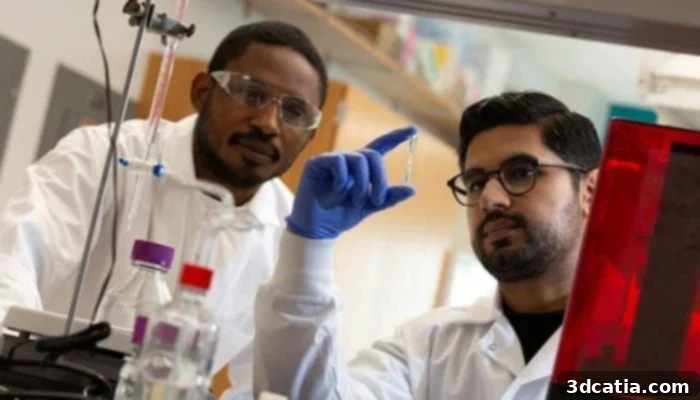
Penn State researchers James Godwin and Kassem Bokhari test the strength of a 3D printed part made with the new resin.
Leading the Charge: Dr. Stephen Chmely’s Vision
At the helm of this innovative research is Stephen Chmely, assistant professor of Agricultural and Biological Engineering in the College of Agricultural Sciences and the leader of the research team. Dr. Chmely articulates a clear and ambitious long-term vision for the project: “Our project team’s long-term goal is to develop new and sustainable bioproducts from lignocellulosic biomass — or dry plant matter — that economically enable a low-carbon bioeconomy.” This statement encapsulates a broader commitment to shifting away from fossil fuels and towards renewable biological resources for various industrial applications. Lignocellulosic biomass, abundant and renewable, represents a vast untapped resource that can be transformed into valuable materials and fuels.
Elaborating on the immediate focus that forms a crucial step towards this grander objective, Dr. Chmely adds, “The objective of this proposal, which is a step toward our long-term goal, is to create a renewable resin material comprised of agriculturally derived components that will enable large-format 3D printing by stereolithography.” This highlights the strategic approach of the team – tackling a specific, high-impact application like large-format SLA 3D printing to demonstrate the viability and advantages of their plant-based material. The successful development of such a resin could serve as a powerful proof-of-concept for the broader bioeconomy, showcasing how plant matter can be effectively utilized to create advanced manufacturing materials.
The concept of a “low-carbon bioeconomy” is central to this research. It envisions an economic system where industries rely on renewable biological resources for energy, materials, and chemicals, significantly reducing greenhouse gas emissions and dependence on fossil fuels. Penn State’s work directly contributes to building the foundational technologies for such an economy, particularly within the advanced manufacturing sector, which is increasingly seeking sustainable alternatives to traditional materials.
The Core Ingredients: Lignin, Nanocellulose, and Soybean Oil
The innovative approach taken by the Penn State team centers on the strategic utilization of readily available plant-based materials: lignin, nanocellulose, and soybean oil. These natural polymers and oils are being ingeniously combined and chemically modified to yield new stereolithographic resins. Lignin, a complex organic polymer, plays a crucial role in nature by making plant cell walls rigid and woody, providing structural integrity to trees and other vascular plants. It is one of the most abundant natural polymers on Earth, yet it is often treated as a waste product in many industrial processes. The researchers are unlocking its potential as a valuable material for advanced manufacturing.
Nanocellulose, on the other hand, is derived from wood pulp and consists of incredibly tiny, strong particles. It boasts exceptional mechanical properties, including high strength-to-weight ratio and stiffness, making it an excellent candidate for reinforcing materials. By incorporating nanocellulose, the team aims to enhance the structural performance of the resin. Complementing these two polymers is soybean oil, another agriculturally derived component, which provides a versatile, renewable base for the resin formulation, contributing to its fluidity and photo-curable properties essential for SLA 3D printing.
Stephen Chmely highlights the remarkable nature of their findings, stating that the results achieved with these materials were previously thought to be impossible. Conventional wisdom often dictated that achieving desirable printability and mechanical properties with entirely plant-based materials for SLA would be exceedingly difficult. However, the Penn State team has proven otherwise. According to the assistant professor, the resins currently under development exhibit exceptional properties, surpassing many traditional petrochemical-based resins. Specifically, they present greater elasticity, meaning printed parts can endure more deformation without breaking; superior hardness, indicating better scratch and wear resistance; and enhanced thermal resistance, allowing printed objects to withstand higher temperatures without deforming. These combined attributes make the new bioplastic resin highly promising for a wide array of industrial applications where material performance is critical.
Interdisciplinary Excellence and Far-Reaching Impact
Penn State’s Department of Agricultural and Biological Engineering provides the research team with a truly unique interdisciplinary perspective, positioned precisely at the intersection of materials science, engineering, agriculture, and forestry. This synergistic environment is crucial, as the research benefits directly from deep knowledge in both advanced material development and the sustainable sourcing of biomass. Dr. Chmely emphasizes that his team possesses “abundant expertise in lignin chemistry, cellulose nanomaterials and 3D printing by stereolithography,” a testament to the comprehensive knowledge base fostered by the department. This specialized expertise is essential for overcoming the complex challenges associated with transforming raw plant materials into high-performance 3D printing resins.
The potential impact of these material developments extends far beyond the confines of the laboratory. Dr. Chmely fully expects the innovation to have a major transformative effect on the broader additive manufacturing industry. By providing a truly sustainable and high-performance alternative to petrochemical-based resins, this research paves the way for greener production practices, reduced environmental footprint, and potentially more resilient supply chains. This aligns perfectly with the growing demand from consumers and industries alike for eco-friendly solutions across all sectors.
Furthermore, the benefits are anticipated to reach rural communities directly. These communities often serve as the primary providers of the biomass feedstock—the lignocellulosic materials like wood waste and agricultural residues—that may be used to manufacture the resin as production scales up. This creates a powerful economic feedback loop, establishing new markets for agricultural and forestry byproducts and fostering job creation in rural areas. It’s a vision where technological advancement in urban research centers directly supports and revitalizes economies in agricultural heartlands, truly embodying the principles of a sustainable and inclusive bioeconomy. This integration of scientific innovation with socio-economic development underscores the holistic approach taken by the Penn State researchers.

The Penn State Department of Agricultural and Biological Engineering
Engage with the Future of 3D Printing
What are your thoughts on Penn State’s pioneering research into new naturally-derived 3D printing resin? We invite you to share your insights and comments below, or engage with us on our social media platforms: connect with us on LinkedIn, give us a like on Facebook, and follow our updates on Twitter! To stay informed about the very latest in additive manufacturing news, don’t forget to sign up for our free weekly newsletter here, delivered straight to your inbox. You can also explore all our insightful videos and interviews on our dedicated YouTube channel.
*All Photo Credits: Penn State