
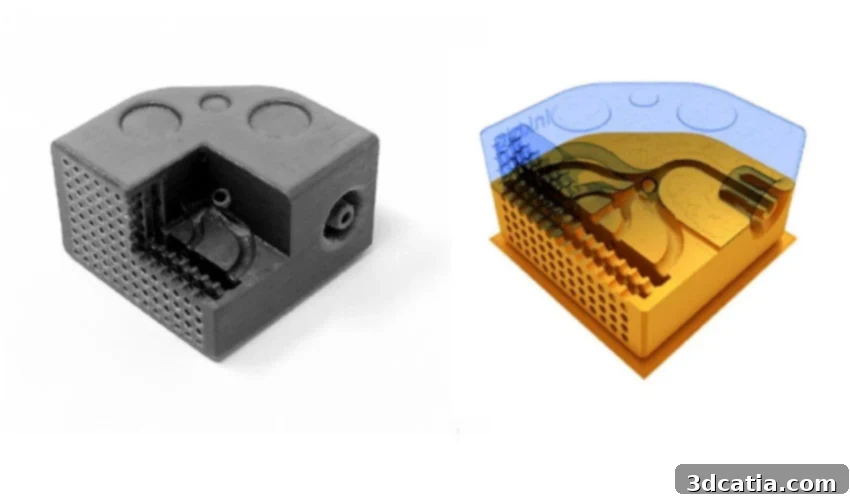
Inkbit Vista: Revolutionizing Additive Manufacturing with Vision-Controlled 3D Printing
The landscape of additive manufacturing is continuously evolving, with innovations pushing the boundaries of what’s possible in digital fabrication. At the forefront of this evolution is Inkbit, a groundbreaking spinout from the prestigious Computer Science and Artificial Intelligence Laboratory (CSAIL) at MIT. Known for pioneering the world’s first 3D printer driven by vision-based feedback control, Inkbit has now unveiled its highly anticipated Additive Manufacturing System, featuring the cutting-edge Inkbit Vista. This system is poised to revolutionize industrial 3D printing with what the company proudly calls the first-of-its-kind closed-loop feedback 3D printing ecosystem, offering unprecedented capabilities for transforming traditional design and manufacturing processes through scalable inkjet deposition and advanced 3D machine vision.
Inkbit’s journey began with a clear vision: to overcome the inherent limitations of conventional 3D printing technologies and usher in a new era of reliability, precision, and scalability. Under the leadership of Professor Wojciech Matusik and CEO Davide Marini, the team has meticulously engineered a platform that leverages sophisticated computational techniques and novel material chemistries. The Inkbit Vista system is a testament to this commitment, designed to bridge the gap between rapid prototyping and industrial-scale production of end-use parts, offering manufacturers a robust and efficient solution for complex applications across various industries.
The Power of Vision-Controlled Jetting (VCJ) Technology
At the heart of the Inkbit Vista Additive Manufacturing System lies Inkbit’s proprietary solution: Vision-Controlled Jetting (VCJ) technology, seamlessly integrated with multi-material design software. VCJ represents a significant leap forward in additive manufacturing, being the first platform to harness the combined power of machine vision and artificial intelligence to deliver a truly advanced multi-material jetting capability. This innovative approach allows for real-time, in-process voxel-level control, a critical factor for achieving the high levels of reliability and performance demanded by volume manufacturing environments.
The convergence of advanced computational techniques with a scalable hardware architecture and unique material chemistries is what sets VCJ apart. Inkbit has developed an impressive material portfolio that includes both high-performance elastomers and high-temperature materials, such as specialized resins. This broad material compatibility, combined with unprecedented control, enables the production of parts with intricate geometries, varied material properties, and exceptional mechanical performance. Davide Marini, co-founder and CEO at Inkbit, expressed his excitement about the launch, stating, “We are thrilled to launch Inkbit’s Additive Manufacturing System and offer a unique, rapidly deployable 3D printing solution to companies looking to adopt digital manufacturing.” This statement underscores Inkbit’s mission to empower manufacturers with tools that can genuinely transform their production capabilities.
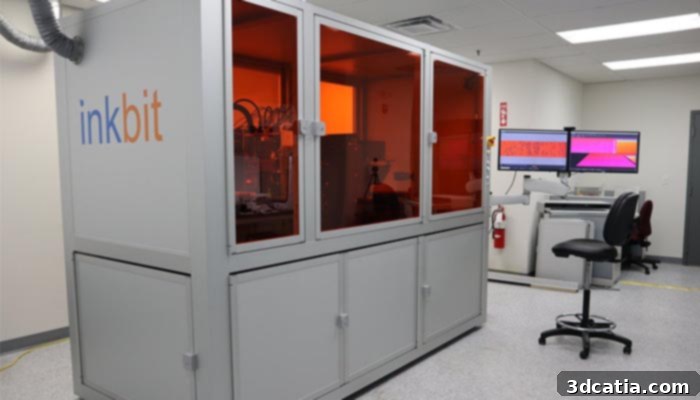
The Inkbit 3D printer (photo credits: Inkbit)
Unlocking the Potential of End-Use Products with High-Performance Polymers
The true promise of Inkbit’s VCJ technology lies in its ability to facilitate the development of functional end-use products crafted from high-performance polymers. This capability is attributed to three pivotal features of the technology:
- **Real-time Optimization for Accuracy and Reliability:** Unlike traditional open-loop 3D printing systems that operate with pre-programmed instructions, VCJ employs a closed-loop feedback mechanism. Integrated machine vision cameras continuously scan each layer as it’s printed, comparing it against the digital design. Any deviations or imperfections are immediately detected, and the system makes real-time adjustments to ensure voxel-level accuracy. This self-correction capability dramatically improves print reliability, reduces waste, and guarantees consistent part quality, which is crucial for demanding industrial applications.
- **Simplified and Automated Workflow:** The Inkbit Vista system is engineered for maximum automation, streamlining the entire additive manufacturing workflow from design to post-processing. This not only reduces the need for manual intervention but also minimizes human error, making the process more efficient and user-friendly. Automation extends to material handling, print preparation, and monitoring, allowing engineers to focus on innovation rather than operational complexities.
- **Precision of Resin 3D Printing with Production-Grade Materials:** Inkbit successfully combines the high precision and fine feature resolution typically associated with resin-based 3D printing with the robustness and durability of production-grade materials. This powerful combination moves 3D printing far beyond its traditional role in prototyping, enabling the creation of final parts that can withstand demanding operational environments. The ability to utilize a diverse range of high-performance elastomers and high-temperature resins opens up new possibilities for functional components across various sectors, including automotive, aerospace, medical devices, and consumer electronics.
The highly-automated 3D printing ecosystem provided by Inkbit Vista features this first-of-its-kind closed-loop feedback control, multi-material printing capabilities, and a significantly lower cost-per-part for final product realization. These attributes position Inkbit as a key player in the transition of additive manufacturing from a prototyping tool to a mainstream production method.
The Paradigm Shift: From Prototyping to Industrial Production
For many years, 3D printing technology was predominantly confined to prototyping, a valuable but limited application. However, a significant shift is underway, with manufacturers increasingly recognizing the potential of additive manufacturing for producing final use parts. This evolution is largely thanks to advancements in technology like Inkbit’s VCJ and the continuous development of sophisticated materials. Despite this progress, considerable work remains to be done before end-use parts become the widely accepted norm in additive manufacturing, particularly for high-volume production.
Davide Marini elaborates on this industry challenge: “Today, engineers are often using 3D printing technology to make prototypes, but limitations in materials and high costs make end-use product production difficult. At Inkbit, we’re on a mission to disrupt that notion and create a technology that provides fast printing capabilities with unmatched design freedom and reliability for even the most demanding applications and environments.” This statement encapsulates Inkbit’s core objective: to dismantle the traditional barriers preventing the widespread adoption of industrial 3D printing for final part production. By addressing critical issues such as material diversity, cost-effectiveness per part, and—most importantly—reliability and accuracy through its closed-loop feedback system, Inkbit is paving the way for a future where additive manufacturing is a default choice for creating complex, high-performance components.
The ability to print complex geometries with multiple materials, combined with real-time error correction, opens up new avenues for product innovation. Engineers can now design parts that were previously impossible or cost-prohibitive to manufacture using traditional methods. This includes components with embedded functionalities, varying material properties within a single print, and intricate internal structures that optimize performance and reduce weight. The robust nature of Inkbit’s system ensures that these complex designs can be consistently reproduced with industrial-grade quality, providing manufacturers with a reliable pathway to digital transformation.
Inkbit’s Vision for the Future of Digital Manufacturing
Inkbit’s Additive Manufacturing System, powered by Inkbit Vista and its unique Vision-Controlled Jetting technology, represents more than just a new 3D printer; it embodies a holistic ecosystem designed to meet the rigorous demands of modern manufacturing. By integrating artificial intelligence and machine vision into the core printing process, Inkbit is not only enhancing the precision and reliability of 3D printing but also making it more accessible and cost-effective for a broader range of industrial applications. This commitment to innovation is set to accelerate the adoption of digital manufacturing practices, empowering businesses to produce customized, high-performance parts at speed and scale.
As industries continue to seek flexible, efficient, and sustainable manufacturing solutions, Inkbit’s pioneering approach stands out. The ability to rapidly deploy such a sophisticated system offers manufacturers a significant competitive advantage, enabling faster product development cycles, localized production, and a greater capacity for iteration and improvement. The future of manufacturing is undeniably digital, and Inkbit is leading the charge with a technology that promises to redefine what’s achievable with additive manufacturing.
For more detailed information about Inkbit’s groundbreaking technology and its applications, you can visit their official website HERE.
What are your thoughts on Inkbit’s revolutionary new technology and its potential impact on industrial production? We invite you to share your insights and comments below, or engage with us on our Facebook, Twitter, and LinkedIn pages! Don’t miss out on the latest advancements in 3D printing – sign up for our free weekly Newsletter here, delivering the most relevant 3D printing news directly to your inbox!