
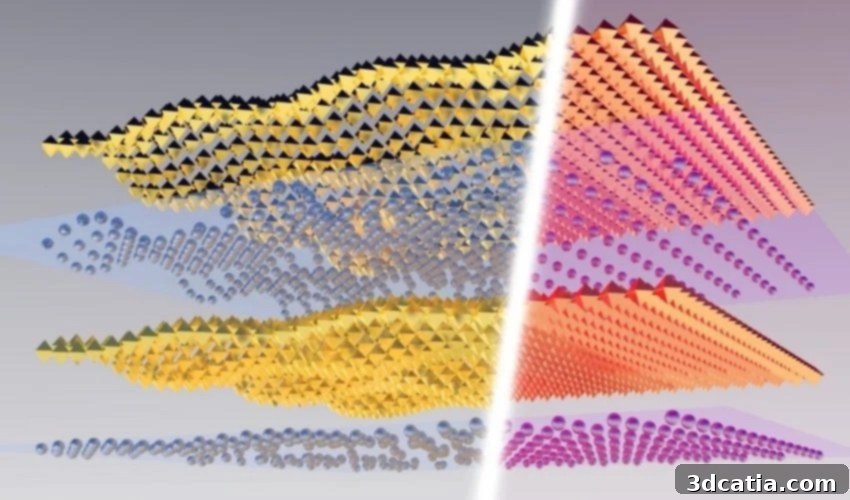
Pioneering Next-Generation Solar Cells: ORNL Blends 3D Printing with Perovskites for Sustainable Energy
In a groundbreaking stride towards a more sustainable future, researchers at the esteemed Oak Ridge National Laboratory (ORNL) have unveiled a significant discovery that promises to redefine solar energy technology. Their latest endeavors focus on perovskites, a remarkable class of materials that initially referred to a specific mineral comprised of calcium, titanium, and oxygen, but has since expanded to encompass a broader range of metallic components exhibiting an identical or similar crystalline structure. For many years, perovskites have captured the attention of the scientific community due to their extraordinary ability to efficiently convert sunlight into electrical energy. Building upon this inherent potential, ORNL scientists have now innovated novel methodologies to engineer components using this versatile material, prominently featuring the transformative capabilities of additive manufacturing, commonly known as 3D printing. A pivotal aspect of their research involves exploring the synergistic combination of 3D printing techniques with perovskites, aiming to pave the way for a revolutionary new generation of high-performance solar batteries. This integration represents a critical leap forward, potentially overcoming limitations faced by conventional solar energy solutions and accelerating the global transition to clean, renewable power.
The dedicated team behind this pivotal study is confident that by leveraging diverse production methods, particularly advanced additive manufacturing processes, they can fabricate photovoltaic devices that are not only significantly more efficient in energy conversion but also remarkably robust and adaptable. This development is paramount in the face of escalating global warming threats, which necessitate an urgent shift towards more reliable and clean power sources worldwide. Olga Ovchinnikova, a distinguished co-author of the study, eloquently articulates the profound advantages of incorporating additive manufacturing into the development of perovskite materials. She remarks, “We can use 3D printing to create wearables, put them on top of cars and really democratize the use of perovskite solar cells. You could put them anywhere.” This vision underscores a future where solar energy harvesting is not confined to rigid, traditional panels but integrated seamlessly into everyday objects and structures, offering unprecedented flexibility and accessibility. Ovchinnikova firmly believes that in the not-so-distant future, 3D technologies are poised to play an absolutely central and transformative role within the domain of solar energy production and deployment, making solar power truly ubiquitous.

Photo Credits: Oak Ridge National Laboratory, showcasing innovative perovskite materials research.
The Unrivaled Potential: Why Perovskites are a Game-Changer
While 3D printing has increasingly become a staple in research and development at ORNL over recent years, the crucial question that underpins this specific project is: Why the focus on combining additive manufacturing with perovskites? As highlighted earlier, one of the foremost motivations driving researchers to intensively investigate this material is its truly exceptional energy conversion efficiency. Traditional multicrystalline silicon-based solar cells, which have long been the industry standard, have largely plateaued in their conversion efficiency, typically reaching a peak of around 23%. However, perovskites demonstrate a compelling potential to significantly surpass this benchmark. Although the ORNL researchers have not yet publicly specified the exact projected conversion rate, their studies have compellingly indicated that this material possesses the capacity to offer “untapped reservoirs of energy generated from light.” This phrase encapsulates the profound optimism surrounding perovskites, suggesting a future where solar energy capture is dramatically more effective and bountiful. This superior efficiency alone positions perovskites as a leading contender in the race to develop next-generation solar technologies, promising a higher yield of electricity from a given amount of sunlight and making solar farms more productive and compact.
Beyond their remarkable efficiency, perovskites present an incredibly attractive profile to researchers owing to several other highly desirable characteristics: their exceptional lightness, inherent flexibility, and comparatively low production cost. These combined attributes enable the design and fabrication of ultra-thin films that can conform to and cover virtually any type of surface, from irregular architectural elements to flexible electronic devices and even automotive bodies. In this specific context, the immense advantages offered by additive manufacturing become unequivocally clear. 3D printing excels at creating parts with intricate and complex geometries that would be challenging or impossible to achieve with conventional manufacturing techniques. This synergy means that perovskite solar cells can be customized to fit diverse applications, moving beyond the flat, rigid panels of today. Imagine solar cells integrated into the fabric of buildings, woven into clothing, or seamlessly applied to vehicle exteriors – a future where solar energy is not an add-on, but an intrinsic part of our built environment. The ability to rapidly prototype and iterate designs with 3D printing further accelerates the development cycle, bringing these advanced solar solutions closer to commercialization.
Overcoming Challenges: The Path to Widespread Perovskite Adoption
Despite the myriad of promising attributes, certain inherent limitations currently prevent the full-scale democratization and widespread adoption of perovskite technology. The most significant hurdle facing perovskites today is their relative instability; compared to the well-established and highly durable silicon, perovskite materials tend to degrade at a considerably faster rate. This accelerated degradation compromises their long-term performance and makes them less durable for practical, real-world applications where a lifespan of several decades is expected. Consequently, enhancing the durability and stability of perovskite solar cells represents the paramount challenge that ORNL scientists are diligently working to overcome. Olga Ovchinnikova provides an insightful perspective on this ongoing effort, stating, “Now that we better understand some of the fundamental physics, we’re looking at how to engineer and improve the materials to enhance their photovoltaic effects. We can think about the next level.” This statement underscores a strategic shift from foundational understanding to advanced material engineering. Researchers are delving into the intricate mechanisms of degradation, exploring various encapsulation techniques, chemical modifications, and structural alterations facilitated by 3D printing to create perovskite devices that can withstand environmental stressors and maintain their efficiency over extended periods. This involves optimizing the crystal structure, fine-tuning the chemical composition, and developing protective layers that are both effective and compatible with additive manufacturing processes.
The “next level” thinking at ORNL involves not just extending lifespan but also integrating these improved materials into practical applications. Imagine solar cells that are not only highly efficient but also exceptionally long-lasting, flexible enough to be integrated into clothing or building materials, and cost-effective to produce on a massive scale. Such advancements would truly revolutionize the renewable energy landscape, offering sustainable power solutions that are accessible and adaptable to a multitude of environments and uses. The research goes beyond simple material science; it encompasses a multidisciplinary approach combining physics, chemistry, materials engineering, and advanced manufacturing techniques to unlock the full potential of perovskites. This holistic strategy is critical to developing solar technologies that can significantly contribute to global energy security and climate change mitigation efforts. You can delve deeper into the specifics of this cutting-edge research by exploring the official press release HERE, or by examining the comprehensive scientific paper titled “Ferroic Halide Perovskite Optoelectronics” HERE, which provides detailed insights into their experimental findings and methodologies.
The Future of Sustainable Energy: A Call to Innovation
The collaborative efforts at Oak Ridge National Laboratory, marrying the incredible properties of perovskites with the versatile capabilities of additive manufacturing, stand as a beacon of innovation in the quest for sustainable energy. This research doesn’t just promise incremental improvements; it foresees a paradigm shift in how we generate and utilize solar power. By addressing the critical challenges of efficiency, flexibility, cost, and durability, ORNL is not only advancing the science of photovoltaics but also laying the groundwork for a future where clean energy is truly limitless and integrated into every facet of our lives. The potential for perovskite-based, 3D printed solar cells to power everything from smart wearables to electric vehicles and entire smart cities is immense, signifying a monumental step towards reducing our carbon footprint and securing a greener planet for generations to come. This fusion of advanced materials and manufacturing technologies represents a powerful synergy, poised to democratize access to solar energy and accelerate the global transition away from fossil fuels. It is a testament to human ingenuity and collaborative scientific endeavor, pushing the boundaries of what is possible in renewable energy. The implications for global energy security, economic development, and environmental sustainability are profound, painting a vivid picture of a future powered by abundant, clean solar energy.
What are your thoughts on the transformative potential of using perovskites in conjunction with additive manufacturing to forge superior solar batteries and revolutionize the energy sector? We invite you to share your insights and opinions in a comment below, or join the discussion on our vibrant social media platforms: LinkedIn, Facebook, and Twitter! To stay at the forefront of the latest advancements in 3D printing and related sustainable technologies, don’t miss out on signing up for our free weekly Newsletter here, delivering the freshest news directly to your inbox. Furthermore, immerse yourself in our extensive collection of informational videos available on our dedicated YouTube channel. Your engagement helps us foster a community passionate about innovation and sustainability!