
Revolutionizing Metal 3D Printing: The Path to Support-Free DMLS with EOS Innovations
The landscape of manufacturing is continually evolving, with metal 3D printing emerging as a transformative technology, primarily benefiting professionals across diverse industries. This cutting-edge method is not just a niche application; it represents a significant growth area within the broader manufacturing sector. Projections from Grand View Research underscore this rapid expansion, indicating that the global metal 3D printing market, valued at an impressive $4.06 billion in 2022, is anticipated to skyrocket to an estimated $22.60 billion by 2030. This remarkable growth trajectory highlights the increasing adoption and vital role of additive manufacturing in modern production. Among the various metal 3D printing techniques, Direct Metal Laser Melting (DMLS) stands out as a particularly influential process. Patented by EOS in 1994, DMLS has since become a cornerstone in sectors ranging from aerospace and medical to automotive, celebrated for its unique ability to combine the inherent advantages of metal additive manufacturing with consistently high, repeatable part quality.
DMLS technology, like many other additive manufacturing processes, typically necessitates the use of support structures. These supports are crucial for anchoring parts to the build platform, dissipating heat, and preventing deformation during the printing process, especially for complex geometries or overhangs. However, while essential, these structures introduce significant challenges. Recognizing the need to unlock the full potential of metal 3D printing and enhance user experience, EOS has pioneered a suite of innovative solutions aimed at drastically reducing or even eliminating the need for support structures when printing intricate metal geometries. This innovation addresses a critical pain point for manufacturers, as traditional supports in metal 3D printing are inherently associated with increased build time, higher material consumption, and considerable effort during post-processing. By tackling these issues head-on, EOS is paving the way for more efficient, cost-effective, and sustainable metal additive manufacturing.
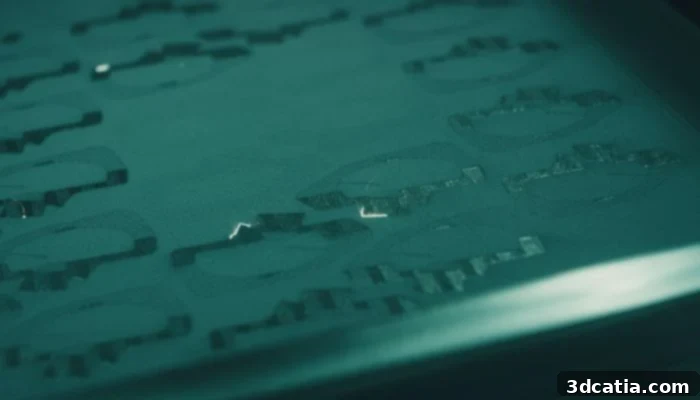
Metal printing process on an EOS Quad laser system (photo credits: EOS GmbH)
The Ubiquitous Challenges of Support Structures in Metal Additive Manufacturing
For current users of DMLS technology, the practice of integrating support structures into designs is a standard and expected part of the workflow. This necessity arises directly from the ambition to 3D print components with increasingly complex and detailed geometries. Without these foundational supports, features such as overhangs with angles smaller than 30 degrees, extended bridges, or intricate internal recesses would inevitably suffer from significant deformation or even complete failure during the high-temperature, layer-by-layer fabrication process. Supports act as essential anchors and heat sinks, maintaining the structural integrity and dimensional accuracy of these challenging features. Therefore, while supports are indispensable for achieving design freedom in complex parts, their presence also introduces a series of practical and economic drawbacks that manufacturers constantly strive to mitigate.
The conventional approach to managing these challenges involves the careful design and integration of supports during the initial CAD phase. Subsequently, once the 3D printing process is complete, these support structures must be meticulously removed. This post-processing step can be executed either manually, requiring skilled labor and specialized tools, or automatically, through automated systems. Regardless of the method, the removal of supports adds a significant layer of complexity, time, and cost to the overall production cycle. The material used for supports is often discarded, leading to waste and increased material expenses. The removal process itself can introduce surface imperfections, necessitating further finishing operations to achieve the desired part quality. It is clear that while supports are a technical requirement for many parts, they represent a bottleneck in terms of efficiency and cost-effectiveness. The advent of innovative solutions that enable printing with a significantly reduced number of support structures in the DMLS process is therefore not merely an incremental improvement; it opens up entirely new possibilities for metal 3D printing, elevating the technology to unprecedented levels of capability and economic viability. This advancement promises to streamline workflows, reduce production costs, and expand the realm of what is achievable with additive manufacturing.
EOS’s Strategic Approach to Enabling Support-Free Metal 3D Printing
To truly harness the transformative potential of support-free or support-reduced metal 3D printing, EOS emphasizes a holistic strategy that integrates three crucial pillars: optimized processes, advanced tools, and comprehensive know-how. These factors, working in synergy, are essential for overcoming the inherent complexities of DMLS and achieving reliable, high-quality results without extensive support structures. EOS effectively demonstrates the power of its approach through a compelling example: the support-free DMLS 3D printing of an impeller. Impellers, with their intricate geometries, multiple blades, complex internal channels, and varying diameters, are typically prime candidates for extensive support structures. The fact that each impeller design presents unique challenges due to diverse properties like blade count or cover designs makes support-free printing particularly difficult. However, EOS maintains that by providing a deep and extensive understanding of these factors, across all levels of expertise, support-free manufacturing becomes a tangible reality.
Central to maximizing the capabilities of metal 3D printing with minimal supports is the cultivation of what EOS terms “additive thinking.” This specialized mindset, which can be instilled through targeted training programs and tailored consulting services, focuses on reimagining design and manufacturing processes specifically for additive technologies. The importance of this advanced knowledge cannot be overstated, as it directly influences critical aspects such as part design optimization, the strategic layout of components on the build platform for efficient material utilization and thermal management, and the judicious selection of materials best suited for support-reduced processes. Furthermore, a significant piece of the puzzle in achieving support-free metal 3D printing is the Smart Fusion tool, which EOS anticipates will soon be available to its users. This intelligent tool represents a breakthrough in process control, as it dynamically adjusts the laser’s energy input in real-time, adapting it precisely to the specific geometry being printed. By optimizing energy delivery, Smart Fusion effectively minimizes thermal stresses within the material during solidification, which is a primary cause of part deformation and the traditional need for extensive supports. The synergistic application of these elements—process optimization, intelligent tools like Smart Fusion, and specialized additive thinking—delivers multifaceted benefits. Reducing support structures in metal-based additive manufacturing not only leads to significantly shortened build times but also dramatically decreases the effort required in laborious post-processing steps and yields substantial material savings. This comprehensive strategy ultimately enhances efficiency, reduces costs, and expands the design possibilities for engineers and manufacturers.
“Even though we are pushing the boundaries of what is possible in support-free 3D printing, you are still dealing with real physics and therefore not everything is possible. But our solution will be a game changer. Both our pilot customers and the customers who have tested the technology with us are excited about the possibilities. I would say challenge us – we are ready to innovate metal 3D printing together,” expands Davy Orye, team leader at Additive Minds Consultants. His statement underscores EOS’s confidence in its pioneering approach while acknowledging the inherent physical limitations that still exist. It also highlights the collaborative spirit with customers, inviting them to jointly explore and expand the frontiers of what’s achievable in metal additive manufacturing.
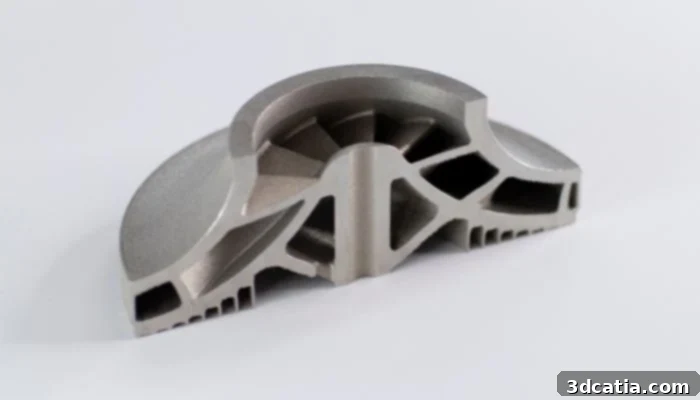
The impeller was produced in an optimized 316L process on an EOS M 290 without internal supports and with a cost reduction of 35% (photo credits: EOS GmbH)
The advancements in support-free additive manufacturing of metals signify immense progress, substantially boosting the attractiveness and practical utility of metal 3D printing. A detailed cost analysis conducted by EOS, using the impeller example, vividly illustrates this impact: a remarkable 35% overall cost reduction was achieved. Delving into the specifics, these substantial savings were primarily realized in critical areas such as post-processing, which traditionally consumes considerable time and resources; material consumption, as less raw material is needed for supports; and overall construction time, thanks to streamlined processes. It is worth noting, however, that the effort and associated costs for the design process with fewer support structures saw a slight increase, moving from 8% to 14% of total costs, reflecting the greater complexity and specialized knowledge required for optimized part design. Beyond the compelling economic benefits, support-free 3D printing significantly enhances sustainability efforts for users. By requiring less material and generating less waste, it contributes to a more environmentally friendly manufacturing footprint. Furthermore, this innovation promotes a safer work environment, as users are no longer compelled to perform hazardous manual post-processing tasks like cutting and grinding to remove support structures. This eliminates risks associated with sharp tools, airborne particles, and repetitive strain injuries. For those eager to delve deeper into the intricate details of support-free metal 3D printing and its vast implications, EOS offers a comprehensive whitepaper, available for free download HERE. This resource provides invaluable insights into the technical nuances and strategic advantages of this groundbreaking technology.
What are your thoughts on the revolutionary potential of metal 3D printing with a reduced number of support structures? We invite you to share your insights and experiences in a comment below or join the conversation on our LinkedIn, Facebook, and Twitter pages! Don’t miss out on the latest advancements and news in additive manufacturing—sign up for our free weekly Newsletter here, delivering essential 3D printing updates directly to your inbox! You can also find an extensive collection of our videos and demonstrations on our YouTube channel, offering visual insights into the world of 3D printing.
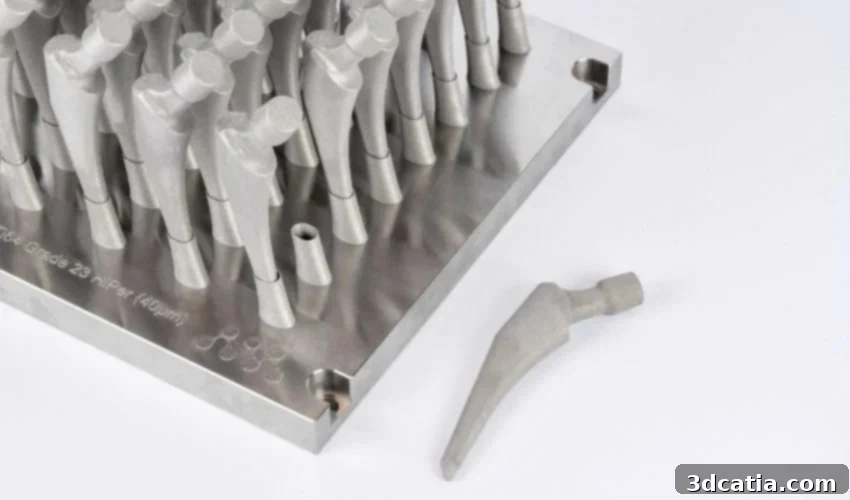
*Cover Photo Credits: EOS GmbH (hip stems produced by optimizing the Ti64 process on an EOS M 300-4 for 100% support-free manufacturing).