
The Future is Now: Top 5 Transformative 3D Printing Videos You Can’t Miss This Week
Welcome to our weekly dive into the dynamic world of additive manufacturing! Each week, we scour the latest developments to bring you the most compelling and insightful videos showcasing the power and potential of 3D printing technology. This week, we’ve curated a spectacular collection of the top five videos that highlight groundbreaking innovations, from personalized automotive designs and accessible desktop printers to revolutionary e-motorbikes, advancements in aerospace, and even sustainable solutions for space exploration. These examples vividly demonstrate how 3D printing is not just a technology for rapid prototyping, but a fundamental driver of innovation across diverse industries, pushing the boundaries of what’s possible. We invite you to explore these incredible applications, share your thoughts, and connect with us on our social media channels. Get ready to be inspired and discover the transformative impact of 3D printing!
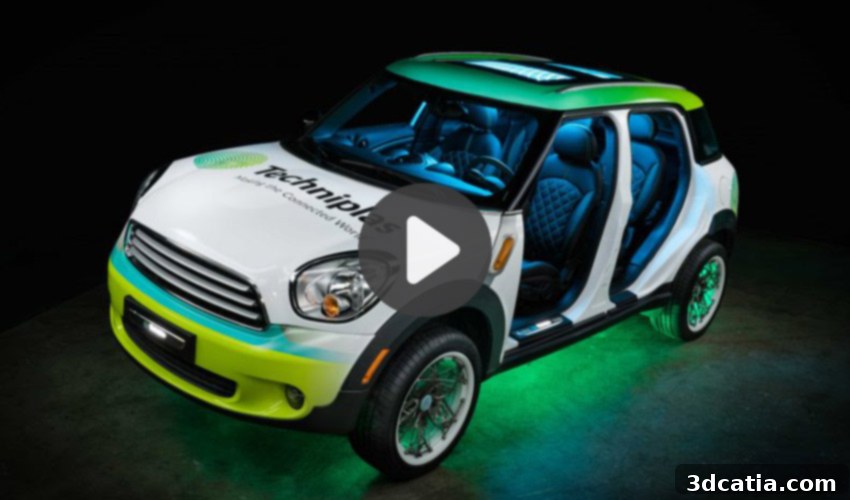
Top 1: 3D Printed Mini Cooper at Formnext – A Glimpse into Automotive Customization
Formnext 2018, a premier exhibition for additive manufacturing, recently offered a captivating display at the Techniplas stand: a special 3D printed Mini Cooper Countryman. This wasn’t merely a static model; it was a powerful demonstration of how additive manufacturing is revolutionizing the automotive industry. The vehicle proudly featured a multitude of 3D printed components, meticulously integrated into both its interior and exterior. From intricate steering wheel elements to stylish wheel trims, the application of 3D printing was evident throughout, showcasing a new paradigm in vehicle design and production. During our visit, Daniel Spirig, CEO of Techniplas, provided invaluable insights into their innovative approach. He elaborated on the immense benefits that 3D technologies bring to automotive manufacturing, particularly emphasizing the unprecedented levels of personalization and customization now achievable. Traditionally, bespoke automotive features were costly and time-consuming, often reserved for high-end luxury vehicles. However, with the advent of advanced 3D printing techniques, manufacturers can now produce highly customized parts on demand, offering consumers an unparalleled ability to personalize their vehicles. This shift not only caters to individual aesthetic preferences but also allows for functional improvements and optimized performance characteristics. The 3D printed Mini Cooper serves as a compelling proof-of-concept, illustrating a future where vehicles are not just mass-produced commodities but highly tailored expressions of personal style and technological sophistication. This development underscores 3D printing’s potential to drive a new era of agile manufacturing and consumer-centric design in the automotive sector.
Top 2: Go Small and Smart with the Da Vinci Nano W 3D Printer
Next up, we delve into the world of accessible 3D printing with XYZprinting, a company renowned for its Da Vinci 3D printer series. Their core philosophy revolves around making additive manufacturing simple, user-friendly, and attainable for a wider audience, all without compromising on print quality. This week’s featured video from XYZprinting introduces us to their innovative Da Vinci Nano W 3D printer, a compact yet powerful device designed to democratize 3D creation. The video serves as an excellent, comprehensive guide, meticulously walking viewers through every stage of the user experience. It begins with the excitement of unpacking the Da Vinci Nano W, demonstrating how straightforward it is to remove the printer from its packaging and prepare it for operation. The tutorial then progresses to the initial setup process, detailing the necessary steps to get the machine up and running quickly and efficiently. What truly sets this presentation apart is its focus on empowering users to dive into 3D modeling from the comfort of their homes. The video expertly showcases the intuitive XYZmaker Mobile software, illustrating how even beginners can easily design and prepare their first 3D models. By providing a clear, step-by-step walkthrough, XYZprinting ensures that anyone, regardless of their prior experience with 3D printing technology, can confidently embark on their journey of digital fabrication. This emphasis on ease of use, combined with the compact design and wireless capabilities of the Da Vinci Nano W, positions it as an ideal entry-level 3D printer, perfect for educational settings, small businesses, and creative individuals eager to explore the possibilities of additive manufacturing.
Top 3: World’s First Functional 3D Printed E-Motorbike: The NERA
Our third pick unveils a truly pioneering achievement in the realm of advanced manufacturing: the world’s first completely 3D printed, functional e-motorcycle, developed by NOWLAB. Christened ‘NERA,’ this groundbreaking electric motorbike is the brainchild of innovators Marco Mattia Cristofori and Maximilian Sedlak, pushing the boundaries of what is conventionally thought possible with additive manufacturing. What makes the NERA so remarkable is the sheer extent of its 3D printed components. Beyond the essential electrical elements necessary for its operation, virtually every other part of the bike has been produced using 3D printing technology. This includes revolutionary airless tires, custom-designed rims, the structural frame, and even the ergonomic seat. The implications of this are profound, showcasing the ability of 3D printing to create complex, fully integrated structures with optimized performance characteristics. NOWLAB achieved this feat by combining several innovative concepts, such as advanced functional integration – where multiple components are consolidated into a single, intricate 3D printed part – and embedded sensor technology, which allows for real-time monitoring and data collection. The NERA isn’t just an engineering marvel; it’s a living testament to the transformative power of additive manufacturing in developing highly customized, efficient, and potentially more sustainable vehicles. It demonstrates a future where entire complex machines can be built layer by layer, leading to lighter designs, reduced material waste, and unprecedented freedom in design. This project boldly illustrates how far 3D printing can take us in revolutionizing product development and manufacturing across various industries, from transportation to consumer goods.
Top 4: Pioneering Aerospace with 3D Printed Jet-Powered UAVs
The fourth video on our list takes us to the skies, highlighting the critical role of 3D printing in the aerospace industry through the pioneering work of Aurora Flight Sciences, a distinguished company within the Boeing Group. For over three decades, Aurora Flight Sciences has been at the forefront of designing and manufacturing unmanned aerial vehicles (UAVs), constantly pushing the envelope of autonomous flight. While 3D printing has been a valuable tool in aerospace for some time, primarily for rapid prototyping and producing lightweight, complex parts, Aurora Flight Sciences has achieved a significant breakthrough that redefines its application. By forging a strategic partnership with Stratasys, a global leader in additive manufacturing solutions, Aurora Flight Sciences has successfully developed what is touted as the world’s most complex 3D printed jet-powered UAV to date. This remarkable achievement goes beyond merely incorporating a few 3D printed components; it represents a holistic approach to designing and constructing an entire advanced aerial platform using additive manufacturing processes. The collaboration leveraged Stratasys’ expertise in high-performance materials and industrial-grade 3D printing systems to create a UAV with unparalleled complexity, optimized aerodynamic structures, and integrated functionalities that would be incredibly challenging, if not impossible, to achieve with traditional manufacturing methods. The primary objective of this project is to serve as a powerful demonstrator, showcasing the vast and exciting possibilities that advanced 3D printing technologies unlock for the aerospace sector. These include the ability to produce lighter, more fuel-efficient designs, accelerate development cycles, enable rapid iteration of prototypes, and create highly customized parts tailored for specific mission requirements. This innovation by Aurora Flight Sciences and Stratasys is not just about building drones; it’s about charting a new course for aerospace engineering, where precision, complexity, and performance are elevated to unprecedented levels through the strategic application of additive manufacturing.
Top 5: The Circular Economy in Orbit: Recycling in Space with 3D Printing
Our final selection takes us beyond Earth’s atmosphere, into the frontier of space exploration, where 3D printing is playing an increasingly vital role. We’ve often highlighted how companies like Made in Space are pioneering the use of additive manufacturing in orbit, demonstrating its potential for on-demand tool creation and manufacturing essential items far from Earth. This week’s featured video elevates this concept to the next level: recycling in space! This innovative initiative addresses a critical challenge for long-duration space missions and future space colonies – waste management and resource scarcity. The video reminds us of NASA’s groundbreaking Refabricator, a revolutionary device stationed aboard the International Space Station (ISS). This incredible technology has the capability to transform the plastic waste generated by astronauts – everything from food wrappers to packaging – directly into high-quality 3D printing filaments. These recycled filaments can then be fed into a 3D printer also located on the space station, enabling astronauts to produce new tools, replacement parts, and even experimental components as needed. The implications of this ‘circular economy’ in space are monumental. It significantly reduces the need to launch new supplies from Earth, which is an extremely costly and logistically complex endeavor. By transforming waste into valuable resources, the Refabricator extends the lifecycle of materials, minimizes the accumulation of non-biodegradable waste in orbit, and enhances the self-sufficiency of space missions. This ingenious application of 3D printing not only provides a sustainable solution for resource management in challenging environments but also represents a paradigm shift in how we approach waste, turning it from a liability into an asset. As humanity ventures further into space, technologies like the Refabricator will be indispensable, paving the way for more sustainable and autonomous space exploration and habitation.
We hope you thoroughly enjoyed this week’s journey through the most exciting advancements in 3D printing and additive manufacturing. From the unparalleled customization possibilities showcased by the 3D printed Mini Cooper at Formnext, illustrating the transformation of the automotive industry, to the democratized access offered by desktop 3D printers like the Da Vinci Nano W, enabling creativity at home, and the revolutionary NERA e-motorbike that redefines vehicle construction – the scope of innovation is truly breathtaking. We also explored the critical contributions of 3D printing in the aerospace sector, exemplified by Aurora Flight Sciences’ advanced UAVs, and witnessed its indispensable role in fostering sustainability through recycling initiatives aboard the International Space Station. These videos collectively demonstrate that 3D printing is not just a technology of the future, but a powerful force shaping our present, from terrestrial applications to the vast expanse of outer space.
We value your insights and opinions! Please feel free to share your thoughts, favorite innovations, or any other remarkable 3D printing projects you’ve encountered, by dropping a comment below. You can also engage with us and join the broader discussion on our Facebook and Twitter pages. To ensure you never miss out on the latest breaking news, exclusive interviews, and technological breakthroughs in the dynamic 3D printing industry, we highly recommend signing up for our free weekly Newsletter. Get all the essential updates delivered directly to your inbox and stay at the forefront of additive manufacturing innovation!