
Navigating the Future of Metal 3D Printing: Market Growth, Technological Advancements, and Key Trends
The landscape of advanced manufacturing is continually evolving, and at its forefront lies metal additive manufacturing, commonly known as metal 3D printing. This transformative technology, capable of producing complex and high-performance components, is poised for significant expansion in the coming decade. A recent report by the esteemed research firm IDTechEx, titled “Metal Additive Manufacturing 2022-2032: Technology and Market Outlook,” projects an impressive market valuation of $18.5 billion within the next ten years. This forecast marks a strong resurgence after the initial uncertainties brought about by the COVID-19 pandemic, which had led to inconclusive predictions in 2020. The aerospace sector, historically a major adopter of metal additive processes, experienced a pronounced downturn during the global health crisis. However, as industries worldwide embark on a path to recovery, the metal 3D printing market is exhibiting robust positive signals, with an anticipated annual growth rate of 18.8%. This optimistic outlook prompts crucial questions: What specific factors are fueling this remarkable recovery? Can we anticipate a more widespread integration and adoption of metal additive technologies across various industries in the years ahead? Conversely, what persistent obstacles continue to impede their full growth potential and market penetration?
The Evolving Landscape of Materials in Metal Additive Manufacturing
Back in 2020, IDTechEx underscored the pivotal role of metals as a primary driver for market growth in the additive manufacturing space. While this conviction remains strong, the market in 2022 continues to actively seek innovation and broader diversity in material offerings. Compared to the vast array of polymers available for 3D printing, the selection of compatible metal materials is still relatively constrained, and often comes with a premium price tag. This limitation has prompted manufacturers to explore alternative solutions, such as high-performance polymers or advanced composites, especially for applications where metals are not strictly mandatory. Nevertheless, in highly demanding sectors like aerospace, medical, and automotive, where extreme durability, strength-to-weight ratios, and thermal resistance are paramount, metals indisputably remain the material of choice. This critical demand is spurring a burgeoning ecosystem of startups and established companies dedicated to research and development, actively pursuing the creation of novel, high-performance alloys. These efforts aim to overcome existing material limitations, reduce costs, and expand the functional capabilities of metal 3D printed parts, ultimately broadening the technology’s applicability across an even wider spectrum of industrial uses.
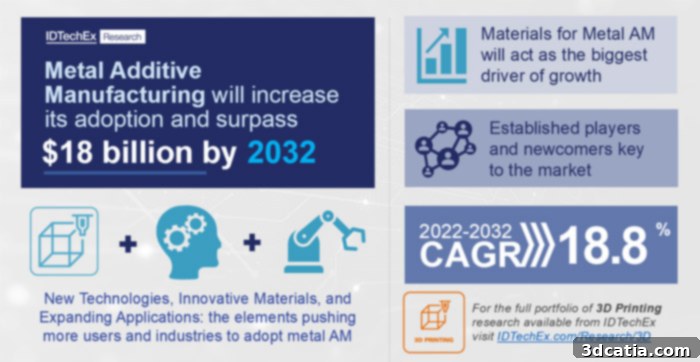
Key trends and driving factors in the metal 3D printing market according to the latest IDTechEx report (photo credits: IDTechEx)
Breaking Down Barriers: Machine Accessibility and Cost Reduction
Beyond material constraints, the IDTechEx study highlights another significant barrier that is gradually being addressed: the high initial investment cost associated with metal 3D printing machinery. Historically, advanced laser fusion printers, capable of producing highly precise and complex metal parts, often came with price tags ranging from €500,000 to well over a million euros. Such substantial capital expenditure has traditionally limited access to this technology primarily to large corporations and specialized research institutions. However, a transformative shift is beginning to take place within the industry, driven by innovative startups and a growing competitive landscape. Pioneering companies like One Click Metal are actively disrupting this trend by developing and offering metal 3D printing solutions at significantly lower price points, with targets around the $100,000 mark. These types of initiatives are instrumental in democratizing access to metal additive manufacturing. By substantially reducing the financial barrier to entry, these more affordable machines empower a broader range of businesses, including small and medium-sized enterprises (SMEs), academic institutions, and even individual innovators, to adopt and experiment with metal 3D printing. This increased accessibility is a crucial catalyst for market growth, fostering innovation and accelerating the integration of additive manufacturing into diverse production workflows. Naturally, the long-term sustainability and comparable effectiveness of these more budget-friendly solutions against their high-end counterparts remain important considerations that the market will continue to evaluate.
The Rise of Binder Jetting and Other Advanced Technologies
The report further emphasizes that a significant catalyst for market expansion is the ongoing development and increased adoption of powder metal binder jetting technology. This process, notably championed by companies such as Voxeljet and ExOne (now part of Desktop Metal), presents a compelling set of advantages that are driving its growing prominence. Unlike traditional powder bed fusion methods that use lasers or electron beams to melt metal powders, binder jetting employs a liquid binding agent to selectively join powdered metal particles, layer by layer, to form a “green” part. This green part is then sintered in a furnace to achieve final density and mechanical properties. One of the primary benefits of binder jetting is its ability to design and produce exceptionally large parts, offering greater design freedom and scalability compared to other metal AM processes. Furthermore, it often boasts higher production speeds and lower per-part costs, making it an attractive option for serial production. The process also offers greater material versatility, as it can be applied to a wide range of metal powders, including those that are challenging for laser or electron beam-based systems.
While binder jetting is undoubtedly a technology to watch, it is by no means the sole innovation propelling the sector forward. Other metal additive manufacturing technologies are also experiencing significant advancements. Direct Energy Deposition (DED), for instance, involves melting metal material as it is deposited, often used for repairing existing components, adding features to existing parts, or creating large, structurally sound objects. DED processes, which include laser-based and arc-based variations, are particularly valuable for applications requiring multi-material deposition or for enhancing the longevity of critical parts in industries like oil and gas, defense, and aerospace. Electron Beam Melting (EBM), another prominent technology, utilizes an electron beam in a vacuum environment to melt successive layers of metal powder. EBM is renowned for producing parts with excellent material properties, often superior to those produced by laser-based methods, especially for challenging alloys like titanium, which are critical in medical implants and high-performance aerospace components. The high temperatures involved in EBM help to mitigate residual stresses, resulting in parts with fewer defects and improved mechanical characteristics.
The synergistic development of these diverse metal AM technologies—binder jetting, DED, EBM, and various forms of Powder Bed Fusion (PBF) like Selective Laser Melting (SLM)—is creating a comprehensive toolkit for manufacturers. Each technology offers unique strengths tailored to specific application requirements, material types, and production volumes. This diversification is particularly timely given the current global trend towards reshoring and localizing manufacturing processes. Metal 3D printing offers an agile and efficient means to establish localized production capabilities, reduce reliance on lengthy global supply chains, and enable faster iteration and customization of products. The ability to produce complex components on demand, closer to the point of use, significantly enhances supply chain resilience and responsiveness, making metal AM an indispensable asset in modern industrial strategies.
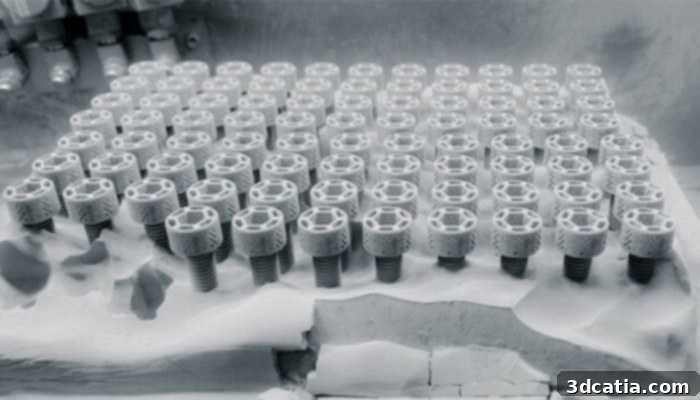
Metal binder jetting is a process showing immense potential and is one to follow closely (photo credits: Digital Metal)
Overcoming Challenges for Broader Adoption
Despite the compelling growth trajectory and technological advancements, the metal 3D printing market still faces several significant hurdles that need to be addressed for broader industrial adoption. One of the foremost challenges is the issue of **certification and standardization**. For critical applications in aerospace, medical, and defense, printed parts must meet stringent quality and performance standards. The variability inherent in additive manufacturing processes, from powder characteristics to machine parameters, makes consistent certification complex and costly. Developing universally recognized standards for material properties, process controls, and post-processing techniques is crucial for widespread trust and acceptance.
Another considerable factor is **post-processing**. While 3D printing allows for incredible geometric complexity, printed metal parts often require extensive post-processing steps, including heat treatment, support removal, surface finishing, and machining, to achieve final part specifications. These steps can add significant cost and time to the overall manufacturing workflow, sometimes negating the efficiency gains of the printing process itself. Innovations in automated post-processing and in-situ process control are vital to streamline this aspect.
The **skill gap** in the workforce also represents a bottleneck. The effective design, operation, and maintenance of metal 3D printing systems, along with the necessary understanding of metallurgy and advanced materials science, require specialized skills that are currently in short supply. Educational institutions and industry training programs are critical to developing the talent pool needed to fully leverage this technology. Furthermore, **integration with existing manufacturing workflows** remains a challenge. Companies need to seamlessly incorporate metal AM into their established production lines, from design software (CAD/CAE) to enterprise resource planning (ERP) systems. This requires robust software solutions, data management strategies, and a willingness to rethink traditional manufacturing paradigms.
Finally, **scalability for mass production** is an area where metal AM is still evolving. While effective for prototyping, low-volume production, and highly customized parts, achieving economies of scale comparable to traditional manufacturing methods for high-volume production remains an ongoing endeavor. Continued advancements in machine throughput, multi-laser systems, and automated material handling will be key to unlocking metal AM’s potential for truly mass-produced components.
Future Outlook: A Dynamic and Resilient Market
The IDTechEx report underscores that despite these challenges, the future of metal additive manufacturing is exceptionally bright and dynamic. The projected $18.5 billion market value by 2032 is a testament to the technology’s inherent advantages and its growing industrial relevance. The drivers of this expansion are multifaceted: continuous innovation in materials leading to new high-performance alloys, the relentless pursuit of more affordable and accessible printing solutions, and the maturation and diversification of printing technologies like binder jetting, DED, and EBM. These factors collectively contribute to a broader adoption across industries, moving beyond aerospace and medical into automotive, energy, consumer goods, and tooling.
The ability of metal 3D printing to enable complex geometries, lightweight designs, rapid prototyping, and on-demand production offers unparalleled opportunities for product differentiation and supply chain optimization. As sustainability becomes an increasingly urgent global priority, additive manufacturing’s capacity to reduce material waste and enable localized production further enhances its appeal. With ongoing research, collaborative industry efforts, and a commitment to addressing the existing roadblocks, metal additive manufacturing is set to redefine what’s possible in manufacturing, driving innovation and fostering a more resilient and agile industrial future.
For those keen to delve deeper into the intricate evolution and profound potential of the metal additive manufacturing market, the comprehensive report by IDTechEx is available for download HERE. We invite you to share your insights, opinions, and questions in the comments section below or connect with us on our social media platforms: LinkedIn, Facebook, and Twitter. Don’t miss out on the latest advancements and news in the 3D printing world—sign up for our free weekly Newsletter here to have updates delivered directly to your inbox! Additionally, explore our extensive library of videos on our YouTube channel for visual insights into the world of additive manufacturing.
*Cover Photo Credits: Sigma Labs