
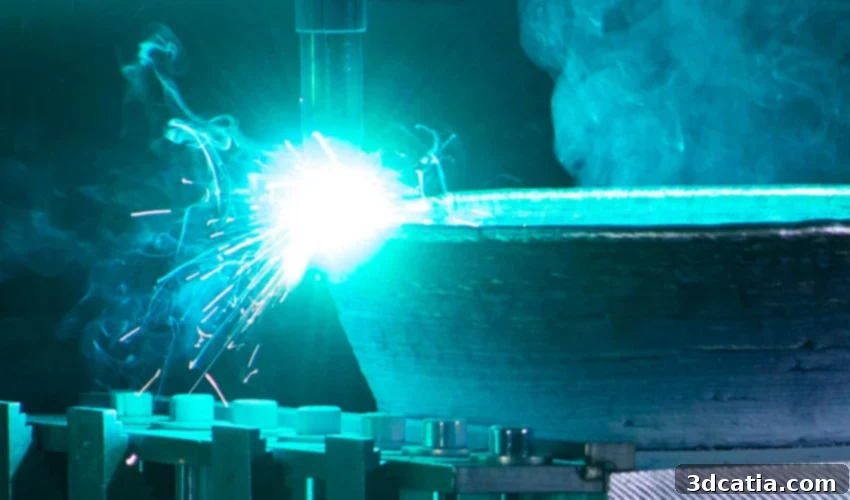
Wire Arc Additive Manufacturing (WAAM): Revolutionizing Large-Scale Metal 3D Printing
Wire Arc Additive Manufacturing (WAAM) stands as a prominent and rapidly evolving technology within the realm of Directed Energy Deposition (DED) 3D printing. DED, a robust metal additive manufacturing technique, operates by precisely depositing metallic material, typically in powder or wire form, onto a substrate using a nozzle integrated with a multi-axis robotic arm. A concentrated energy source, which can be a laser, electron beam, or plasma, is employed to melt the material as it is strategically laid down, layer by layer, to construct the desired part. In the specific context of WAAM, this critical melting function is performed by an electric arc, drawing its inspiration directly from conventional arc-welding processes. This ingenious adaptation allows WAAM to leverage established welding principles and equipment, offering a cost-effective and scalable approach to fabricating complex metal components.
The foundation of WAAM technology lies in its sophisticated utilization of various automated arc welding techniques, typically controlled by advanced robotic systems. These include well-known methods such as metal-inert gas (MIG) welding, also known as gas metal arc welding (GMAW), or its variant, metal-active gas (MAG) welding. Additionally, tungsten-inert gas (TIG) welding, or gas tungsten arc welding (GTAW), and plasma arc-wire (PAW) processes are effectively integrated into WAAM systems. A notable advancement in this field is the Cold Metal Transfer (CMT) welding process, a specialized derivative of MIG welding, originally developed by Fronius in 2004. CMT offers reduced heat input, which can be particularly advantageous in mitigating certain defects often associated with high-temperature deposition. A wide array of metals and their alloys are compatible with WAAM, making it an incredibly versatile technology. These materials commonly include high-performance alloys such as titanium and its alloys, lightweight yet strong aluminum and its derivatives, various nickel-based superalloys known for their high-temperature strength, and diverse steel alloys, ranging from structural steels to stainless and tool steels. The availability of wire feedstock for these materials is generally abundant and more economical than powder, further contributing to WAAM’s appeal.
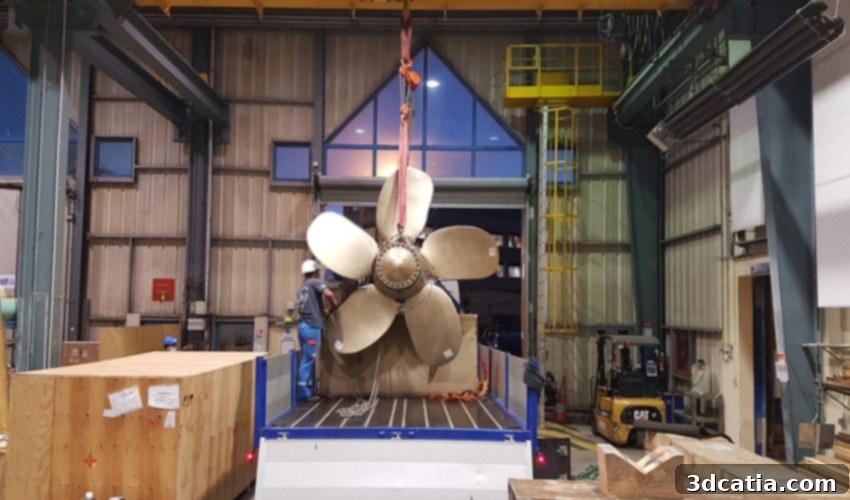
The 3D-printed propeller by Naval Group (photo credits: Naval Group)
Diverse Applications for WAAM 3D Printing Across Industries
Like other DED processes, WAAM is frequently employed for crucial applications such as repairing worn or damaged equipment and reproducing parts that are no longer manufactured, thereby extending the lifespan of older machinery and reducing downtime. However, the capabilities of WAAM extend far beyond repair; the technology is increasingly utilized for the direct manufacturing of entirely new and complex components. WAAM’s suitability for producing large metal parts makes it particularly valuable across a spectrum of demanding industries. It finds significant application in the aeronautics and aerospace sectors for structural components, tooling, and prototypes, where weight reduction and rapid iteration are paramount. The automotive industry leverages WAAM for specialized tooling, bespoke components for high-performance vehicles, and rapid prototyping of chassis elements. In the energy sector, WAAM is crucial for creating critical infrastructure components, such as turbine blades, heat exchangers, and replacement parts for power generation facilities. Furthermore, the defense sector benefits from WAAM’s ability to produce high-strength, complex geometries with reduced lead times for crucial military applications. The technology is adept at manufacturing prototypes, custom molds, unique single parts, and small production series. While its use for true mass production is still an area of ongoing research and development, WAAM’s exceptional capacity for creating large-format, robust metal parts positions it as a transformative solution for industries requiring substantial and durable metallic structures.
Numerous real-world examples underscore the transformative potential of WAAM. In the maritime and defense sectors, Naval Group notably utilized WAAM technology to successfully manufacture a massive propeller for its mine-hunting ship, the Andromède. This achievement highlighted WAAM’s capability for producing large, mission-critical components with complex geometries. The energy sector has also seen innovative applications, with Vallourec employing WAAM to produce the first sealing ring for EDF Hydro’s hydroelectric installations, a component measuring one meter in diameter and weighing a substantial 100 kg. This application demonstrates WAAM’s capacity for creating large, heavy-duty parts essential for infrastructure safety. The robotics and construction industries have also embraced WAAM; MX3D, for instance, famously used the technology to produce a structurally integral steel connector for Takenaka, a leading Japanese architectural firm. Beyond this, MX3D consistently leverages WAAM to manufacture robust pipe connectors for the demanding oil and gas industry, along with various gears and specialized custom components for large-scale industrial machinery. Perhaps one of MX3D’s most iconic projects involved using the WAAM process to construct a functional pedestrian bridge in Amsterdam, a testament to the technology’s ability to create monumental, load-bearing structures. Furthermore, in the cutting-edge aerospace industry, Relativity Space employed WAAM to build significant portions of its Terran 1 light launcher, showcasing its applicability for mission-critical components in rockets. The production of intricate molds for the plastics industry represents another common and highly beneficial application of WAAM, where its ability to create complex internal cooling channels can significantly improve mold performance and lifespan.
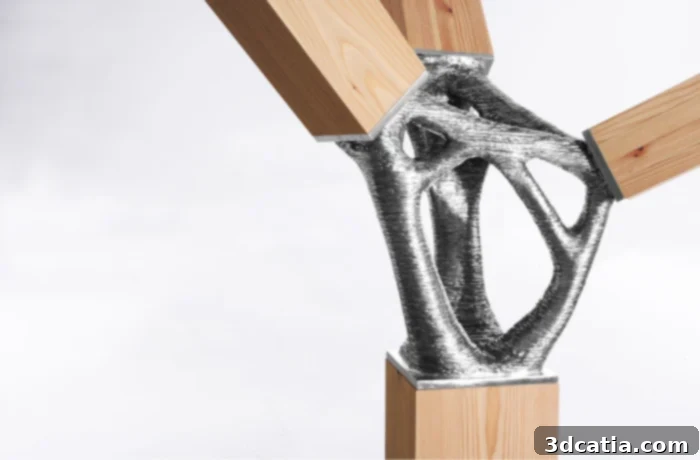
The Takenaka steel connector from one of Japan’s leading architectural firms (photo credits: MX3D)
WAAM 3D printing offers a compelling suite of advantages that position it as a highly attractive additive manufacturing solution. Foremost among these is its impressive deposition rate, which translates directly into high printing speeds. This capability has a profoundly positive impact on overall production times, making WAAM a competitive choice for rapid prototyping and efficient small-batch manufacturing. Furthermore, the operational costs associated with WAAM are generally significantly lower compared to machines utilizing powder-bed fusion technologies, such as Selective Laser Melting (SLM). This cost-effectiveness stems from the comparatively lower price of wire feedstock versus metal powder, as well as the reduced complexity and maintenance requirements of the equipment. A defining characteristic of WAAM technology is its unparalleled ability to produce exceptionally large parts, often exceeding the build volumes achievable with other metal additive manufacturing methods. This makes it ideal for industries that require substantial metal components, where traditional manufacturing might be excessively time-consuming or expensive. As previously highlighted, the availability of a wide and versatile range of compatible metals further enhances WAAM’s utility, allowing designers and engineers greater material flexibility to meet specific application requirements for strength, corrosion resistance, or temperature performance. This combination of speed, cost-efficiency, large-scale capabilities, and material versatility makes WAAM a powerful tool in modern manufacturing.
Acknowledging and Addressing the Limitations of WAAM Technology
Despite its numerous advantages, the WAAM process, like any advanced manufacturing technology, comes with its own set of limitations. Since WAAM prioritizes faster printing and higher deposition rates, the achievable detail and dimensional accuracy of parts are generally less precise when compared to technologies like powder-bed fusion. This often necessitates subsequent machining operations to achieve final part tolerances and surface finish. A critical concern with parts manufactured using WAAM technology is the potential for internal defects, particularly porosities. These voids can significantly degrade the mechanical properties of the part, impacting both its static strength and fatigue performance—meaning its ability to withstand repeated stresses over time without damage. This susceptibility to porosity is particularly pronounced in parts made from aluminum alloys, which require careful process control to minimize these imperfections. Understanding and controlling these internal defects is paramount for ensuring the structural integrity and reliability of WAAM components, especially in high-stress applications.
Another significant anomaly that can manifest with WAAM technology is the formation of residual stresses. These stresses are internal forces locked within the material, resulting from the non-uniform heating and cooling cycles inherent to the layer-by-layer deposition process. If not properly managed, residual stresses can lead to undesirable deformation of the part’s dimensions and/or overall shape. Common manifestations include curling, where edges lift; warping, a general distortion of the part; or, in severe cases, delamination, where layers separate from each other. All these phenomena are characterized by unwanted deformation across various layers of the printed part, affecting the top, bottom, or entire cross-section. These deformations are primarily caused by the extremely high working temperatures involved in arc welding and the intrinsic thermomechanical properties of the materials being processed. Such residual stresses compromise the part’s ability to maintain its intended shape and can significantly reduce its performance and reliability when external forces are exerted upon it, potentially leading to premature failure.
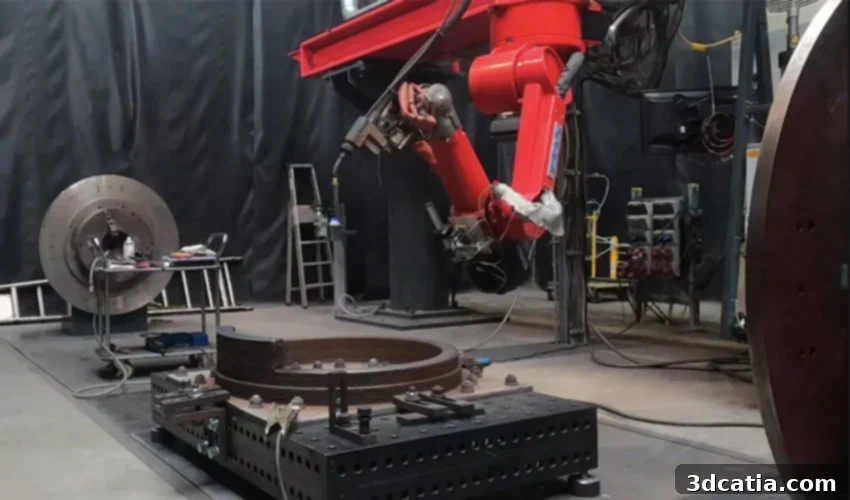
Vallourec uses WAAM technology for power plants (photo credits: Vallourec)
To effectively limit the occurrence and severity of these inherent defects, a thorough understanding and precise control of all WAAM process parameters are absolutely crucial. Meticulous calibration ensures a consistent molten metal deposit and maintains a stable heat input throughout the build process. Essential factors requiring precise adjustment include the wire unwinding speed, the robot’s feed speed (travel speed), the welding current, the voltage, the layer thickness, the protective gas flow rate, and the bead spacing between successive weld passes. Optimizing these parameters is vital for ensuring a smooth, stable, and high-quality deposition process, directly impacting the final part’s integrity. Beyond parameter optimization, several technical solutions are employed to actively mitigate these anomalies. Mechanical work-hardening, often achieved through rolling, is one such method. This technique involves exerting localized pressure on the solidified weld bead with a roller during the cooling phase. This compressive force can effectively reduce internal porosities and refine the grain structure. To alleviate residual stresses, preheating the base material or intermediate layers can significantly reduce thermal gradients during deposition, thus minimizing subsequent deformation. It is also important to note that certain materials and their alloys are inherently more susceptible to cracking or delamination than others under WAAM conditions, for instance, aluminum-copper, aluminum-titanium, and aluminum-iron alloys often present greater challenges in achieving defect-free builds.
As with most additive manufacturing technologies, a significant amount of finishing post-processing is typically required for WAAM parts to meet final specifications. This post-processing is usually carried out using traditional subtractive machining processes to achieve the desired dimensional accuracy, surface finish, and geometric tolerances. In more advanced WAAM applications, an innovative approach involves integrating machining capabilities directly into the printing phase. This is achieved by utilizing a second robotic arm, equipped with a machining tool, to perform in-process machining. This concurrent additive and subtractive manufacturing strategy, often referred to as hybrid manufacturing, allows for the removal of excess material and the creation of precise features while the part is still being built, potentially reducing overall production time and improving geometric accuracy before the final part is even complete. Additionally, heat treatments may be applied post-build to relieve residual stresses and optimize the material’s microstructure and mechanical properties.
Leading Innovators: WAAM 3D Printer Manufacturers
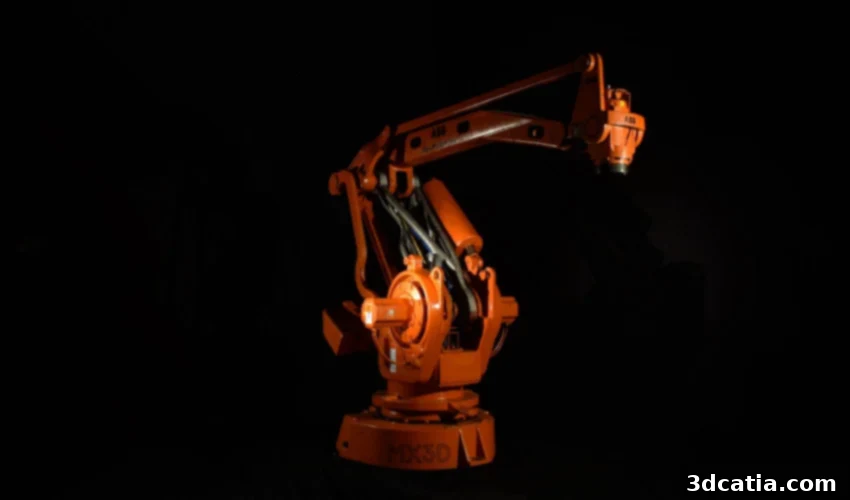
An MX3D 3D printer using WAAM technology (photo credits: MX3D)
The landscape of WAAM technology is continually expanding, driven by several pioneering manufacturers who are pushing the boundaries of what’s possible in large-scale metal additive manufacturing. Prominent among these innovators is Prodways, a company known for its industrial 3D printers that often incorporate the WAAM-TIG process, emphasizing high precision and material quality. Norsk Titanium stands out with its proprietary Rapid Plasma Deposition (RPD™) process, a specialized form of WAAM that has achieved significant traction, particularly in the aerospace industry, for producing certified titanium components. GEFERTEC is another key player, offering a range of WAAM machines designed for industrial-scale production of metal parts. MX3D, famous for its architectural and structural applications like the Amsterdam bridge, continues to develop and deploy advanced WAAM systems for complex and large-scale metal fabrication. WAAM3D is a specialist in this field, focusing exclusively on developing and commercializing WAAM technology and related software for various industrial applications. Lastly, Lincoln Electric, a global leader in welding technology, has naturally extended its expertise into the additive manufacturing space, offering comprehensive WAAM solutions that leverage their deep understanding of arc welding processes. These manufacturers are collectively driving the adoption and refinement of WAAM, making it an increasingly viable option for a wide range of industrial challenges.
What are your thoughts on the rapidly advancing Wire Arc Additive Manufacturing (WAAM) technology and its potential to reshape industrial production? We invite you to share your insights in a comment below or join the conversation on our LinkedIn, Facebook, and Twitter pages! Don’t miss out on the latest advancements and breaking news in the additive manufacturing world – sign up for our free weekly Newsletter here to receive top 3D printing stories directly in your inbox. For more visual content and in-depth discussions, you can also find all our videos on our dedicated YouTube channel.
*Cover Photo: Relativity Space’s Terran 1 rocket under construction (photo credits: Relativity Space)