
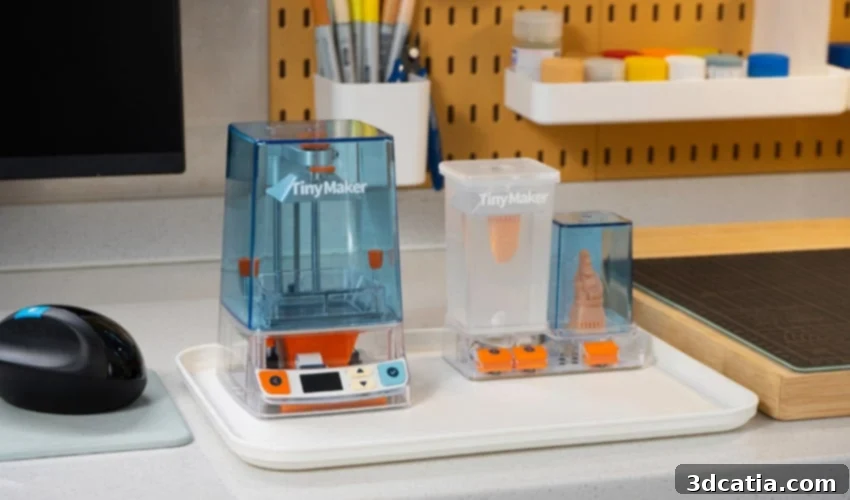
TinyMaker: Is This Miniature Resin 3D Printer a Game Changer or a Crowdfunding Caution?
In an era dominated by advancements in large-format 3D printing, where the focus often lies on expansive build volumes, industrial-grade speed, and robust repeatability, a curious counter-trend has emerged. Some innovators are opting to challenge the status quo by introducing solutions that are diametrically opposite in scale. Among these pioneering endeavors is TinyMaker, a brand that has garnered significant attention for developing one of the smallest resin 3D printers available on the market. This diminutive device, designed to fit comfortably in the palm of your hand, epitomizes portability, aiming to democratize 3D printing by making its benefits accessible to a broader audience, regardless of location. The overarching question, however, remains: what practical applications will this micro-machine truly serve, and will the ambitious promises made by its manufacturer on various crowdfunding platforms ultimately materialize? Initially pegged at an enticing price point of approximately 110 euros, with deliveries optimistically slated to commence in February, the manufacturer appears to have significantly lagged behind schedule. This situation naturally prompts a deeper inquiry: does this petite resin 3D printer represent a genuine, disruptive innovation, or is it merely a fleeting trend that potential adopters should approach with a healthy dose of skepticism?
The concept of a surprisingly small 3D printer isn’t entirely unprecedented in the additive manufacturing landscape. We’ve previously witnessed projects like the Pluto or the intriguing My N Mi, a machine reportedly no larger than a common matchstick. Such miniature solutions invariably capture attention because they starkly contrast with the industry’s predominant trajectory towards bigger, faster, and more robust systems. The market, accustomed to industrial-scale machines prioritizing sheer print volume and efficiency, finds itself surprised by these compact contenders. TinyMaker’s core philosophy, however, diverges from the pursuit of size or speed. Instead, its raison d’être is to enhance the accessibility of 3D printing, empowering users to initiate projects wherever and whenever inspiration strikes. This vision wasn’t realized overnight; it was the culmination of an intensive two-year development period, involving numerous prototypes and iterative refinements, all aimed at perfecting its design, functionality, and user experience.
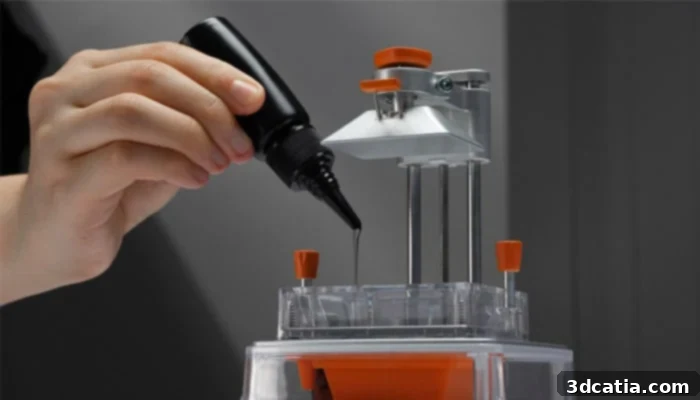
The TinyMaker 3D printer uses resin, showcasing its compact form factor.
Taking a Closer Look at the TinyMaker’s Specifications and Potential
Delving into the specifics, the TinyMaker 3D printer boasts an exceptionally compact design, measuring a mere 100 x 115 x 155 mm and tipping the scales at just 600 grams. To put this into perspective, it’s roughly the size of a large smartphone stood on its end, making it an ideal companion for travel or limited workspaces. Its minimal power consumption is another standout feature, allowing users the flexibility to connect it to an external battery pack for operation. This capability opens up a world of possibilities for printing on the go, in classrooms, during outdoor activities, or in locations with unreliable power sources, truly embodying the spirit of portable additive manufacturing. The print plate, while compact, offers a respectable build volume of 30.6 x 40.8 x 60 mm. Within this limited space, the machine is capable of achieving remarkable detail, with layer thicknesses ranging between 0.05 and 0.1 mm, ideal for crafting intricate models, miniatures, jewelry prototypes, or small functional parts where precision is paramount.
A significant advantage of the TinyMaker is its open-source nature. This commitment to open-source philosophy means that the device’s hardware designs and software are publicly accessible, fostering a vibrant community of users, developers, and enthusiasts. This collective engagement can lead to a continuous stream of modifications, improvements, and innovative applications, potentially extending the printer’s lifespan and expanding its capabilities far beyond its initial specifications. The TinyMaker utilizes MSLA (Masked Stereo-Lithography Apparatus) technology. MSLA is a form of resin 3D printing that employs an LCD screen to selectively mask a UV light source, curing liquid resin layer by layer. This technology is highly regarded for its ability to produce highly detailed and accurate prints, making it an excellent choice for a miniature printer where precision is often prioritized over sheer volume. The efficiency and resolution offered by MSLA are key to TinyMaker’s ability to deliver quality within its compact footprint.
Addressing Post-Processing and the Crowdfunding Dilemma
Recognizing that successful resin 3D printing extends beyond the print itself, the TinyMaker brand has also meticulously developed post-processing solutions that mirror the machine’s compact philosophy. These include a dedicated cleaning solution and a heat treatment device, both designed with portability in mind and offered at an accessible price point of approximately thirty dollars. The entire ecosystem has been engineered for effortless transportability and usability in virtually any setting, reinforcing the “print anywhere” promise. However, a critical question remains regarding the efficacy of these compact post-processing tools: can they genuinely ensure that printed parts are thoroughly cleaned, free of uncured resin, and meticulously divested of all support structures, especially given the intricate nature of typical resin prints? While the convenience is undeniable, the thoroughness of such miniature solutions often warrants a degree of healthy skepticism.
The excitement surrounding TinyMaker’s innovative concept has translated into overwhelming success on leading crowdfunding platforms. Both the Kickstarter and Indiegogo campaigns not only met but significantly surpassed their initial funding targets, indicating a strong market appetite for such a device. However, this success is overshadowed by persistent concerns regarding the fulfillment of pledges. The initial delivery schedules, set for February 2023 on Kickstarter and April 2023 on Indiegogo, have faced considerable delays. A closer examination of the campaign pages reveals troubling discrepancies: the Kickstarter campaign, launched many months ago, now redirects to the Indiegogo campaign, which, remarkably, remains open and actively soliciting new pledges. This ongoing fundraising, despite having massively exceeded initial goals and facing substantial delivery backlogs, raises serious questions about the project’s operational transparency and commitment to its backers. The situation understandably fosters skepticism about the seriousness and logistical capabilities of the TinyMaker team. While the shared images and promotional videos undeniably present a promising vision, this scenario perfectly encapsulates the inherent dangers and uncertainties associated with crowdfunding platform projects, a risk that 3D printing innovations are unfortunately not immune to.
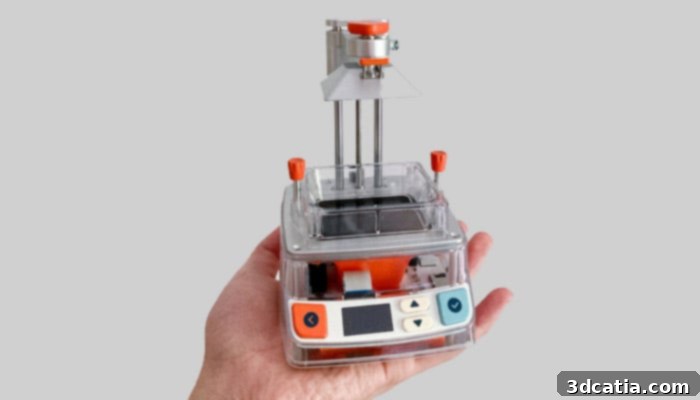
The MSLA 3D printer is exceptionally easy to transport, fitting in the palm of your hand.
The Broader Implications and Final Verdict
Despite the valid concerns surrounding its crowdfunding execution, the buzz generated by TinyMaker remains significant and worth acknowledging. The underlying concept is inherently interesting, demonstrating a compelling vision for making 3D technology more accessible and inclusive for the largest possible number of people. It challenges the conventional perception of 3D printers as bulky, expensive, and complex machines, opening doors for hobbyists, students, educators, and even casual users to experiment with additive manufacturing. The ultra-portability, coupled with the open-source ethos, fosters a community-driven approach to innovation, promising potential for future enhancements and broader applications. Imagine students learning about CAD and printing small prototypes in a remote classroom, or travelers creating personalized souvenirs on the go. These are the transformative possibilities TinyMaker envisions.
However, we maintain our reservations concerning the practical build volume and the ultimate quality of the parts produced, especially when compared to more established, albeit larger, resin printers. For a machine priced at less than 150 euros, it’s unrealistic to expect industrial-grade performance or extensive print capabilities. The TinyMaker likely caters to a very specific niche: users who prioritize portability and affordability above all else, and who primarily intend to print small, intricate objects where fine detail is more important than sheer size. While its price point makes it an undeniably attractive entry-level device into resin printing, particularly for those curious about MSLA technology without a significant financial commitment, the unaddressed delays and ongoing fundraising on crowdfunding platforms are red flags that prospective buyers should seriously consider. It serves as a potent reminder that while crowdfunding can be a powerful accelerator for innovation, it also carries inherent risks regarding product delivery, quality control, and long-term support. To learn more about the project, you can find the manufacturer’s campaign HERE.
What are your thoughts on the TinyMaker? Do you believe a miniature, portable resin 3D printer fills a critical gap in the market, or are the crowdfunding concerns too significant to overlook? Share your opinions in a comment below or join the conversation on our LinkedIn, Facebook, and Twitter pages! Don’t forget to sign up for our free weekly newsletter here to get the latest 3D printing news delivered straight to your inbox. You can also explore all our video content on our YouTube channel.
*All Photo Credits: TinyMaker