
Unveiling Tomorrow: The Top 5 3D Printing Videos That Are Reshaping Our World
This week, we delve into the most captivating advancements in additive manufacturing, presenting our curated selection of the top five videos that highlight how 3D printing is profoundly shaping various facets of our society. Far from being a niche technology, 3D printing has successfully infiltrated a multitude of sectors, demonstrating its versatility and transformative power. From revolutionizing medical applications with patient-specific implants and prosthetics to streamlining production in the automotive industry for lightweight parts and rapid prototyping, its impact is undeniable. Join us as we explore cutting-edge innovations, emerging trends for the future, and fascinating real-world applications of this dynamic technology. Our selection this week covers everything from a comprehensive recap of Formnext, the world’s leading exhibition for additive manufacturing, to the exciting integration of 3D printing in the fashion industry, alongside significant developments in automation and industrial production. These videos offer an invaluable glimpse into the future, showcasing how additive manufacturing is driving progress and opening up new possibilities across industries. If you find these insights compelling and wish to explore more, we invite you to visit our dedicated YouTube channel, where a vast library of 3D printing videos awaits. We trust you’ll enjoy this journey through the latest in 3D printing innovation and have a splendid week ahead!
Top 1: Unpacking Formnext 2019 – A 3Dnatives Perspective on Additive Manufacturing Trends
Formnext stands as the premier global exhibition for additive manufacturing, bringing together industry leaders, innovators, and enthusiasts to showcase the latest breakthroughs. In our exclusive Formnext 2019 recap, 3Dnatives meticulously identified the overarching trends that are steering the future of this rapidly evolving industry. A standout observation from the event was the unprecedented presence of metal additive manufacturing solutions. This segment of 3D printing is experiencing a veritable boom, with an impressive array of offerings from both well-established manufacturers and innovative newcomers. The advantages of metal AM—including the ability to produce highly complex geometries, achieve significant weight reductions, and create parts with superior mechanical properties—are driving its accelerated adoption across critical sectors like aerospace, automotive, and medical. Beyond metals, materials continue to be a central pillar of innovation within the additive manufacturing landscape. Formnext 2019 highlighted remarkable advancements in specialized materials such as ceramics, silicone, and composites. Ceramics, known for their exceptional thermal stability, hardness, and wear resistance, are opening doors for applications in high-temperature environments and advanced biomedical devices. Silicone, with its inherent flexibility, biocompatibility, and chemical resistance, is gaining traction for soft robotics, custom medical implants, and consumer goods. Meanwhile, the development of advanced composites, often incorporating carbon fiber or glass fiber, is enabling the creation of parts with unparalleled strength-to-weight ratios, critical for high-performance applications. We engaged with numerous exhibitors and visitors, gathering their invaluable insights and perspectives on the monumental impact and future direction of the world’s largest additive manufacturing fair. Their collective vision painted a clear picture of an industry poised for exponential growth and diversification.
Top 2: Revolutionizing Production: Automating Chanel Mascara Brush 3D Printing
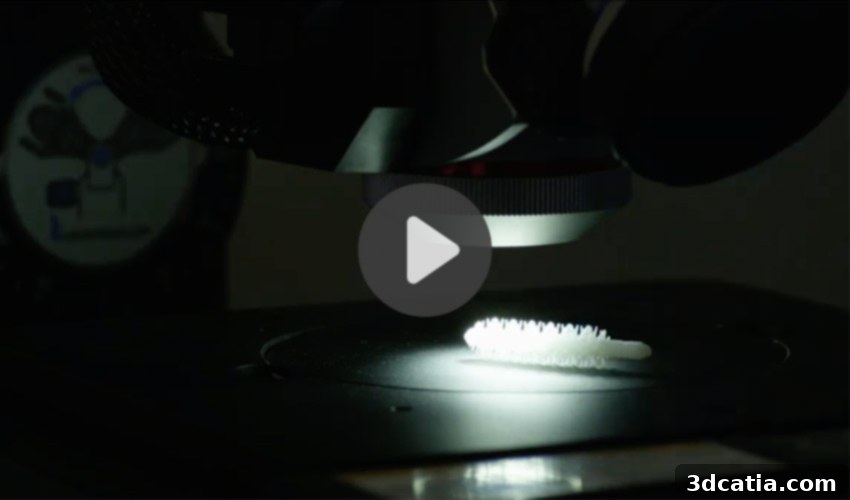
The journey from prototyping to mass production in additive manufacturing often presents significant challenges, especially when consistency and high volume are paramount, as is the case for luxury brands like Chanel. This segment explores how advanced additive manufacturing (AM) automation software is transforming production workflows, enabling companies to seamlessly unite every stage of the manufacturing process to achieve optimal efficiency and output. Erpro, a leading specialist in additive manufacturing, prototyping, pre-production, and mass production, has embraced this innovative approach to produce Chanel mascara brushes. By leveraging sophisticated AM automation software, Erpro is able to manage and streamline complex production cycles, ensuring precision and scalability. The key enabler for this transformation is 3YOURMIND, a company renowned for its cutting-edge AM software solutions. Their platform is designed to inject accuracy, speed, and transparency into every aspect of additive manufacturing order processing and management. Imagine a comprehensive digital ecosystem where all communications, design iterations, production schedules, and quality checks are consolidated onto a single, intuitive platform. This centralized approach eliminates communication silos, reduces human error, and drastically cuts down lead times. For Erpro, this means an optimized workflow that ensures each Chanel mascara brush meets the stringent quality standards expected from a global luxury brand, from the initial design phase through to automated post-processing and final delivery. This case study perfectly illustrates the profound impact of automation in scaling 3D printing for high-volume, high-value consumer products, marking a significant step towards the industrialization of additive manufacturing.
Top 3: Precision Engineering: Metal 3D Printing for Ortofon Phono Cartridges
In the realm of high-fidelity audio, precision and material science are paramount. Ortofon, a revered Danish company and one of the world’s foremost manufacturers of phono cartridges, has successfully integrated metal 3D printing into its production processes to elevate the performance and design of its products. This pioneering move, undertaken in collaboration with the Danish Technological Institute, showcases the immense potential of additive manufacturing for intricate and performance-critical components. Traditional manufacturing methods often impose limitations on geometric complexity and material combinations, which can restrict innovation in areas like acoustic design. Metal 3D printing, however, liberates designers from these constraints. For Ortofon, this meant the ability to create cartridges with highly optimized internal structures and geometries that were previously impossible to achieve. By using metal AM, they can fine-tune the mass distribution, resonance characteristics, and damping properties of the cartridge body, directly influencing the sound quality and tracking performance. The partnership with the Danish Technological Institute provided Ortofon access to advanced metal additive manufacturing technologies, likely including selective laser melting (SLM) or direct metal laser sintering (DMLS), which are ideal for producing precise metal components. These processes allow for the use of specific metal alloys, such as titanium or stainless steel, which possess desirable acoustic properties and structural integrity. The ability to rapidly iterate designs and produce functional prototypes in metal significantly accelerates the development cycle, leading to faster innovation. This application highlights how metal 3D printing is not just a prototyping tool but a viable and superior production method for specialized, high-performance components, enabling companies like Ortofon to push the boundaries of what is acoustically possible.
Top 4: Pioneering the Future: Key 3D Printing Trends of 2020 and Beyond
Materialise, a global leader in 3D printing software and services, offers profound insights into the pivotal trends that shaped and continue to define additive manufacturing in 2020 and the years that followed. Their expert analysis highlights several critical areas that underscore the maturation and expansion of the 3D printing industry. The first significant trend is **sustainability**, a concept rapidly gaining momentum across all industrial sectors. 3D printing inherently offers numerous environmental advantages, including reduced material waste through optimized part design and near-net-shape manufacturing, the ability to produce lightweight components that improve energy efficiency in transportation, and the potential for localized production, which minimizes supply chain emissions. Furthermore, AM facilitates repair and customization, extending product lifecycles and supporting a circular economy. Secondly, the industry is witnessing a profound shift from 3D printing primarily as a **prototyping technology** to its burgeoning role as a **mass customization technology**. This transition enables the production of highly personalized products at scale, catering to individual customer needs without incurring prohibitive costs, as seen in medical devices like prosthetics and orthotics, or consumer goods. This leads directly to the third trend: the acceleration of 3D printing for **industrial production**. Companies are increasingly establishing dedicated “3D printing factories” equipped for high-volume, reliable manufacturing. This evolution necessitates greater **automation** across the entire AM workflow, from pre-processing and build preparation to the printing process itself and, crucially, post-processing. To achieve true industrial scalability and efficiency, manual interventions must be minimized. For this reason, Materialise emphasizes two interconnected big trends: **artificial intelligence (AI)** and **automated post-processing** at the service of AM. AI plays a transformative role in generative design, optimizing part geometries for performance and printability, predicting print failures, and enhancing process control through real-time data analysis. Automated post-processing, addressing one of the most significant bottlenecks in AM production, includes robotic support removal, automated surface finishing, and streamlined curing processes, all vital for cost-effective and high-throughput manufacturing. Last but not least, **materials** continue to be a cornerstone of innovation. The continuous expansion of the material palette—including new polymers, advanced metal alloys, high-performance composites, and specialized ceramics—is enabling applications that were previously unattainable. These material breakthroughs are pushing the boundaries of what 3D printing can achieve in terms of strength, flexibility, biocompatibility, and resistance to extreme conditions, further solidifying its position as a key manufacturing technology for the future.
Top 5: Fashion Forward: The Continuous Evolution of 3D Printing in Textile Design
The intersection of high fashion and cutting-edge technology continues to be a fertile ground for innovation, and 3D printing is at the forefront of this convergence. This captivating segment showcases how Greta Oto is pushing the boundaries of textile design with a fresh and groundbreaking approach to customization. Rather than creating fully rigid 3D printed garments, Greta Oto employs 3D printing directly onto the surface of traditional textiles. This ingenious method, developed in collaboration with renowned designer Travis Fitch and additive manufacturing giant Stratasys, allows for the integration of intricate, sculptural forms and dynamic textures onto flexible fabric. The collection demonstrates a sophisticated interplay between soft textiles and rigid or semi-rigid 3D printed elements, resulting in dresses that exhibit new forms, movements, and structural integrity. This hybrid approach offers several significant advantages: it maintains the inherent comfort and drape of conventional fabrics while introducing revolutionary aesthetic and functional possibilities. Designers can create complex geometric patterns, articulated elements, or even functional components directly on the fabric, opening up new avenues for custom fit, interactive textures, and dynamic visual effects. The use of multi-material 3D printing, a specialty of Stratasys, likely plays a crucial role, allowing for varying degrees of flexibility and aesthetic qualities within the printed structures. This innovation signifies a pivotal moment in fashion, illustrating how 3D printing can enhance rather than replace traditional materials, offering a powerful tool for customization, personalization, and artistic expression. It highlights a future where clothing is not only designed but also engineered with unparalleled precision and creativity. The continuous evolution of 3D printing in fashion promises garments that are more adaptable, aesthetically diverse, and truly unique.
We hope you’ve enjoyed this deep dive into the fascinating world of additive manufacturing and our selection of this week’s top five videos. The dynamism and rapid evolution of the 3D printing industry are truly remarkable, consistently delivering groundbreaking innovations that challenge conventional manufacturing paradigms. Each video presented a unique perspective on how this technology is not just changing what we make, but how we make it, influencing everything from industrial efficiency and product customization to artistic expression and sustainability. Your thoughts and feedback are invaluable to us! What did you find most inspiring or surprising in this week’s collection? Do you have a favorite application or a trend that you believe will dominate the future of 3D printing? Drop a comment below to share your insights, or join the conversation on our Facebook and Twitter pages. Engaging with our community helps us understand what matters most to you. And to ensure you never miss out on the latest news, breakthrough technologies, and expert analyses in the 3D industry, don’t forget to sign up for our free weekly Newsletter. It’s your direct link to staying updated on all the exciting developments coming straight to your inbox! Thank you for joining us on this journey into the future of manufacturing.