
BMW’s €10 Million Additive Manufacturing Campus: Driving the Future of Automotive 3D Printing
In a significant move poised to revolutionize its production processes, the renowned German automotive giant BMW has officially announced the establishment of a cutting-edge additive manufacturing campus. This ambitious project represents a substantial investment of €10 million, underscoring BMW’s deep commitment to integrating and accelerating the adoption of 3D printing technology across its vast manufacturing ecosystem. Slated to open its doors in 2019, this state-of-the-art facility is strategically located in Oberschleissheim, a northern suburb of Munich, placing it at the heart of BMW’s operational and innovation landscape. The campus is not merely an expansion but a strategic pillar designed to push the boundaries of what is possible with additive manufacturing within the demanding automotive sector, from initial concept design to final component production, solidifying BMW’s leadership in advanced manufacturing techniques.
The opening of this advanced campus signifies BMW’s unwavering dedication to embedding additive manufacturing deeper into its core production cycles. The automaker has long recognized the transformative potential of 3D technology, having already leveraged it for critical components such as the intricate convertible top of its groundbreaking i8 Roadster. This early adoption demonstrated the practical benefits of 3D printing in achieving complex geometries, optimizing performance, and reducing weight – all crucial factors in high-performance automotive design. Beyond internal applications, BMW has also proactively invested in pioneering start-ups like Desktop Metal, a clear testament to its desire to not only utilize but also actively contribute to the broader development and advancement of industrial additive manufacturing solutions. These strategic investments highlight a forward-thinking strategy, aiming to shape the future of industrial production and supply chains. Furthermore, BMW has an established Additive Manufacturing Center in Munich, which already showcases impressive capabilities by annually 3D printing over 100,000 diverse components. These range from crucial spare parts that ensure vehicle longevity to intricate parts for metal frames, demonstrating the versatility, reliability, and growing scale of 3D printing in a high-stakes automotive environment.
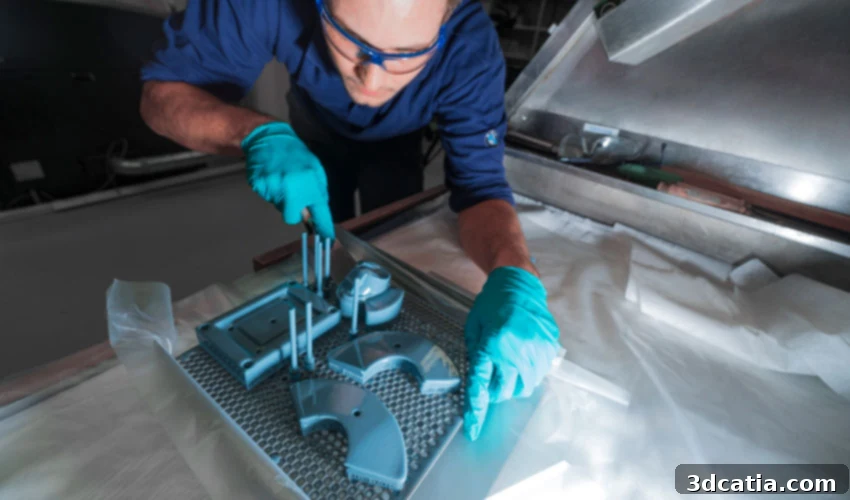
BMW’s new additive manufacturing campus: A hub for innovation and advanced production.
A 6,000 Square Meter Hub for Additive Manufacturing Excellence
The new additive manufacturing campus is meticulously designed to foster innovation, collaboration, and efficiency on an industrial scale. Housed within an expansive existing 6,000 square meter facility, it provides ample space for cutting-edge operations and future expansion. The campus is anticipated to accommodate a dedicated team of up to 80 highly skilled employees, comprising engineers, designers, material scientists, and specialized technicians. This interdisciplinary team will work collaboratively to push the boundaries of 3D printing applications, explore new materials, and optimize production workflows. Crucially, it will be equipped with an impressive array of over 30 industrial additive manufacturing solutions, encompassing advanced metal and plastic printing technologies. This diverse arsenal of machinery will enable BMW to explore a wide spectrum of applications and materials, ensuring comprehensive capabilities for various automotive needs, from high-strength structural components to lightweight interior parts.
BMW states that the new center will initially concentrate its efforts primarily on rapid prototyping, a critical phase in automotive development where quick iterations, functional testing, and design validation are paramount. The ability to rapidly produce prototypes dramatically shortens development cycles and allows for more aggressive experimentation with new designs and concepts. However, its scope extends far beyond mere prototyping. The campus is also strategically geared towards serial production, enabling the manufacturing of complex, low-volume components that would be challenging or uneconomical with traditional methods. Furthermore, it will focus on the creation of highly customized solutions, catering to niche markets, specialized vehicle editions, or personalized customer requests, which is a growing trend in the luxury automotive segment. A key function of this campus will be the rigorous testing and validation of the very latest innovations emerging from the rapidly evolving 3D printing industry. By acting as a living laboratory, it will facilitate the seamless integration of new technologies, bringing them closer to existing pilot plants and accelerating their deployment into BMW’s wider global production network. This approach promises a new level of interdisciplinary collaboration and advanced training, providing invaluable opportunities for engineers and designers across different echelons of the BMW manufacturing chain to hone their skills and expertise in additive manufacturing, fostering a culture of continuous innovation.
The Strategic Vision: Optimizing Technology and Process Chains for Automotive
Jens Ertel, the esteemed Director of the BMW Additive Manufacturing Center, articulates the profound significance of this new initiative with compelling clarity: “Our new facility will be a major milestone in additive manufacturing at the BMW Group. The team there will evaluate new and existing technologies in both plastics and metals printing and develop them to series maturity. Our goal is to provide the optimum technology and process chain, be it for individual components, small production runs or even large-scale manufacturing.” This statement powerfully underscores the German manufacturer’s strategic and unwavering commitment to additive manufacturing, viewing it not just as a tool but as a fundamental shift in production philosophy. BMW is firmly convinced of the immense benefits this technology can bring to the automotive sector, enhancing performance, efficiency, design flexibility, and overall vehicle quality. This integrated approach, from research to serial production, positions BMW at the forefront of the industrial additive manufacturing revolution.
A compelling example of these tangible benefits can be seen in the design and production of specific components for the BMW i8 Roadster. Through the intelligent application of additive manufacturing, BMW engineers were able to achieve remarkable gains in both strength and lightness for specific parts, such as the sophisticated convertible top mechanism. This capability is absolutely crucial in modern automotive engineering, where reducing vehicle weight directly translates to improved fuel efficiency, enhanced acceleration, superior handling characteristics, and ultimately, a better driving experience. Furthermore, the unprecedented freedom of design afforded by 3D printing allows for the creation of complex, organic structures that are impossible or prohibitively expensive to produce with traditional manufacturing methods like casting or machining. This opens up new avenues for innovation in component integration, thermal management, aerodynamic optimization, and even aesthetic elements, giving BMW a significant competitive edge in both performance and design aesthetics.
High-quality 3D printed spare parts manufactured using advanced SLS technology (photo credit: BMW).
Towards a Decentralization of Production: The Future of Global Manufacturing
The BMW Group harbors an ambitious long-term vision: to progressively enable the production of parts directly at the point of need. This revolutionary concept, often referred to as decentralized manufacturing or distributed manufacturing, holds enormous potential for optimizing supply chains and enhancing responsiveness, a sentiment strongly supported by a comprehensive study published by the VTT Technical Research Center of Finland. Jens Ertel further elaborates on this transformative goal, explaining, “The 3D printers that are currently operating across our production network represent the first step towards local part production. We are already using additive manufacturing to make prototype components on location in Spartanburg (US), Shenyang (China) and Rayong (Thailand). Going forward, we could well imagine integrating it more fully into local production structures to allow small production runs, country-specific editions and customizable components – provided it represents a profitable solution.” This strategy aims to bring production closer to the customer, assembly lines, or service centers, dramatically changing traditional logistics.
This vision of decentralized production, powered by agile additive manufacturing, promises numerous strategic advantages for BMW. It can significantly reduce supply chain complexities, lead times, and logistical costs, especially for specialized or low-volume parts that typically involve extensive international shipping. By manufacturing components closer to assembly plants, or even directly at dealerships for specific service parts, BMW can minimize transportation expenses, lower inventory holding costs, and respond much more swiftly and flexibly to market demands or unexpected disruptions. This agility is particularly valuable for producing country-specific vehicle editions, enabling rapid localization of designs and features to meet regional preferences and regulations. It also empowers the offering of bespoke customization options to discerning customers, allowing for a level of personalization previously unimaginable at scale. The ability to create ‘parts on demand’ also opens up new possibilities for maintaining legacy vehicles, ensuring the immediate availability of spare parts for older models without the need for extensive tooling, warehousing, or long lead times from distant suppliers. While profitability remains a key consideration for full integration, the profound efficiency, flexibility, and customer-centric gains offered by local 3D printing capabilities present a compelling and strategic case for its broader adoption across BMW’s global operations.
The Broader Impact of Additive Manufacturing in the Automotive Sector
BMW’s substantial investment in this new additive manufacturing campus is not an isolated incident but rather a strong indicator of a wider paradigm shift within the automotive industry. Additive manufacturing offers unique benefits that are perfectly aligned with the evolving demands of modern vehicle production, driven by trends such as electrification, autonomous driving, and increasing customization. Beyond the previously mentioned advantages of improved strength-to-weight ratio and unprecedented design complexity, industrial 3D printing facilitates rapid design iterations, dramatically shortening product development cycles. This means new concepts, from engine components to interior aesthetics, can be tested, refined, and brought to market much faster than ever before, accelerating innovation. Furthermore, it enables a high degree of personalization and customization, allowing manufacturers to cater to individual customer preferences with greater ease and cost-effectiveness, moving towards a ‘mass customization’ model. This is particularly relevant in the premium and luxury segments where bespoke features are a significant differentiator.
The technology also plays a crucial role in tooling, jig, and fixture production, where custom manufacturing aids can be rapidly 3D printed. This reduces lead times and costs associated with traditional manufacturing methods for specialized tools, directly impacting assembly line efficiency, quality control, and ergonomic improvements for workers. From an environmental perspective, additive manufacturing often produces significantly less material waste compared to subtractive methods like machining, contributing to more sustainable production practices. The ability to print only the material needed for a part, combined with optimized lightweight designs, can lead to overall resource savings and reduced energy consumption throughout the vehicle’s entire lifecycle. As materials science continues to advance, the range of printable materials—from high-performance polymers and composites to advanced metal alloys with specific mechanical properties—will only expand, further cementing additive manufacturing’s indispensable role in the automotive industry’s sustainable and efficient future. This commitment from a global leader like BMW serves as a powerful validation for the entire additive manufacturing ecosystem. It stimulates further research and development in printer technology, materials science, and software solutions, driving innovation across the board. The Oberschleissheim campus will undoubtedly become a beacon for industrial 3D printing, fostering a new generation of talent and establishing best practices that will likely be adopted by other manufacturers worldwide. It positions BMW not just as a user, but as a significant driver of the future of advanced manufacturing, ensuring its continued leadership in innovation and vehicle design for decades to come.
Find all the comprehensive information regarding this groundbreaking new campus in the official BMW press release, and gain further insights by watching the illuminating video below:
What are your thoughts on the ever-increasing integration and innovative use of 3D printing within the dynamic automobile sector? We encourage you to share your perspectives and engage in the conversation by leaving a comment below or by connecting with us on our vibrant social media platforms, including Facebook and Twitter! For all the latest breaking news, exclusive insights, and developments in the world of 3D printing, make sure to sign up for our free weekly Newsletter, delivered directly to your inbox, keeping you at the forefront of additive manufacturing innovation!