
Revolutionizing Industry: The Latest Innovations and Breakthroughs in Additive Manufacturing
Welcome back to our weekly roundup of the most significant developments in the world of additive manufacturing! This edition of #3DEXPRESS brings you cutting-edge innovations that are pushing the boundaries of what’s possible, from industrial-scale metal printing to groundbreaking space applications and sustainable material science. This week, we dive into Eplus3D’s impressive new multi-laser metal 3D printer, a machine set to redefine large-format metal additive manufacturing with its unprecedented laser count. We’ll also explore the European Space Agency’s ambitious Ariane 6 mission, which aims to prove the immense potential of 3D printing for constructing infrastructure on the Moon and Mars. Furthermore, we celebrate AM Craft’s successful funding round, a significant step forward for aerospace 3D printing solutions. The European MIMOSA project, a collaborative effort led by Politecnico di Torino, reveals its initial findings on optimizing aircraft components through advanced multi-material 3D printing. Finally, we highlight a remarkable breakthrough from the University of Birmingham, where researchers have developed a pioneering photopolymer resin derived from lipoic acid, enabling the sustainable recycling of 3D-printed prototypes into new functional parts. Join us as we explore these transformative advancements shaping the future of manufacturing. Enjoy!
Eplus3D Unveils EP-M2050: A New Era for Multi-Laser Metal 3D Printing
Kicking off this week’s 3DExpress with a bang, Chinese additive manufacturing giant Eplus3D has introduced its latest innovation: the EP-M2050 metal 3D printer. This formidable machine, based on advanced powder bed laser melting technology, represents a significant leap forward in industrial metal additive manufacturing. What immediately sets the EP-M2050 apart is its incredible laser configuration, incorporating an astonishing 36 lasers, with the capacity to be upgraded to a staggering 62 lasers. This multi-laser approach dramatically increases build speed and efficiency, making it ideal for high-volume production and exceptionally large components. Such a high number of lasers working in unison allows for rapid melting of metal powders across a vast build platform, significantly reducing lead times for complex parts.
The EP-M2050 boasts an exceptionally generous print volume of 2050 x 2050 x 1100 mm, positioning it among the largest metal 3D printers available on the market. This expansive build envelope opens up new possibilities for industries requiring very large, high-performance metal parts, which were previously challenging or impossible to produce using additive manufacturing. Furthermore, the machine offers a versatile layer thickness range of 20 to 120 microns, allowing users to balance between fine detail and rapid production depending on application requirements. Eplus3D highlights that this industrial powerhouse is particularly well-suited for the rigorous demands of the aerospace industry, where the production of large, high-quality, and precise components is paramount for critical applications. The ability to achieve exceptional quality and precision with such a large build volume is a testament to Eplus3D’s engineering prowess. Each fiber laser comes with a power output of either 500W or 700W, offering flexibility to users based on their specific material and application needs, from high-strength alloys to specialized metals. This new machine from Eplus3D is poised to accelerate the adoption of additive manufacturing in sectors that demand scale, speed, and uncompromising quality, further solidifying metal 3D printing’s role in the future of industrial production.
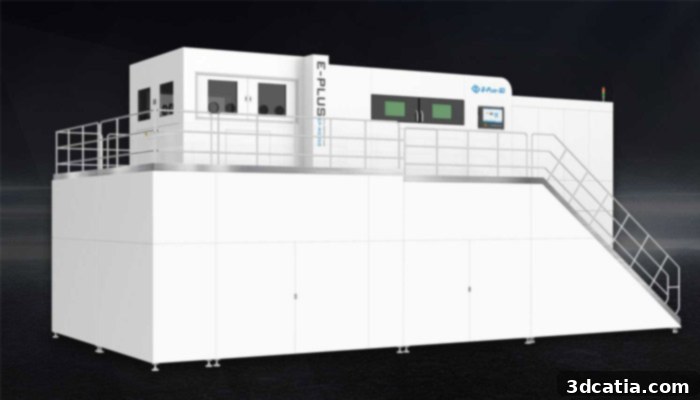
The Chinese manufacturer’s new multi-laser metal 3D printer, the EP-M2050. (Photo Credits: Eplus3D)
Ariane 6 Rocket to Carry In-Orbit 3D Printer, Paving the Way for Space Infrastructure
The European Space Agency (ESA) has recently announced the highly anticipated inaugural flight of its next-generation launch vehicle, the Ariane 6 rocket. This monumental launch carries not only ambitious objectives for space exploration but also a pioneering mission to test the frontiers of new manufacturing technologies in extraterrestrial environments. Central to this endeavor is the “Replicator mission,” an innovative project spearheaded by the startup Orbital Matter. This mission is specifically designed to demonstrate the full capabilities and transformative potential of 3D printing in the unique conditions of Earth’s orbit, with an ultimate long-term vision of establishing critical infrastructure on the Moon and Mars.
Orbital Matter’s groundbreaking technology is engineered to operate efficiently in microgravity, a crucial factor for successful in-orbit manufacturing. Unlike conventional 3D printing methods, their system is designed to minimize heat generation during the printing process, mitigating potential challenges and risks associated with thermal management in space. During the Ariane 6 flight, Orbital Matter’s CubeSat 3D printer is tasked with an unprecedented demonstration: printing a 50 cm-long beam while orbiting at an altitude of 580 kilometers. This represents a significant milestone for the technology, as it marks its first operational test in space, having previously only proven its efficacy in terrestrial simulations and controlled environments. The successful completion of this in-orbit printing task would validate a crucial step towards autonomous off-Earth manufacturing. Such capabilities are vital for future deep-space missions, allowing for on-demand production of tools, spare parts, and even large-scale habitats directly in space. This not only reduces the immense cost and logistical complexity of launching pre-fabricated structures from Earth but also enables greater mission flexibility and resilience. The Ariane 6 mission, with its integrated 3D printing experiment, is set to open a new chapter in space exploration, showcasing how additive manufacturing can revolutionize our approach to living and working beyond Earth.
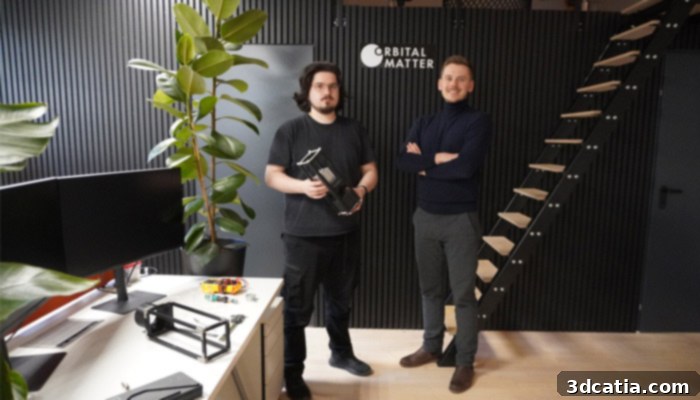
Jakub Stojek, CEO of Orbital Matter, and Robert Ihnatisin, CTO, showcasing a replica of the CubeSat 3D printer designed for the Ariane 6 mission. (Photo Credits: ESA)
AM Craft Secures €600,000 to Scale Aerospace 3D Printing Solutions
In a clear indicator of growing investor confidence in the additive manufacturing sector, AM Craft, a specialized startup dedicated to producing 3D-printed equipment for the demanding aerospace industry, has successfully raised €600,000 in its latest funding round. This substantial capital injection is poised to fuel the company’s growth, accelerate its research and development efforts, and expand its operational capabilities, ultimately strengthening its position within the burgeoning aerospace additive manufacturing market.
Didzis Dejus, CEO of AM Craft, shared his insights on this significant achievement, articulating a compelling vision for the future of aerospace manufacturing. He stated, “The vision is to enable low-cost, rapid sourcing of a large library of parts, delivered sustainably by local certified manufacturing hubs around the world, thereby massively increasing the use of additive manufacturing in spare part sourcing and eventually also OEM manufacturing.” This statement encapsulates AM Craft’s strategic direction, which focuses on establishing a decentralized network of certified manufacturing hubs. This innovative approach aims to decentralize production, reducing the reliance on traditional, often lengthy, global supply chains. By enabling local production, AM Craft seeks to significantly lower costs and drastically cut down lead times for aerospace components, from critical spare parts to original equipment manufacturer (OEM) components. Furthermore, the emphasis on “sustainable” delivery highlights the company’s commitment to environmentally responsible manufacturing practices, a growing priority within the aerospace sector. This funding will allow AM Craft to invest in advanced 3D printing technologies, further develop its material science expertise, and expand its network of partners to realize this ambitious vision. The success of this funding round not only validates AM Craft’s business model but also underscores the broader trend towards digital, localized, and resilient supply chains powered by additive manufacturing across critical industries like aerospace.
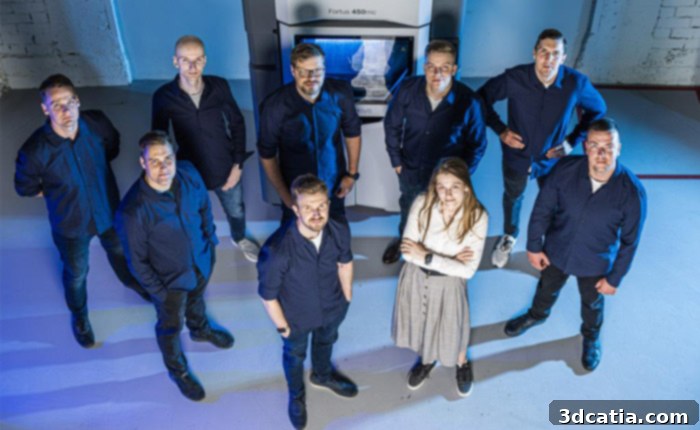
The dedicated AM Craft team, pioneers in aerospace 3D printing solutions. (Photo Credits: AM Craft)
MIMOSA Project Reveals Initial Successes in Optimizing Aircraft Design Through Advanced 3D Printing
A significant European initiative, the MIMOSA project, has recently presented its promising initial results, signaling a potential paradigm shift in aeronautical construction. Led by the prestigious Politecnico di Torino in collaboration with TÜV Italia and a consortium of other key partners from the aerospace industry, the project, which commenced at the end of 2022, is dedicated to revolutionizing aircraft manufacturing through the innovative combined use of advanced composite materials and sophisticated 3D-printed metals. The core objective of MIMOSA is to develop and implement novel multi-material structures that leverage the unique advantages of both material classes, leading to lighter, stronger, and more efficient aircraft components.
On May 15th, a dedicated conference was held at the Automobile Museum in Turin, where the initial findings and advancements of this ambitious research project were unveiled to a broad audience of companies and stakeholders within the aerospace sector. The presentations highlighted how MIMOSA is strategically exploiting specific patents held by Politecnico di Torino to achieve its goals. The project’s most innovative aspect lies in its ability to produce multi-material structures composed of metal alloys and composite materials without the need for traditional intermediate elements such as adhesives or rivets. This groundbreaking integration is achieved through a sophisticated combination of metal additive manufacturing, precise plasma surface treatments, and the strategic incorporation of carbon fibers. By directly bonding these dissimilar materials at a molecular level, the MIMOSA project aims to eliminate the weight and structural weaknesses often associated with conventional joining methods. This direct integration not only enhances the overall structural integrity and performance of aeronautical parts but also significantly reduces assembly complexity and manufacturing time. The long-term implications for the aerospace industry are profound, promising lighter aircraft that consume less fuel, possess greater payload capacity, and offer improved durability. The MIMOSA project exemplifies how collaborative European research is pushing the boundaries of material science and additive manufacturing to create the next generation of aerospace solutions.

Stefano Pasquino, Sabrina Zapperi from TUV Italia, and Giorgio De Pasquale from Politecnico di Torino, showcasing the collaborative spirit behind the MIMOSA project. (Photo Credits: Politecnico di Torino).
University of Birmingham Pioneers Sustainable 3D Printing with Recyclable Lipoic Acid Resin
In a significant move towards more sustainable additive manufacturing, researchers at the University of Birmingham have unveiled a revolutionary new photopolymer resin this week. Their findings, which promise to address critical environmental concerns within the 3D printing industry, focus on a novel resin developed entirely from lipoic acid. Lipoic acid, a natural fatty acid molecule commonly found as a dietary supplement, serves as the bio-sourced foundation for this innovative material, marking a substantial departure from traditional petrochemical-derived resins.
According to the research team, the most compelling aspect of this new resin is its inherent recyclability. This breakthrough enables the creation of fully finished, functional parts directly from 3D-printed prototypes that might otherwise be discarded. The ability to reclaim and reprocess printed materials significantly reduces waste and fosters a more circular economy within additive manufacturing. Professor Andrew Dove, a leading figure in the research, encapsulated the importance of their work, stating, “Our approach is an important step away from relying on 3D-printable resins made from petrochemicals, which cannot be efficiently recycled. While we still have improvements to make to the properties of the new resin, this research opens up exciting new avenues for development.” This quote highlights the dual benefit of the innovation: moving away from finite, fossil-fuel-based resources and simultaneously tackling the challenge of waste generation. While acknowledging that further optimization of the resin’s mechanical properties is still ongoing, the research provides a robust foundation for future developments in eco-friendly 3D printing materials. This advancement is particularly crucial as the 3D printing industry continues its rapid growth, demanding sustainable practices and materials that align with global environmental goals. The development of a recyclable, bio-sourced resin from lipoic acid offers a promising pathway to reduce the environmental footprint of 3D printing, making it a truly greener manufacturing technology for the future.
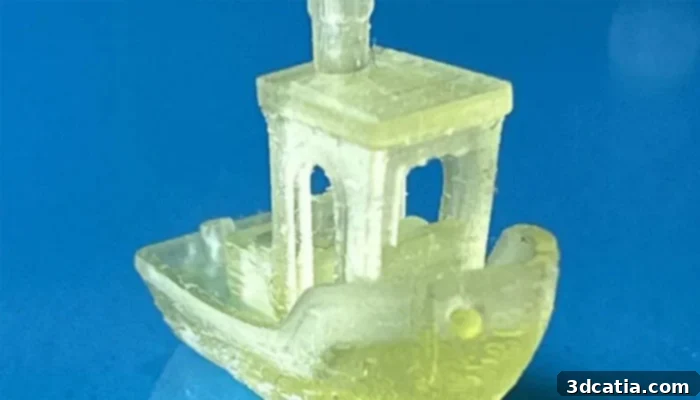
A complex 3D-printed part fabricated from the innovative, fully bio-sourced and recyclable resin. (Photo Credits: University of Birmingham)
This week’s additive manufacturing news truly underscores the dynamic and rapidly evolving nature of the industry. From industrial-scale metal printing with Eplus3D’s multi-laser powerhouse to Orbital Matter’s ambitious in-orbit manufacturing for space exploration, and AM Craft’s strategic funding for aerospace solutions, innovation is accelerating across all fronts. The MIMOSA project’s advancements in multi-material integration for aircraft and the University of Birmingham’s pioneering work in sustainable, recyclable resins further highlight the industry’s commitment to efficiency, performance, and environmental responsibility. These developments are not just incremental improvements; they represent foundational shifts that promise to reshape manufacturing, redefine supply chains, and unlock new possibilities for humanity, both on Earth and beyond.
What are your thoughts on Eplus3D’s groundbreaking new metal 3D printer, or the exciting prospects of in-space manufacturing with the Ariane 6 rocket? Share your insights and join the conversation in the comments section below or connect with us on our LinkedIn, Facebook, and Twitter pages! Don’t miss out on the latest advancements and industry updates; be sure to sign up for our free weekly newsletter here for the most recent 3D printing news delivered straight to your inbox! Additionally, explore our extensive library of videos and interviews on our YouTube channel to stay fully informed on all things additive manufacturing.