
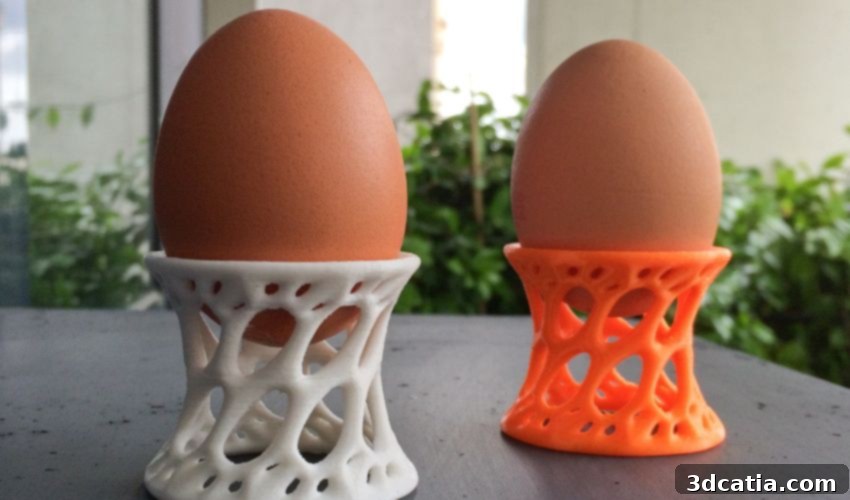
Ensuring Food Safety in 3D Printing: A Comprehensive Guide for Food-Contact Applications
In recent years, the landscape of the food industry has been dramatically reshaped by the advent of 3D printing technology. Beyond the fascinating innovation of directly printing edible items like custom chocolate designs from Cocoa Press’s 3D printer, or the industrial-scale production of alternative proteins by pioneers such as Revo Foods and Steakholder Foods for meat, fish, and desserts, additive manufacturing offers another crucial application. This involves the creation of parts that come into direct or indirect contact with food, ranging from customized plates and unique cutlery to specialized packaging and innovative kitchen tools. However, when any 3D printed component interacts with consumables, the paramount concern becomes its “food safety.” This means ensuring that the item poses no risk of contamination or harm to human health, a complex topic that requires careful consideration of materials, processes, and post-processing techniques.
What precisely does “food safe” entail in the context of 3D printing? What are the most critical factors designers, manufacturers, and hobbyists must consider to guarantee the safety of their creations? This comprehensive guide delves into these essential questions, providing a detailed exploration of how users can reliably ensure that a 3D printed part meets stringent food safety standards. While ceramics and metals are also viable food-safe materials, our primary focus will be on polymer additive manufacturing, given its widespread accessibility, particularly in non-industrial and consumer-level applications.
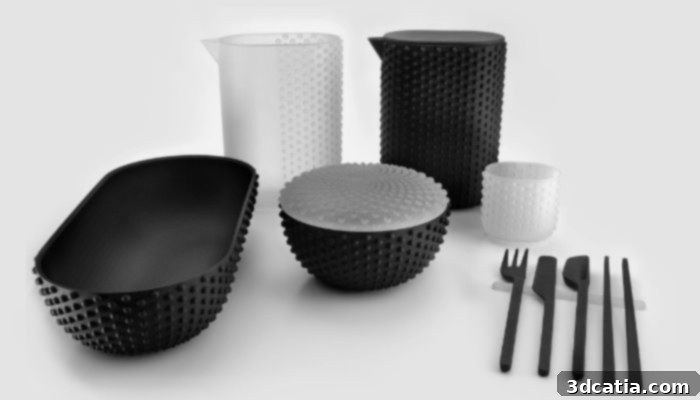
3D printed tableware from Joe Doucet (photo credits: Joe Doucet)
Understanding “Food Safe”: Definition and Regulatory Frameworks
Before embarking on the intricacies of food-safe 3D printing, it is crucial to establish a clear definition of what “food safe” truly signifies. Generally, a material is deemed “food safe” if it is authorized to come into direct or indirect contact with food products without causing any harm to the consumer or altering the food’s quality. This designation means the material fulfills specific requirements based on its intended use and will not pose a food-safety hazard. These regulations, however, are not universal; they vary significantly across different countries and economic blocs, necessitating an understanding of regional guidelines.
For instance, in the United States, the stringent regulations governing food-safe materials and manufacturing processes are set forth by the U.S. Food and Drug Administration (FDA). Specifically, the FDA Code of Federal Regulations Title 21 (CFR 21) outlines the acceptable substances that can be used for manufacturing parts intended for both single-use and repeated-use food contact. This extensive code dictates the types of chemicals, polymers, and other materials deemed safe under various conditions. Concurrently, within the European Union, the safety of polymer materials and articles designed for food contact is primarily governed by Regulation (EU) No 10/2011 on plastic materials and articles intended to come into contact with food. This regulation details migration limits for substances from plastic materials into food, ensuring consumer protection across EU member states.
Beyond regulatory compliance, a food-safe part must inherently possess several critical characteristics. Firstly, it must prevent the migration of any deleterious substances – those that cause harm or damage – into the food it contacts. Secondly, it should not impart unwanted colors, odors, or tastes to the food, preserving its natural quality and appeal. Thirdly, the part must maintain its integrity and safety under normal and foreseeable use conditions, including typical temperatures, contact durations, and food types. Furthermore, food-safe items must be durable, corrosion-resistant, and non-absorbent, preventing the absorption of food particles or liquids that could foster bacterial growth. They need to be sufficiently robust to withstand repeated washing cycles, crucial for reusable items. The surface finish is equally vital; it must be smooth and easily cleanable, devoid of breaks, cracks, and sharp internal angles where food residues or microorganisms could accumulate. Finally, a truly food-safe item must be resistant to pitting, chipping, scratching, scoring, distortion, and decomposition, ensuring its longevity and hygienic properties over time. Adhering to these comprehensive guidelines is paramount for anyone intending to utilize 3D printing for components that will interact with food, safeguarding public health and maintaining product quality.

Materials or parts that are food safe are often designated with this universal symbol
Material Selection: Is PLA Truly Food Safe?
One of the foundational steps in achieving food-safe 3D printing is the meticulous selection of materials. This is particularly critical for plastics, as concerns about the leaching of chemicals into food and the broader environmental implications of microplastics have intensified in recent years. While these concerns are valid, several polymers are indeed suitable for food contact, provided specific conditions are met.
Undoubtedly, PLA (Polylactic Acid) stands as the most widely utilized polymer for domestic 3D printing. It is highly valued for its user-friendliness in printing and its reputation for biodegradability under industrial composting conditions. However, the question of whether PLA can safely come into contact with food is more nuanced than a simple yes or no.
From a technical standpoint, pure, uncolored PLA, devoid of any additives, is indeed classified as food-safe by the FDA. This technical approval, however, doesn’t translate directly into practical, everyday food-safe usage for several reasons. The immediate concern arises when PLA is colored or modified with other additives; these non-PLA components can leach harmful chemicals into food, instantly rendering the material unsafe for contact. Beyond additives, PLA possesses inherent characteristics that significantly limit its suitability for food-contact applications.
Notably, PLA has a relatively low melting point, typically around 175-180°C, but more importantly, a low glass transition temperature (Tg) of about 60-65°C. This makes it unsuitable for parts that may encounter heat, such as coffee mugs or items designed for microwave use, as they can deform or degrade, potentially releasing chemicals. Furthermore, this low heat resistance means PLA cannot endure the high temperatures of a dishwasher, which also prevents proper sterilization. Without effective cleaning, 3D printed PLA parts are highly susceptible to bacterial contamination due to their porous nature (discussed further below). Consequently, such parts are generally recommended for single-use applications only to mitigate hygiene risks, a significant limitation for practical kitchenware. These cumulative factors demonstrate that while technically sanctioned by the FDA, PLA is often not the most food-friendly material for durable, reusable food-contact items.
Fortunately, PLA is not the sole polymer on the FDA’s list of food-safe materials. Other widely recognized and safer alternatives include polypropylene (PP), known for its excellent chemical resistance and high melting point; PETG (Polyethylene Terephthalate Glycol), a derivative of PET (used in plastic bottles), which, like PLA, is only food safe if the filament contains no colorants or other non-approved additives; and industrial-grade nylons such as PA11 and PA12, which offer superior durability and chemical resistance. Silicone is another excellent choice, prized for its flexibility, heat resistance, and inertness. These more robust and chemically stable materials generally present a safer and more reliable option compared to consumer-grade PLA for food-contact applications.
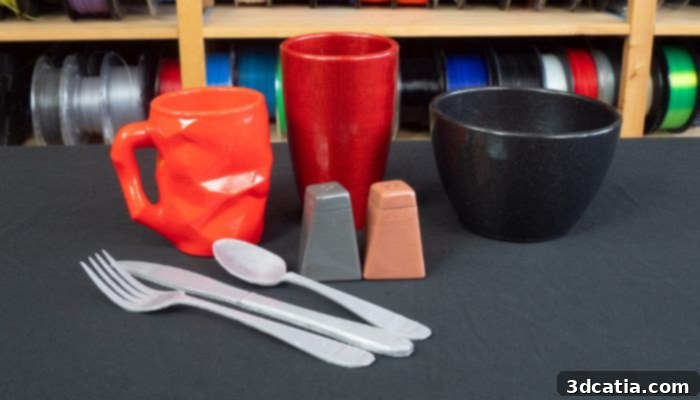
Parts made by Prusa to test food safety (photo credits: Prusa Original 3D Printers)
Furthermore, many leading material manufacturers, such as BASF and igus, actively develop and market their own lines of specialized “food-grade” or “food-safe” materials specifically formulated to meet stringent regulatory conditions. These materials undergo rigorous testing and certification processes, offering a higher degree of assurance for demanding applications. However, it is crucial to understand that merely selecting a food-safe material is only the initial step. The resulting 3D printed part will not automatically be food safe; its safety is also profoundly influenced by the manufacturing process itself.
How to Ensure Food-Safe 3D Printing Across Different Processes
As previously highlighted, while material selection is fundamental, it represents only the first layer of ensuring food safety in 3D printing. Even when utilizing FDA-approved materials, the additive manufacturing process itself can introduce contaminants or structural issues that compromise a part’s food-safe status. Let’s delve into how popular 3D printing technologies—FDM, SLS, and resin-based methods—impact the final part’s suitability for food contact and what measures can be taken.
**FDM (Fused Deposition Modeling) 3D Printing:** FDM technology remains the most prevalent and accessible 3D printing process, especially for hobbyists and individual makers. It’s often the go-to for creating customized cookie cutters, cake toppers, or even prototype kitchen utensils. However, the FDM process, by its very nature, is not inherently food safe, necessitating several critical considerations to mitigate risks.
Firstly, attention must be paid to the 3D printer’s nozzle. The vast majority of consumer-grade 3D printers come equipped with brass nozzles. A significant concern here is that brass can contain trace amounts of lead, which can leach into the filament during extrusion and subsequently contaminate the printed part. The safest and recommended alternative is a stainless steel nozzle, as this material is FDA-approved for food contact and is free from such heavy metals. Additionally, ensure that any PTFE (Teflon) tubing in the hotend path, commonly found in Bowden setups, does not extend into areas of high heat where it could degrade and release toxic fumes. Ideally, a direct drive extruder, which minimizes the PTFE tube’s presence in the heated zone, is preferable. Beyond hardware, meticulous printer hygiene is paramount. Before printing any food-contact item, the 3D printer must be thoroughly cleaned. This involves removing any residual material from previous prints that might be toxic, as well as ensuring the print bed and nozzle are free from dust, debris, and potential bacterial growth.
Despite these precautions, FDM 3D printing still presents a significant challenge to food safety due to its inherent layer-by-layer deposition method. This process invariably leaves microscopic gaps and crevices between layers, as well as an overall porous surface finish. These tiny voids are perfect breeding grounds for bacteria, allowing food particles and moisture to become trapped and nearly impossible to clean effectively, even with vigorous washing. This porosity fundamentally compromises the “easily cleanable” and “non-absorbent” requirements of food safety. For this reason, FDM-printed parts intended for food use are often recommended for single-use applications only. For any repeated use, extensive post-processing is absolutely essential.
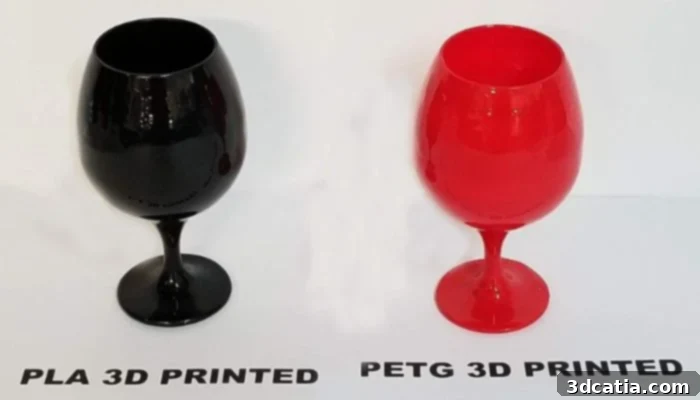
Food-safe coating can help make 3D printed parts more suitable for use with food (photo credits: The Epoxy Experts)
**Post-Processing: The Food-Safe Seal for Porous Parts:** The most effective method to render porous 3D printed parts, particularly those from FDM or SLS, suitable for food contact is through rigorous post-processing involving smoothing and coating. Smoothing techniques can reduce surface roughness, but applying a food-safe sealant is crucial. Materials such as FDA-compliant epoxy resins or food-grade silicone coatings can effectively seal all micro-cracks and pores on the part’s surface. This creates a watertight, non-absorbent, and smooth barrier that prevents food particles from getting lodged and significantly simplifies cleaning and sanitation. It transforms the uneven, layered surface into one that meets hygienic standards.
However, it’s vital to remember that even the most robust coatings can degrade or wear down over time, especially with repeated use, washing, or exposure to abrasives. This means that while a coated part might not be single-use, any 3D printed polymer item, even with a food-safe coating, should not be in continuous, long-term contact with food or subjected to extensive, heavy-duty use. Regular inspection for signs of wear and reapplication of coating, or replacement of the part, is necessary.
**Resin (SLA/DLP/LCD) 3D Printing:** Generally, resin 3D printing processes are not considered food safe due to the inherent toxicity of liquid resins. Even after printing, uncured resin can remain on the surface or within the part, posing a significant health risk. While resin prints typically boast much smoother surfaces than FDM parts, which aids in cleaning, the toxic nature of the raw material necessitates extreme caution. Thorough post-curing is critical to polymerize the resin fully, but even then, direct food contact is usually not recommended. If a resin-printed part is intended for food contact, it must be completely and uniformly covered with an FDA-approved, food-safe coating, much like FDM parts, to create a barrier between the resin and the food.
**SLS (Selective Laser Sintering) 3D Printing:** SLS 3D printing presents a slightly different set of considerations. While it avoids the issues related to brass nozzles or highly toxic liquid resins, SLS parts, particularly those printed with nylon (a common SLS material), are inherently porous. This porosity, similar to FDM, can harbor bacteria and make thorough cleaning difficult, compromising food safety standards. Therefore, for SLS parts intended for food contact, applying a food-safe coating is strongly recommended to seal the surface and create a non-porous, cleanable barrier.
In conclusion, while achieving food-safe 3D printing is certainly possible, it is not a task to be taken lightly and is not without its risks. Safety considerations must always be the utmost priority when creating anything that will interact with food, especially to ensure the health and well-being of consumers. This is precisely why all items destined for contact with consumable products undergo rigorous testing and certification processes. However, by carefully selecting FDA-approved, food-grade materials, opting for appropriate printer components like stainless steel nozzles, maintaining impeccable printer hygiene, and critically, applying effective food-safe post-processing coatings to seal porous surfaces, you can confidently use your 3D printer to create safe and functional items such as novelty cookie cutters, custom molds, or even unique cutlery. Always err on the side of caution and prioritize consumer safety above all else.
What do you consider the most important aspect of food-safe 3D printing? Have you successfully made parts that come into contact with food? Share your insights and experiences in the comments below or connect with us on our LinkedIn, Facebook, and Twitter pages! Don’t forget to sign up for our free weekly newsletter here for the latest 3D printing news delivered straight to your inbox! You can also find all our videos on our YouTube channel.
*Cover Photo Credits: Gregoware on Cults