
This week, we delve into the forefront of additive manufacturing, showcasing five of the most breathtaking and truly unbelievable 3D printing innovations that are redefining what’s possible. From stunning full-color creations that capture every nuance to life-changing prosthetic limbs and revolutionary mobile scanning capabilities, the advancements highlighted here are pushing the boundaries of technology. These breakthroughs not only demonstrate the rapid evolution of 3D printing but also its profound impact across various industries, from art and design to healthcare and industrial production. Join us as we explore how companies like Mimaki, Open Bionics, Qlone, HP, and Structo Velox are shaping the future, one layer at a time. A new compilation of the most exciting developments in 3D printing is released every Sunday, so be sure to check back next week for more groundbreaking updates!
1 – Mimaki: The Dawn of True Full-Color 3D Printing
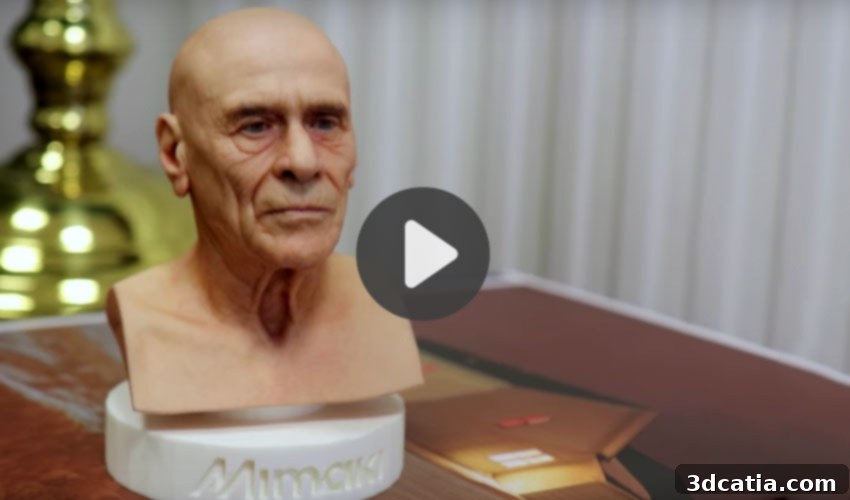
A few months ago, the world of 3D printing was abuzz with the announcement from Mimaki regarding their groundbreaking 3D printer, capable of reproducing an astonishing palette of over 10 million different colors. This monumental achievement marked a significant leap forward, moving beyond monochrome or limited-color prints to usher in an era of unparalleled realism and vibrancy in 3D models. Mimaki’s technology, utilizing UV-curable inkjets, can jet and cure multiple inks simultaneously, creating intricate color gradients and faithful reproductions of digital designs. The true power of this innovation was recently demonstrated when Mimaki took a 3D scan of a man and produced an incredibly detailed, full-color model of his face. The resulting replica was not merely a physical object but a lifelike portrait, capturing the subtle tones, textures, and details that were previously unattainable in 3D prints. This vivid demonstration underscores the transformative potential of Mimaki’s technology in fields requiring high fidelity color, such as architectural modeling, medical education, detailed prototyping for consumer products, and particularly in the replication of portraits and artistic creations. The ability to precisely control color at a microscopic level opens up new avenues for designers, artists, and engineers, allowing them to bring their digital visions to life with unprecedented accuracy and aesthetic richness. It truly signifies how powerful and advanced 3D printing has become in the pursuit of realistic and expressive replication.
2 – Open Bionics: Revolutionizing Lives with 3D Printed Prostheses
Open Bionics, a pioneering British company, is at the forefront of a profound revolution in the field of prosthetics. Their mission is clear: to empower amputees and significantly improve their quality of life by making advanced, custom-designed prosthetic limbs more accessible and enjoyable. Traditional prosthetics are often expensive, heavy, and lack personalization, leading to discomfort and self-consciousness. Open Bionics addresses these challenges head-on by leveraging the incredible potential of 3D printing. The process begins with a precise 3D scan of each individual’s amputated limb, allowing for the creation of a perfectly customized prosthetic that fits comfortably and functions optimally. This personalized approach ensures a superior fit, reduces bulk, and enhances the overall user experience. Beyond mere functionality, Open Bionics has taken a groundbreaking step in psychological empowerment, especially for younger users. They have secured visionary deals with entertainment giants like Disney, Marvel, and Star Wars, enabling them to design prosthetics inspired by beloved characters such as Iron Man, Elsa from Frozen, and various Star Wars heroes. These “Hero Arms” transform a medical device into an exciting, aspirational accessory, helping children feel proud and confident about their prosthetics rather than self-conscious. This innovative blend of advanced 3D printing technology and imaginative design not only provides functional benefits but also addresses the emotional and social aspects of living with a limb difference, truly helping amputees, particularly children, live a more normal and fulfilling life with a renewed sense of self-esteem.
3 – Qlone: The Mobile 3D Scanning Revolution in Your Pocket
The accessibility of 3D scanning has traditionally been limited by the cost and complexity of specialized hardware. However, Qlone is changing this paradigm, transforming your everyday smartphone into a powerful and intuitive 3D scanner. This innovative app democratizes 3D modeling, making it available to anyone with a smartphone. The brilliance of Qlone lies in its simplicity and effectiveness. Users merely need to print out Qlone’s unique QR code paper, which serves as a specialized mat, and place the object they wish to scan directly onto it. The smartphone app then guides the user to capture the object from various angles, utilizing augmented reality (AR) to ensure comprehensive coverage. The QR code acts as a calibration marker, allowing the app to accurately reconstruct the object’s geometry and texture with surprising detail and precision. Once the scanning process is complete, the digital 3D model can be easily exported in a variety of widely recognized file formats, including the ubiquitous STL file, OBJ, and PLY. This versatility means that the scanned object can be immediately sent to a 3D printer for physical replication, stored digitally for future use or archiving, or effortlessly shared with friends, colleagues, or even other makers across the globe. Qlone represents a significant leap towards integrating 3D technology into daily life, empowering creators, educators, small businesses, and enthusiasts to easily bridge the gap between physical objects and digital models, paving the way for endless possibilities in design, prototyping, and personalized manufacturing.
4 – HP Jet Fusion: Advancing Industrial 3D Printing with Voxel-Level Control
HP’s entry into the additive manufacturing space with its Multi Jet Fusion (MJF) technology has significantly disrupted the industrial 3D printing landscape. Following the recent unveiling of four brand new 3D printers within their Jet Fusion 300 and 500 series ranges, HP has been actively demonstrating the remarkable advancements and improvements these machines bring to the market. These new printers represent a pivotal moment, being among the very first to achieve true voxel-level accuracy – a “3D pixel” that allows for incredibly fine-grained control over material properties and color at an unprecedented scale. This granular control means that designers and engineers can now create parts with extremely detailed features, intricate textures, and full-color capabilities, all within a single build. The ability to manipulate properties at the voxel level opens up a myriad of opportunities for custom materials with varying densities, textures, and even electrical conductivities embedded directly within a part, leading to highly functional and complex components. HP has also strategically collaborated with leading design software providers, notably Solidworks, to expand the design possibilities further. This partnership ensures seamless integration from design to print, streamlining workflows and enabling engineers to fully harness the power of voxel-level design in their creations. The HP Jet Fusion series is setting new benchmarks for speed, cost-effectiveness, and part quality in industrial 3D production, making advanced manufacturing more accessible and efficient for a broader range of applications, from functional prototyping to end-use parts across diverse industries like automotive, healthcare, and consumer goods.
5 – Structo Velox: The Future of Automated Dental 3D Printing
The dental industry has been one of the earliest and most successful adopters of 3D printing technology, revolutionizing the way custom dental implants, crowns, bridges, and aligners are manufactured. Companies like 3D Systems and Formlabs have already made significant contributions, enabling dental professionals to produce highly accurate, customized components with greater efficiency than traditional methods. However, Structo, with its groundbreaking Velox system, is poised to elevate dental 3D printing to an entirely new level by introducing unparalleled automation. The Structo Velox differentiates itself by offering a fully-automated dental printing solution that encompasses not just the printing process but also crucial post-processing steps. This integrated approach significantly streamlines the workflow, reduces manual labor, minimizes human error, and accelerates production times for dental labs and clinics. The Velox system, leveraging advanced resin 3D printing technology, is designed for high throughput and consistent quality, capable of producing a vast array of dental applications from models for aligners and retainers to surgical guides and custom trays. Its automation capabilities, including automated washing and curing cycles, mean that a dental professional can initiate a print run and return to perfectly finished, ready-to-use parts, dramatically increasing laboratory efficiency and patient turnaround. This resin 3D printer represents a significant step towards a fully digital and automated dental workflow, promising to deliver even more precise, consistent, and cost-effective dental solutions. With its imminent release, the industry watches with anticipation to see the full impact and widespread adoption of this highly automated system, which holds the potential to redefine the standards of dental manufacturing and patient care.
The rapid pace of innovation in 3D printing continues to astound us, as evidenced by this week’s incredible lineup of breakthroughs. From the artistic fidelity of Mimaki’s full-color prints and the life-changing impact of Open Bionics’ prosthetics to the everyday accessibility offered by Qlone’s mobile scanning, the industrial prowess of HP’s voxel-level control, and the automated efficiency of Structo Velox in dentistry, these developments are not just incremental; they are truly transformative. Each innovation highlights the immense potential of additive manufacturing to solve complex problems, inspire creativity, and improve lives across a multitude of sectors. What are your thoughts on this week’s Top 5 Videos? We invite you to share your insights and engage with us in the comments section below, or join the conversation on our vibrant Facebook and Twitter pages! For those eager to stay at the cutting edge of this dynamic industry, don’t forget to sign up for our free weekly Newsletter, ensuring all the latest news and vital updates in 3D printing are delivered directly to your inbox!