

The Evolving Landscape of 3D Printed Firearms: Unpacking the Rise of Ghost Guns and Their Global Implications
The proliferation of 3D printed firearms represents a significant and rapidly evolving challenge for law enforcement agencies and governments worldwide. A recent report published in March 2024 by the United States National Library of Medicine (NLM), titled “The Emergence of 3D-printed Firearms: An Analysis of Media and Law Enforcement Reports,” shed critical light on this phenomenon. The comprehensive study meticulously gathered data from 186 reported cases involving 3D printed firearms and their components, revealing a disturbing trend: an overwhelming 92% of these incidents occurred in North America, Europe, or Oceania. Even more striking was the NLM’s primary finding: a dramatic and sharp increase in reported cases involving these weapons since 2021.
This alarming surge in the use and discovery of 3D printed guns is not merely an academic observation; it is visibly corroborated by the growing number of mainstream media headlines dedicated to the subject. These untraceable weapons, often referred to as “ghost guns” due to their lack of serial numbers, are increasingly making their way into criminal hands. A stark example of this occurred just this past October, in a high-profile case in Indiana, where an individual received a seven-year federal prison sentence. His crime? Illegally manufacturing and distributing 3D printed ghost guns and “Glock switches,” which are components that can convert a standard semi-automatic pistol into a fully automatic machine gun. Such incidents underscore that the issue is far from isolated; it has become a pervasive global concern. Consequently, governmental bodies across the United States, Canada, Australia, and Europe, among many others, are actively grappling with how to effectively address this complex and burgeoning threat.
To truly understand the gravity of this situation, it’s essential to delve into several key questions: How did the concept of 3D printed guns first emerge? What specific additive manufacturing technologies are being utilized for their creation? Is the perceived threat of these homemade firearms genuinely escalating, and if so, what are the underlying reasons? Furthermore, what might the future landscape of this issue look like as technology advances and regulatory efforts intensify? This article aims to explore these critical aspects, providing a comprehensive overview of 3D printed firearms, from their controversial origins to their present-day impact and potential future trajectory.
Cody Wilson: The Architect of the First 3D Printed Gun
The story of 3D printed firearms traces its contentious origins back to 2012, when Cody Wilson, a self-described crypto-anarchist and then-law student at the University of Texas, publicly announced his audacious plan. His vision was to make firearm designs open-source, thereby empowering any individual with a 3D printer to fabricate a weapon in the privacy of their own home. Wilson’s ideology was deeply rooted in the belief that digital information, including blueprints for weapons, should be freely accessible and beyond government control. In pursuit of this goal, he left his law studies in 2013 to fully dedicate himself to the development and dissemination of 3D printable gun designs. This commitment led to the founding of Defense Distributed, an organization he characterizes not as a typical tech business but as a “nonprofit defense organization” dedicated to combating what he perceives as government censorship and advocating for individual liberties, particularly the right to bear arms.
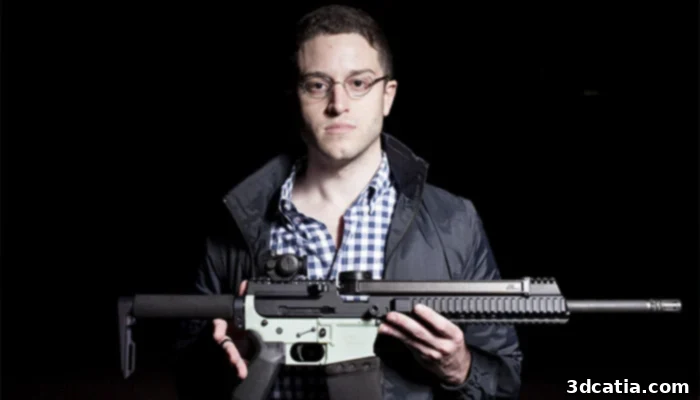
Cody Wilson, a central figure in the 3D printed gun movement.
In 2013, Defense Distributed achieved a landmark moment: the release of the very first CAD (computer-aided design) file for a fully functional 3D printed gun, dubbed “The Liberator.” This digital blueprint was made available online for free download to anyone across the globe. The file immediately went viral, garnering an astonishing more than 100,000 downloads within just two days. This rapid and widespread dissemination quickly caught the attention of the US Government, which swiftly demanded that Defense Distributed remove the controversial file from their website, initiating what would become a protracted and complex legal struggle over the legality and accessibility of these digital weapon designs.
A Complex and Ongoing Legal Battle in the US Over 3D Printed Firearms
The US Government’s demand to remove the Liberator files marked the beginning of an intricate and enduring legal battle between Cody Wilson’s Defense Distributed and federal authorities. This legal saga continued for several years, reaching a pivotal moment in 2018 when the Trump administration seemingly legalized 3D printed guns, or at least the online sharing of their digital blueprints, through a settlement that allowed Defense Distributed to publish its files again. However, this period of relative freedom for Defense Distributed was soon complicated by personal legal issues for Wilson himself; he was charged with sexual assault of an underage girl in the same year, forcing him to step down from the organization. Despite his departure, Defense Distributed continued its operations. Following a plea deal in 2019, Wilson eventually rejoined the company, resuming his controversial advocacy.
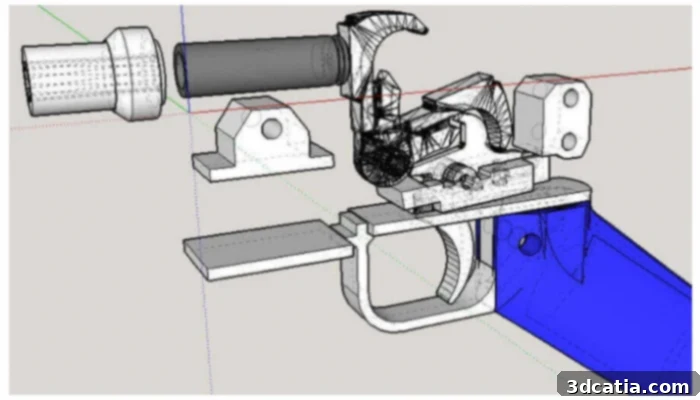
A digital rendering showcasing a common 3D printed gun design.
Also in 2019, the legal landscape shifted once more when a federal judge in Seattle ruled against the broad legalization of 3D printed firearms, deeming it unlawful and imposing a temporary blockage on Defcad, Defense Distributed’s online platform. In direct response to this renewed restriction, a new, more decentralized network of gun activists emerged: Deterrence Dispensed. This group differentiates itself from Defense Distributed by its inherently distributed structure, making it significantly more challenging for authorities to regulate or shut down. Despite their structural differences, both Defense Distributed and Deterrence Dispensed operate under a shared ideological framework, heavily relying on their interpretation of the Second Amendment of the US Constitution. They frequently cite the amendment’s declaration: “A well-regulated Militia, being necessary to the security of a free State, the right of the people to keep and bear Arms, shall not be infringed,” as foundational to their belief in the unequivocal right of individuals to possess firearms, including those they manufacture themselves.
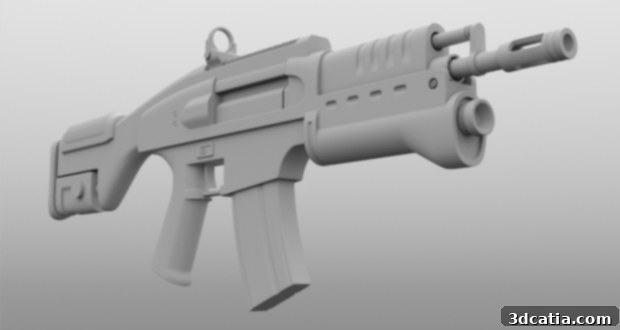
A detailed 3D model illustrating a firearm design.
The contentious legal struggle between gun rights advocates and the US Government continued unabated into early 2020. A formidable coalition of 20 states and the District of Columbia collectively filed a lawsuit against the federal government, challenging the Trump Administration’s controversial decision to permit the widespread online sharing of 3D printed gun files. This intensified the pressure on federal agencies to act. In 2021, the US Department of Justice (DOJ) responded by proposing crucial updates to existing firearm definitions. The core of this proposal was to expand the legal definition of “firearm” to explicitly include unserialized, privately made firearms, encompassing those created using 3D printing technology. The intent was clear: to subject these “ghost guns” to the same stringent regulations and oversight as conventionally manufactured firearms, thereby closing a significant loophole in gun control legislation.
The DOJ’s proposed rule officially came into effect in 2022, marking a significant step towards regulating these untraceable weapons. However, its implementation was immediately challenged, and in 2023, a federal district court judge issued a ruling against the regulation, temporarily overturning it. This decision triggered a series of appeals, pushing the highly divisive issue all the way to the Supreme Court. On October 8th, 2024, the case was finally argued before the nation’s highest court. While a definitive final decision from the Supreme Court is still pending, preliminary observations from the arguments suggested that the justices appeared open to siding with the regulation, signaling a potential affirmation of the DOJ’s efforts. In the interim, the rule remains in effect, ensuring that 3D printed firearms are currently subject to the same regulatory framework as their traditionally manufactured counterparts. This ongoing legal ebb and flow highlights the deep divisions and profound societal implications surrounding the accessibility and control of 3D printed weaponry.
Exploring the Diverse Types of 3D Printed Firearms
A primary concern surrounding 3D printed firearms, and indeed the driving force behind recent regulatory efforts, is their inherent untraceability. This characteristic is precisely why they are colloquially known as “ghost guns.” Lacking commercial serial numbers or any other identifying marks, these weapons pose a significant challenge for law enforcement seeking to trace their origin or ownership after an incident. The very first fully 3D printed plastic gun to gain notoriety was “The Liberator .380,” famously designed and released by Cody Wilson in 2013. This single-shot pistol was predominantly made from plastic using Fused Deposition Modeling (FDM) technology on a Stratasys Dimension SST 3D printer. While largely plastic, The Liberator still required a crucial metal component: a steel nail to serve as the firing pin. A terrifying, defining characteristic of such plastic firearms, and a major reason for fear, is their ability to potentially bypass traditional metal detectors, making them an insidious threat in security-sensitive environments.
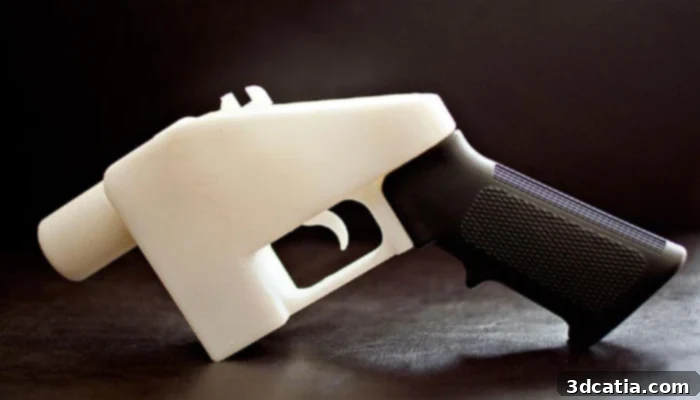
The infamous Liberator, the pioneering 3D printed plastic firearm.
More recently, a new and arguably more potent model of a 3D printed firearm has emerged, with its initial designs published in 2020 by the decentralized group Deterrence Dispensed. This weapon, controversially named the FGC-9 (an acronym for “F*** Gun Control”), is a semi-automatic, pistol-caliber carbine that has rapidly gained traction in criminal circles globally. The New York Times, in a video report from September 2024, documented the use of the FGC-9 in at least 15 countries. They highlighted its deployment by criminal organizations in Australia, Spain, the UK, and France, and most notably, by an anti-government rebel group in Myanmar. What makes the FGC-9 uniquely threatening is that, unlike many other 3D printed firearms that might incorporate some regulated components, none of the parts required for its construction are subject to regulation. This means the FGC-9 can be entirely printed from scratch, significantly increasing its accessibility and posing an even greater challenge to conventional arms control measures.
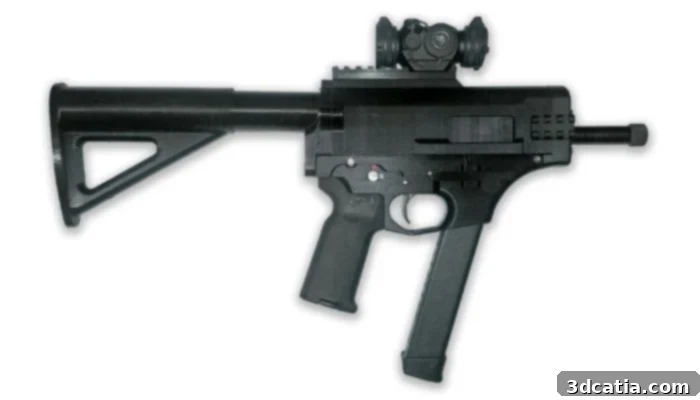
The FGC-9, a potent and entirely 3D printable firearm. (Photo credits: JStark1809 / Deterrence Dispensed)
While plastic 3D printed firearms like The Liberator and the FGC-9 are widely known, the capabilities of additive manufacturing extend to creating far stronger and more reliable weapons using metal 3D printing. A notable milestone in this area was achieved by Solid Concepts, an additive manufacturing company based in California (later acquired by Stratasys in 2014). In 2013, they produced the world’s first 3D printed metal gun: a fully functional replica of the iconic Browning 1911 handgun. This groundbreaking weapon was built using Direct Metal Laser Sintering (DMLS) technology. Critically, this metal 3D printed handgun demonstrated remarkable durability, capable of firing over 600 bullets without sustaining any significant damage, showcasing the immense potential for strength and reliability offered by metal additive manufacturing.
Metal 3D printed guns offer significantly enhanced reliability and longevity compared to their plastic counterparts. However, they remain largely out of reach for the average individual due to the prohibitive costs associated with the technology. For instance, the DMLS metal printer used to fabricate the Solid Concepts 1911 weapon carried a price tag of between $500,000 and $1 million at the time of its creation in November 2013. Even the finished gun itself was sold for a substantial $11,900 apiece. Despite these high costs, the technology and the sophistication of models created through metal 3D printing have advanced dramatically since Solid Concepts introduced its pioneering firearm in 2013. Today, it is technically possible to print a wide array of fully functional and operationally effective weapons, including advanced assault rifles, light machine guns, sniper rifles, and their corresponding accessories, all using industrial-grade metal 3D printers. While not accessible to the masses, this capability represents a significant leap in the potential for illicit, high-performance weaponry.
The Advanced Technology Powering 3D Printed Guns
Understanding the “how” behind 3D printed firearms requires a look into the additive manufacturing process itself. It’s important to clarify that a standard desktop 3D printer cannot fabricate an entire, complex, functional firearm in a single, monolithic piece. Instead, the individual components – such as the receiver, slide, barrel, and grip – are all printed separately. These distinct elements are then meticulously assembled manually to create the complete weapon. This process is often lengthy and can be quite challenging, requiring a degree of technical skill and patience. However, to circumvent some of the difficulties, kits for assembling these weapons are becoming increasingly available, simplifying the process and making the final assembly the primary remaining step for the end-user.
For manufacturing plastic firearms, particularly with FDM (Fused Deposition Modeling) 3D printers, users typically choose from a range of thermoplastics. The most commonly employed materials are PLA (Polylactic Acid) and ABS (Acrylonitrile Butadiene Styrene). Each has its own characteristics and limitations when used for firearms. PLA, while easy to print with, is generally softer and thus prone to quicker deformation under stress, making it less ideal for repeated firing. ABS is a more robust and rigid plastic; however, its tendency is to crack and break rather than deform when subjected to extreme forces, which can also compromise the structural integrity of a printed gun. The durability of a 3D printed thermoplastic gun can vary wildly. In some instances, a poorly designed or printed weapon might fail after firing just a single bullet. Conversely, expertly designed and robustly printed guns, utilizing optimized geometries and quality materials, have demonstrated the capacity to withstand thousands of rounds. As 3D printing technology continues its rapid advancement, accompanied by the development of new and stronger materials specifically engineered for high-stress applications, the overall quality, reliability, and destructive potential of 3D printed guns are continuously improving, presenting an ongoing challenge for regulation and safety.
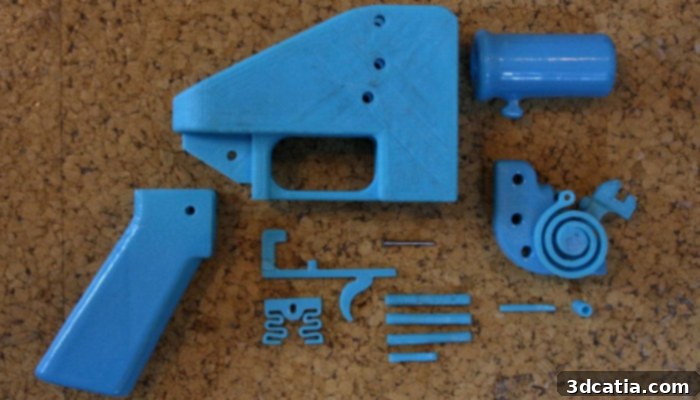
The disassembled components of The Liberator, ready for assembly.
Debate and Controversy: The Dual Nature of 3D Printed Weapons
The emergence of 3D printed firearms has ignited intense debate, creating a clear divide between proponents of gun rights and advocates for stricter gun control, a conflict vividly reflected in the ongoing legal battles across the United States. A primary concern for gun control activists and law enforcement is the untraceable nature of these “ghost guns.” Their lack of serial numbers makes it incredibly difficult, if not impossible, to identify a shooter or track the weapon’s origin after a crime, severely hampering criminal investigations. Furthermore, a significant objection revolves around the complete absence of background checks for the makers and owners of 3D printed firearms. This loophole allows individuals who would typically be disqualified from legal gun ownership – such as those with mental illnesses, convicted felons, or minors – to easily 3D print a firearm, effectively bypassing established safety protocols designed to keep weapons out of dangerous hands.
The inherent safety threat posed by plastic 3D printed guns is further amplified by their potential to circumvent traditional security measures. Depending on the sensitivity and calibration of security equipment, these plastic weapons may fail to trigger metal detectors, making them exceptionally difficult to detect in high-security areas. A chilling demonstration of this vulnerability occurred in 2013 when three reporters from the Daily Mail successfully 3D printed a Liberator pistol using a printer costing less than $2,000. They then boarded a Eurostar train with the disassembled plastic gun. Because the weapon was primarily plastic, it did not set off metal detectors, allowing the reporters to smuggle parts in their individual pockets. The Liberator was subsequently reassembled in the train’s toilet cabin, underscoring the alarming ease with which deadly weapons could be smuggled into relatively high-security environments like airports and train stations, presenting a critical challenge for public safety.

A Daily Mail reporter demonstrating a 3D printed gun’s potential to bypass security on a Eurostar train. (Photo Credit: The Daily Mail)
While the security risks associated with 3D printed firearms are undeniably grave, there exists another facet to this complex issue: groups of dedicated gun enthusiasts who embrace these weapons for recreational purposes. In 2020, such a community formed the Gun Maker’s Match (GMM) in Pennsylvania, establishing what has now become an annual shooting contest. Participants in this unique event compete using firearms they have personally 3D printed, showcasing their technical skills and exercising what they view as their Second Amendment rights. According to GMM’s official website, they advocate that “Making your gun is a fun, educational activity for firearms enthusiasts.” In a blog post, the organization eloquently articulated its work as representative of the “other side” of the 3D printed gun narrative, emphasizing the activities of “hobbyists having fun and exercising their rights responsibly.” This perspective highlights the cultural divide and the differing interpretations of personal liberty and public safety that fuel the ongoing debate.
Are 3D Printed Firearms and Parts Becoming More Common and Why?
The NLM report’s finding of a significant uptick in reported cases involving 3D printed firearms and parts since 2021 raises critical questions about the underlying reasons for this surge. The report identifies 3D printing guns as a “cost-effective and reliable alternative to conventional firearms,” attributing their production to a complex interplay of political, economic, social, cultural, and historical motives. A primary driver of their widespread appeal appears to be their inherent accessibility. Unlike purchasing traditional firearms, there is no requirement for background checks to manufacture these weapons, making them readily available to individuals who might otherwise be legally prohibited from owning guns. Furthermore, the NLM’s report highlights that producers predominantly utilize entry-level equipment and do not necessarily require high-end materials, lowering the barrier to entry significantly. While background checks are a cornerstone of conventional gun control, intended to prevent firearms from falling into the wrong hands, the DIY nature of 3D printing circumvents this crucial, albeit not foolproof, security method.
Another intriguing aspect reported by the NLM is the growing popularity of 3D printed guns “in various regions, irrespective of the severity of firearm regulations and culture, and not just as a last-resort option.” This observation suggests that the demand for these weapons transcends specific legal frameworks or societal norms. The report concludes that this trend “reflects their broad appeal and indicates a demand that cuts across diverse regulatory landscapes.” In essence, regardless of the strictness of local gun laws, 3D printed firearms are demonstrating an increasing presence, challenging the effectiveness of existing regulatory measures and indicating a global demand that existing legislation struggles to contain.
However, it’s crucial to consider how domestic laws and their shifts impact the prevalence of 3D printed guns, particularly within the United States. In a 2022 press release, the White House stated that “20,000 suspected ghost guns were reported as being found by law enforcement in criminal investigations in 2022—a tenfold increase from 2016.” While this statistic is alarming, it’s important to acknowledge that 3D printed guns and their files were more or less legally accessible and shareable from 2018 until the enforcement of the DOJ’s rule in 2022. This period of diminished regulation could partially explain the significant increase in their presence and discovery by law enforcement during those years, illustrating the direct correlation between regulatory frameworks and the proliferation of these weapons.
Regardless of specific legal interpretations and historical contexts, the NLM report unequivocally claims a strong potential for 3D printed firearms to become even more widespread, consequently demanding heightened attention from law enforcement agencies globally. This is an almost inevitable outcome as the technology for 3D printing guns continues its relentless advancement, forcing police and security forces to constantly adapt and evolve their countermeasures. While it is true that a minority of 3D printed firearms might be used for legitimate recreational purposes, the overwhelming majority of headlines and criminal investigations clearly suggest their predominant use in violent acts. This stark reality underscores the urgent and pressing need for robust, comprehensive, and adaptable legislation and regulation to effectively mitigate the growing threats posed by these untraceable and easily manufactured weapons. For a more detailed understanding, the full NLM report can be accessed here.
What are your thoughts on the complex and controversial issue of 3D printed guns? We invite you to share your perspective in a comment below or join the conversation on our Facebook and Twitter pages! Don’t miss out on the latest advancements and news in additive manufacturing—sign up for our free weekly Newsletter to have all the critical updates delivered straight to your inbox!