
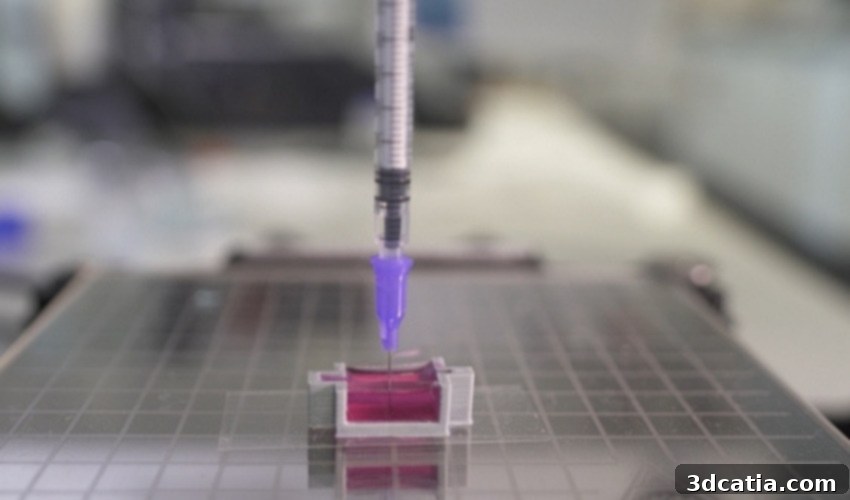
Revolutionary Ceramic Bioink: 3D Printing Living Bone for Advanced Regenerative Medicine
In a groundbreaking stride for medical science and additive manufacturing, scientists at the University of New South Wales (UNSW Sydney), a distinguished research and teaching institution in Australia, have engineered an innovative ceramic-based ink. This pioneering material holds the potential to enable surgeons to 3D print functional bone parts complete with living cells, directly at the point of care. The field of 3D printing has experienced an exponential rise in its application within the medical sector, with implants garnering significant attention. This surge is primarily due to 3D printing’s unparalleled capability to craft highly personalized biomedical devices, perfectly tailored to individual patient anatomies and needs. The development of this new ceramic ink, fundamentally distinguished by its inclusion of viable living cells, represents a monumental leap forward. This innovation paves the way for a future where custom-made, biologically active implants can be fabricated and integrated seamlessly into surgical procedures, potentially transforming patient outcomes and reducing recovery times.
Unlocking the Potential of Bioprinting: The COBICS Technique
This visionary project falls under the exciting umbrella of bioprinting, an advanced methodology dedicated to constructing complex cellular structures from specialized bioinks laden with stem cells. At its core, bioprinting mirrors many conventional additive manufacturing techniques, but with a biological twist: living cells and sophisticated biomaterials are meticulously combined and deposited layer by layer. The ultimate objective is to create intricate biomedical models that faithfully replicate the structural and functional properties of living tissues and organs. The past few years have witnessed extraordinary progress in this nascent field. Cutting-edge laboratories worldwide have already made significant headway, successfully bioprinting intricate human tissues and even rudimentary organs such as livers, kidneys, and even hearts. While 3D printing has been utilized for medical implants, particularly in bone reconstruction, the ability to embed living cells directly into a 3D printed structure during fabrication marks a paradigm shift, setting this UNSW innovation apart as a truly transformative advancement.
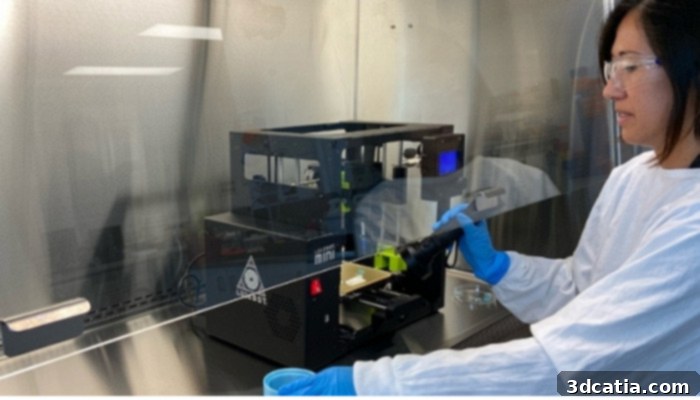
A scientist from the project prepares to 3D-print a piece of bone using the COBICS technique. (photo credits: UNSW)
Dr. Iman Roohani, a leading scientist from UNSW’s School of Chemistry and a key contributor to this pioneering endeavor, articulated the profound implications of their work: “This is a unique technology that can produce structures that closely mimic bone tissues. It could be used in clinical applications where there is a large demand for in situ repair of bone defences such as those caused by trauma, cancer, or where a big chunk of tissues is resected.” Dr. Roohani further highlighted the unprecedented nature of this breakthrough, stating that it is the first time 3D printed bone-mimicking structures can be created at physiological room temperature, fully integrated with living cells, and crucially, without the need for harsh chemicals that are typically detrimental to cell viability. The scientists achieved this feat by formulating a specialized ink derived from calcium phosphate. This compound is naturally occurring in bones and teeth, and is widely recognized for its biocompatibility and its use in supplements to address calcium deficiencies. This innovative calcium phosphate ink is employed in a 3D printer using a proprietary technique developed by the UNSW team, named Ceramic Omnidirectional Bioprinting in Cell-Suspensions, or COBICS. This ingenious method enables the creation of intricate, bone-like structures that subsequently harden upon immersion in water, ready for biological integration.
The Power of Personalization: Why 3D Printing is Critical for Bone Regeneration
The new ceramic bioink masterfully leverages one of 3D printing’s most compelling advantages: the unparalleled ability to customize and fabricate parts on-demand, achieving a superior fit and functionality compared to traditionally manufactured components. Associate Professor Kristopher Kilian, another pivotal member of the research team, articulated the profound clinical implications: “The cool thing about our technique is you can just extrude it directly into a place where there are cells, like a cavity in a patient’s bone. We can go directly into the bone where there are cells, blood vessels and fat, and print a bone-like structure that already contains living cells, right in that area.” This direct, in-situ printing capability bypasses many of the challenges associated with conventional bone grafting. Currently, surgeons often rely on autografts (bone taken from the patient’s own body) or allografts (bone from a donor). Both methods have significant drawbacks; autografts can cause additional pain and complications at the donor site, while allografts carry risks of immune rejection and disease transmission. The COBICS technique offers a revolutionary alternative, enabling the creation of bespoke bone structures that perfectly match the patient’s anatomy, potentially minimizing surgical complexity, accelerating healing, and vastly improving long-term integration.
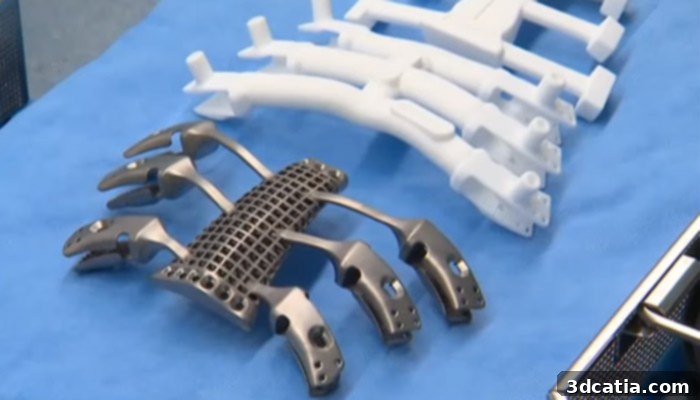
Previous projects in replacing bone through 3D printing has used titanium. The ability to put in bone with real cells would be a huge advancement in bioprinting. (photo credits: 7News Australia; Anatomics)
The combination of this innovative ink with a collagenous substance, which effectively suspends and nurtures living cells, facilitates the direct, in-situ fabrication of bone-like tissues. This breakthrough holds immense promise for a diverse range of applications within regenerative medicine. These include sophisticated bone tissue engineering, where complex bone structures can be rebuilt; advanced disease modeling, providing more accurate in-vitro systems for studying skeletal pathologies; enhanced drug screening, allowing for more biologically relevant testing platforms; and crucially, the precise in-situ reconstruction of complex bone and osteochondral defects resulting from trauma, disease, or congenital abnormalities. Associate Professor Kilian envisions a future transformed by this technology: “I imagine a day where a patient needing a bone graft can walk into a clinic where the anatomical structure of their bone is imaged, translated to a 3D printer, and directly printed into the cavity with their own cells. This has the potential to radically change current practice, reducing patient suffering and ultimately saving lives.” This vision underscores the profound impact of personalized regenerative therapies, offering hope for countless individuals facing severe bone loss or damage.
While the full clinical implementation of this technology is still some way off, requiring crucial in vivo tests in animal models to ascertain the long-term viability and integration of the living cells within existing bone tissue, this development marks a truly significant stride forward for the medical industry and the field of regenerative medicine. The successful integration of living cells into 3D printed bone structures at room temperature and without harsh chemicals addresses major hurdles in bioprinting. This research brings us closer to a future where surgeons could routinely employ 3D printers directly in the operating room. Such a capability would allow for the immediate, on-demand creation of implants precisely tailored to each patient’s unique biological and anatomical requirements. This level of personalization promises not only vastly improved compatibility and integration but also more successful post-operative outcomes, minimized complications, and accelerated patient recovery. The journey ahead involves rigorous testing and regulatory approvals, but the foundation for a new era of personalized bone regeneration has undeniably been laid. For a deeper understanding of the innovative process, you can view a video of the technique below.
To delve further into this pioneering research, we invite you to explore the official press release from UNSW HERE. We are eager to hear your thoughts on this revolutionary bioink. Do you believe we are on the cusp of widespread 3D printed bone implants for medical use? Share your insights in the comments section below or engage with us on our Facebook and Twitter pages! Don’t miss out on the latest advancements in additive manufacturing—subscribe to our free weekly Newsletter here and receive cutting-edge 3D printing news directly in your inbox!
*Thumbnail photo credits: UNSW