
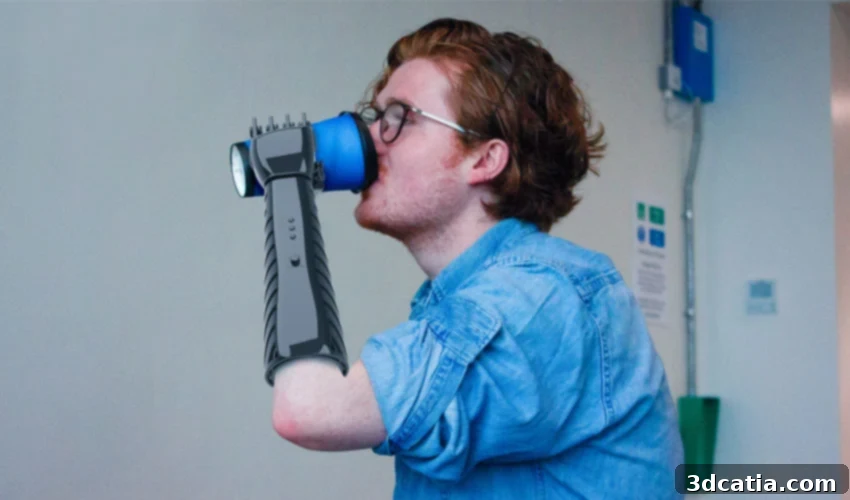
Revolutionizing Prosthetics: Lorenzo Spreafico’s Affordable 3D Printed Arm with Tactile Feedback
In a groundbreaking development at the University of Leeds, student Lorenzo Spreafico has engineered an innovative 3D printed prosthetic arm that promises to revolutionize the lives of amputees. This remarkable device, dubbed the T1, integrates advanced vibro-tactile feedback, a feature that enables users to perceive the sensation of touch when interacting with objects. Historically, prosthetics offering such sophisticated sensory capabilities have been prohibitively expensive, placing them out of reach for many who could benefit. However, Spreafico’s pioneering approach leverages the transformative potential of additive manufacturing – more commonly known as 3D printing – to drastically reduce production costs without compromising the effectiveness or functionality of the prosthetic device. This prototype, currently undergoing evaluation, is estimated to cost just under €3,500, a figure that dramatically undercuts the market price of comparable high-tech prosthetic solutions. This achievement underscores a significant leap forward in making advanced bionic limbs accessible, bridging a critical gap between cutting-edge technology and affordability for amputees worldwide.
3D printed prostheses have gained considerable traction in recent years, primarily due to their ability to offer personalized and functional devices. Often constructed from durable plastics, these prosthetics aim to significantly improve patients’ daily lives by providing a comfortable and customized fit that traditional methods struggle to match. While many basic 3D printed prosthetics focus on core functionality, the integration of electronics opens up a new realm of advanced capabilities. Lorenzo Spreafico, a visionary student, recognized a critical deficiency in the existing landscape of prosthetic development. He eloquently articulates this challenge, stating: “There is a huge gap in the development of prostheses: although we are developing extremely advanced technology to simulate human movement and dexterity, there is much less work done when it comes to simulating human touch.” This insight highlights the profound impact that the absence of tactile sensation has on an amputee’s ability to fully interact with their environment, making the development of the T1 prosthetic arm a crucial step forward in restoring a more complete human experience.
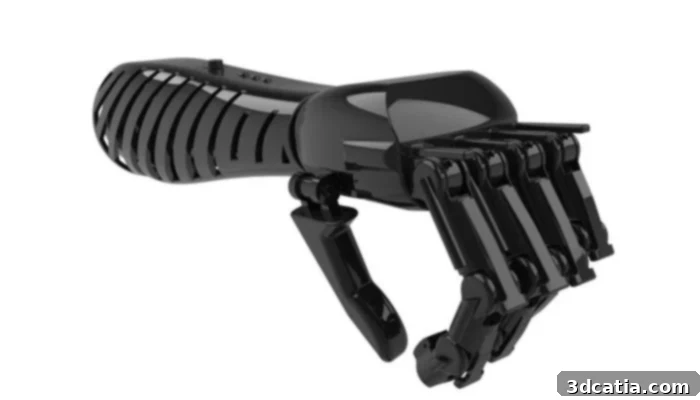
The innovative T1 prosthetic arm, designed to offer touch sensation at an affordable price.
The T1: A New Era for Low-Cost 3D Printed Prosthetic Arms
While the specific 3D printer utilized by Lorenzo Spreafico for the T1 prosthesis remains undisclosed, the fabrication process most likely involved Fused Deposition Modeling (FDM). FDM is a popular and cost-effective additive manufacturing technique ideal for creating functional prototypes and end-use parts, making it a fitting choice for developing an affordable and accessible prosthetic device. Spreafico’s ingenuity is evident in the sophisticated integration of pressure sensors meticulously placed at the tip of each prosthetic finger. These sensors are ingeniously connected to vibrating disc motors located at the stump, the point where the prosthetic interfaces with the wearer’s residual limb. This intelligent design allows the wearer to receive immediate haptic feedback, perceiving the force they are applying to an object. This innovative pressure simulation process is key to keeping the manufacturing and assembly costs of the T1 significantly lower than those of traditional myoelectric prosthetic devices, which often rely on complex and expensive electromyography sensors to interpret muscle signals.
The user-centric design of the T1 extends beyond its core functionality, offering a high degree of personalization and control. Wearers can easily adjust the intensity of the vibrations emitted by the T1 with a simple touch of a button, allowing them to fine-tune the tactile feedback to their individual preferences and the specific task at hand. Furthermore, this innovative feature can be entirely disabled if the user prefers, providing ultimate flexibility. The prosthetic arm also offers three distinct gripping modes that can be selected: open hand for general movements, pinch grip for delicate handling of small objects, and precision grip for tasks requiring meticulous control. These diverse grip options, combined with the haptic feedback, dramatically enhance the prosthetic’s versatility and utility in daily activities. By integrating this essential tactile feedback, the risk of rejection of the prosthetic arm is expected to decrease significantly. This is because the proprioception – the body’s sense of self-movement, force, and position – is substantially increased, allowing users to feel more connected to their prosthetic limb. Lorenzo emphasizes the critical nature of this feature: “The lack of tactile feedback in prosthetic arms creates an extremely unrealistic user experience. It reduces precision in movement and grip control, which makes it more difficult for users to perform delicate actions with precision, and makes it more difficult to adapt the grip force to different activities.” The T1 aims to mitigate these challenges, fostering greater acceptance and improving the overall quality of life for amputees.

Lorenzo’s innovative design integrates precise pressure sensors directly into the fingertips.
The Broader Impact of Affordable Bionic Technology
The affordability of the T1 prosthetic arm is one of its most compelling aspects. Lorenzo states that the final product could cost less than €3,500, positioning it as an exceptionally accessible solution for people in need worldwide. This price point becomes even more remarkable when contrasted with the exorbitant costs of other advanced prosthetic devices, which are typically manufactured using traditional, labor-intensive processes and can run into tens of thousands of euros. This significant cost reduction, made possible by 3D printing technology, has the potential to democratize access to sophisticated bionic limbs, especially in developing regions where advanced healthcare solutions are often out of reach. Beyond the immediate functional benefits, the prospect of personalization extends to aesthetics and individual preferences. It’s easy to envision a future where wearers can customize not only the functionality but also the appearance of their prosthetic arm, transforming it from a mere medical device into a unique expression of identity. This new perspective on disability empowers individuals, fostering greater confidence and challenging traditional perceptions. The T1 represents not just a technological advancement, but a step towards a more inclusive and adaptable world for amputees.
Future Potential and Advancements in 3D Printed Prosthetics
The T1 prosthetic arm is a testament to what is possible when innovative design meets accessible manufacturing. This device opens doors for further research and development in the field of bionic prosthetics. Future iterations could explore even more nuanced sensory feedback, perhaps incorporating temperature or texture perception, which would further enhance the realism of the touch experience. The potential for integrating artificial intelligence and machine learning algorithms could lead to prosthetics that learn and adapt to user habits, making them even more intuitive. Furthermore, the modular nature of 3D printed components allows for easier upgrades and repairs, extending the lifespan and utility of the device. This approach could also facilitate an open-source movement in prosthetic design, encouraging a global community of innovators to contribute to and improve upon designs like the T1. The continuous development of advanced materials compatible with 3D printing will undoubtedly lead to lighter, stronger, and more flexible prosthetic limbs, pushing the boundaries of what these devices can achieve. The focus on patient-centric design, emphasizing comfort, usability, and psychological well-being, will remain paramount as these technologies evolve, ensuring that future innovations truly serve the needs of amputees.
What do you think of this low-cost 3D printed prosthetic arm with tactile feedback? Share your thoughts and join the conversation in the comments section below, or connect with us on our Facebook and Twitter pages! Don’t miss out on the latest advancements in additive manufacturing – sign up for our free weekly Newsletter to get all the news in 3D printing delivered straight to your inbox!