
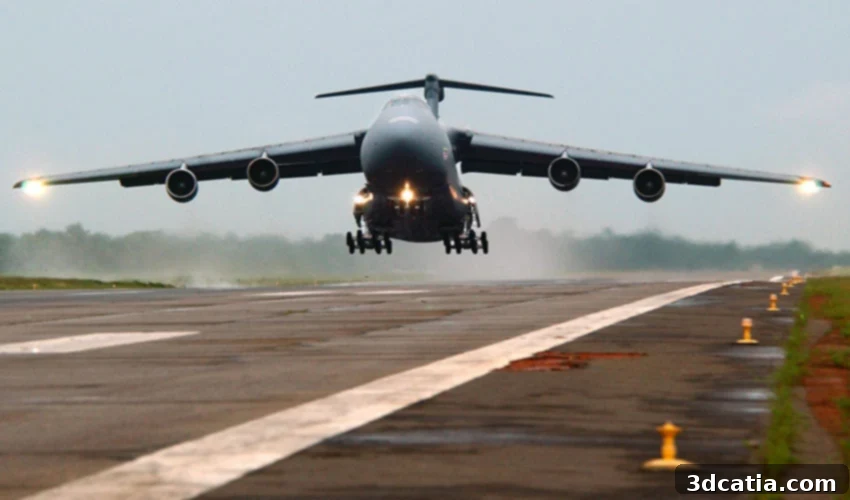
Revolutionizing Military Aviation: How 3D Printing is Cutting Costs and Boosting Readiness for the C-5 Super Galaxy
In a groundbreaking stride for military logistics and advanced manufacturing, a U.S. Air Force C-5 Super Galaxy transport aircraft, specifically tail number 70035, has become a prime example of the transformative power of additive manufacturing. Stationed at the Dover Air Base in Delaware, this colossal military workhorse has been significantly upgraded with a suite of 3D printed metal and plastic parts. This pioneering initiative is not merely about adopting new technology; it’s a strategic move aimed at drastically reducing sustainment costs and enhancing operational readiness across the Air Force’s aging fleet by integrating 3D printing technology into aircraft maintenance and sustainment programs.
The project at Dover Air Base underscores a shift towards more agile and cost-effective maintenance strategies. Following several weeks of meticulous 3D printing, a total of 17 distinct parts, comprising both polymer and metal components, were installed on the C-5 Super Galaxy in an impressive timeframe of less than three days. This rapid integration highlights the efficiency and potential of additive manufacturing for on-demand part production and replacement. Eddie Preston, a senior materials engineer for the Rapid Sustainment Office (RSO), articulated the broader vision behind these efforts, stating, “It is innovative ideas such as these that continue to drive down sustainment costs, leading to improved weapon system readiness. If you can imagine sitting on a commercial aircraft, everything around you including parts of the seat you are sitting in, we can print.” Preston’s statement vividly illustrates the expansive potential of 3D printing, suggesting a future where virtually any non-structural aircraft component could be produced rapidly and locally, thereby streamlining supply chains and reducing downtime for vital military assets.
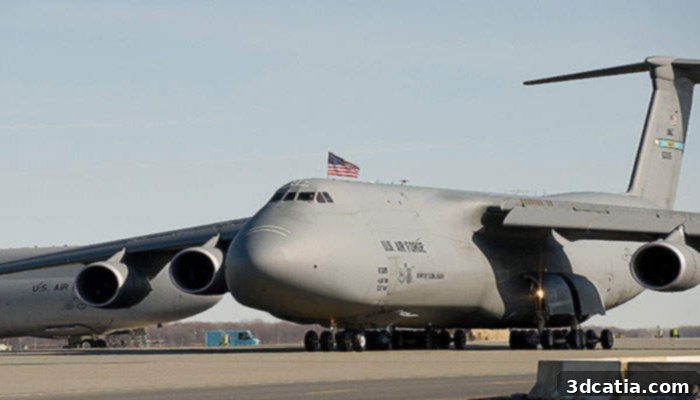
The C-5 Galaxy Aircraft
This ambitious project was a collaborative triumph, bringing together key stakeholders from across the Air Force ecosystem. The Rapid Sustainment Office (RSO) worked in close conjunction with innovative engineers from the C-5 Program Office, Air Mobility Command, and the 436th Airlift Wing – the unit directly responsible for operating and maintaining the C-5 aircraft. This multi-organizational effort ensured that the 3D printed components met stringent aerospace standards while addressing the specific operational needs of the Super Galaxy fleet.
The range of 3D printed parts installed on the C-5 Super Galaxy was diverse, targeting areas frequently subjected to wear and tear or those requiring specific design improvements. These included various cabin components designed to enhance comfort and functionality for both crew and cargo, as well as crucial elements within the crew bunk areas of the plane. Specifically, the additive manufacturing process delivered new overhead panels, covers for reading and emergency lights, window reveals, gasper panels (which regulate air flow), and even improved aluminum seal retention handles. The selection of these particular parts for 3D printing highlights their potential for significant impact on both maintenance efficiency and crew experience, leveraging the technology’s ability to produce complex geometries and customized designs on demand.
What are the advantages of integrating this technology into military aircraft sustainment?
The integration of additive manufacturing, or 3D printing, into military aircraft sustainment offers a multitude of advantages that are critical for modern defense operations. One of the overarching goals for the U.S. Department of Defense (DoD) is the rapid adoption and scaling of additive manufacturing technologies across its various branches. The Rapid Sustainment Office (RSO) was, in fact, established specifically to tackle the escalating sustainment costs associated with maintaining an aging fleet of military aircraft, like the C-5 Super Galaxy. John Hedke of the U.S. Air Force (USAF) Life Cycle Management Centre (Product Support Engineering Division) eloquently summarized the strategic necessity of the RSO, noting, “Currently, the Air Force lacks a standardised and centralised process to rapidly implement new technologies at scale […] The RSO is resourced and empowered to discover/ implement new technological methods for the Air Force”. This highlights the RSO’s vital role as an innovation hub, tasked with identifying, vetting, and deploying cutting-edge solutions to overcome traditional logistical and maintenance hurdles.
The RSO’s mandate is to move beyond conventional procurement methods, which often involve lengthy lead times and reliance on original equipment manufacturers (OEMs) for spare parts that may no longer be in active production. By embracing additive manufacturing, the Air Force gains the capability to produce parts on demand, reducing the reliance on a complex and sometimes brittle global supply chain. This strategic shift not only lowers costs but significantly enhances the readiness and operational availability of crucial military assets.

The Air Force created a new Rapid Sustainment Office. Secretary Heather Wilson demonstrates a 3D printed part of a KC-135 during a Washington Post-sponsored event in July 2018.
A prime example of the tangible benefits derived from RSO’s work is the redesign of the seal retention handles for the C-5 Super Galaxy. RSO engineers didn’t just replicate existing parts; they leveraged the design freedom of additive manufacturing to significantly improve them. The redesigned handles are now ergonomically friendly, lighter in weight, and more robust, better tolerating installation variations. These improvements translate directly into enhanced functionality and durability, reducing the frequency of replacements. Furthermore, the engineers were able to dramatically reduce the manufacturing build time for these components. They also eliminated the need for a labor-intensive, two-tone, multi-coat paint scheme that had been in use since the aircraft’s inception. This innovative approach to part design and production continues to drive down both manufacturing and sustainment costs, showcasing the intrinsic value of designing for additive manufacturing (DfAM).
Another significant efficiency gain was achieved through close collaboration between the RSO engineers and the polymer raw material supplier. By working together, they managed to print the parts directly in “gunship grey” – the specified color – effectively reducing post-processing time and labor. Traditionally, parts would be printed in a base color and then painted, adding multiple steps, curing times, and material costs. Printing directly in the final color not only saves time and money but can also lead to a more durable finish, as the color is integral to the material rather than a surface application. This innovative approach demonstrates a holistic understanding of the additive manufacturing workflow, from material selection to final application, optimizing every step for efficiency and cost-effectiveness.
The contrast between additive manufacturing and traditional procurement methods is stark when it comes to lead times. Obtaining replacement parts through conventional supply chains can often take weeks, months, or even years, especially for legacy aircraft where original suppliers may no longer exist or produce specific components. This lengthy waiting period results in significant aircraft downtime, impacting operational readiness and accruing substantial costs. With 3D printing, however, the process is dramatically accelerated; it often takes only a couple of days to print and prepare necessary parts. This immense saving in terms of both time and cost represents a monumental leap forward for military logistics. The ability to produce parts on-demand, closer to the point of need, minimizes inventory requirements, reduces warehousing costs, and ensures that aircraft can return to service much faster. As the USAF’s additive manufacturing library of validated parts continues to grow, the benefits of this technology are expected to become exponential, leading to a pervasive transformation in how military aircraft are maintained and supported throughout their lifecycles.
Beyond immediate cost savings and improved readiness, the adoption of 3D printing in military aerospace fosters several long-term strategic advantages. It bolsters supply chain resilience, reducing vulnerability to global disruptions and geopolitical tensions by enabling localized, agile manufacturing capabilities. It also encourages continuous innovation, as engineers are empowered to redesign and optimize components for performance, weight reduction, and durability, rather than being limited by traditional manufacturing constraints. Furthermore, lighter 3D printed parts can contribute to fuel efficiency, offering environmental benefits and further operational savings over the lifespan of the aircraft. This comprehensive approach positions the U.S. Air Force at the forefront of defense innovation, ensuring its fleet remains operational, adaptable, and cost-efficient for decades to come.
Find out more information HERE.
What do you think of the C-5 Super Galaxy integrating 3D technologies? The implications for military readiness and cost efficiency are profound. Let us know your thoughts in a comment below or join the conversation on our Facebook and Twitter pages! Don’t forget to sign up for our free weekly Newsletter to stay informed with all the latest news and breakthroughs in 3D printing delivered straight to your inbox!