
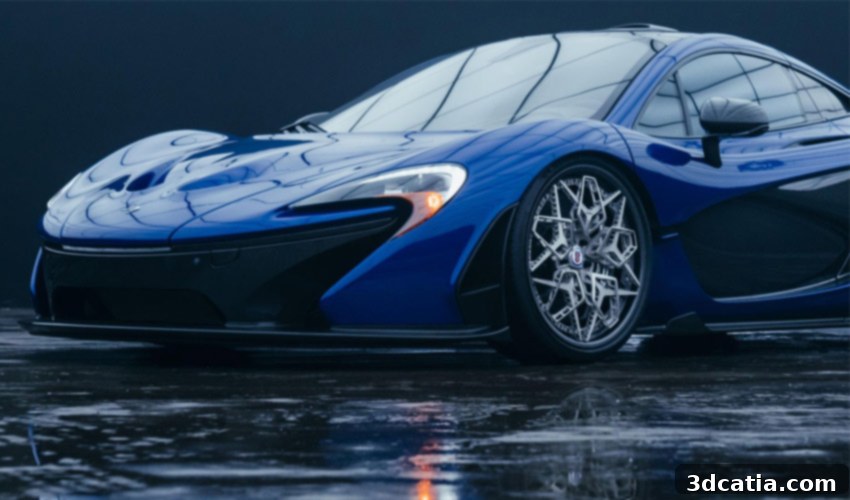
Revolutionizing Automotive Performance: HRE and GE Additive Pioneer the World’s First 3D Printed Titanium Wheel Rim
In the highly competitive world of high-performance automotive parts, innovation is paramount. HRE Performance Wheels, a distinguished US manufacturer renowned for its exquisite aluminum rims for racing and luxury vehicles, has consistently pushed the boundaries of design and engineering since its inception in 1978. With a steadfast commitment to crafting customized solutions that enhance both aesthetic appeal and vehicle performance, HRE has earned a reputation for excellence. Recently, the company embarked on a groundbreaking venture into the realm of additive manufacturing, collaborating with industry giant GE Additive to develop a revolutionary product: the world’s first 3D printed titanium wheel rim. This pioneering creation, aptly named HRE3D+, stands as a powerful testament to the transformative capabilities of metal additive manufacturing, particularly in its ability to produce components of unprecedented geometric complexity for the demanding automotive sector.
The integration of 3D printing technologies within the automotive industry is far from a novel concept; indeed, this sector has long been one of the most fervent adopters of additive manufacturing for various applications, ranging from rapid prototyping to the production of intricate end-use parts. However, its application in the creation of crucial components like wheels and rims has, until recently, remained relatively limited. While isolated initiatives and experimental prototypes have surfaced periodically – for instance, BigRep’s impressive 3D printed wheel rim, a prototype fabricated using their advanced 3D Studio printer – HRE has taken a monumental leap forward. They are the pioneers bringing true innovation to the forefront by presenting the world’s first fully functional 3D printed titanium rim. This remarkable achievement was made possible through the sophisticated Electron Beam Melting (EBM) technology, an advanced metal additive manufacturing process that enables the creation of highly complex and robust parts from metallic powders.
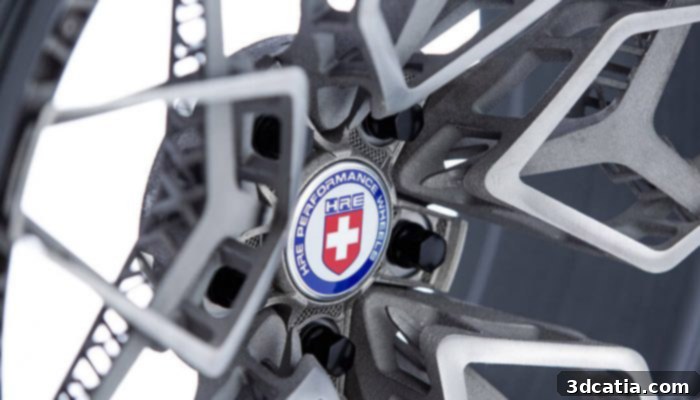
3D Printed Titanium Rim: A Paradigm Shift Towards Lighter Weight, Enhanced Performance, and Sustainable Manufacturing
At the core of the collaborative project between GE Additive and HRE was a fundamental and ambitious objective: to drastically minimize material waste during the manufacturing process. This goal represents a significant challenge in traditional manufacturing, especially for high-performance automotive components. The successful realization of the HRE3D+ titanium rim project marks a resounding success for both partners, demonstrating the profound advantages of embracing additive manufacturing. They proudly report that by leveraging advanced 3D printing techniques, they managed to reduce material loss to an astonishingly low 5% of the original material input. This figure stands in stark contrast to conventional production methods, such as forging and subsequent machining, where material waste can soar to an exorbitant 80%. To illustrate this disparity, consider the common practice of wheel forging: the process typically commences with a substantial block of metal, often weighing around 45 kilograms (approximately 100 pounds), usually aluminum. The vast majority of this material is then meticulously machined away to achieve a light, strong, and aesthetically pleasing rim. This not only consumes enormous amounts of energy and time but also generates significant scrap metal.
Titanium, as a material, possesses inherently superior characteristics compared to aluminum, making it an ideal candidate for high-performance applications where strength, durability, and weight are critical factors. Its advantages include exceptional strength-to-weight ratio, superior corrosion resistance, and remarkable fatigue strength, all of which contribute to enhanced longevity and performance. However, traditional machining operations on titanium are notoriously difficult and prohibitively expensive due to the material’s hardness and reactivity. This is precisely where metal 3D printing, specifically Electron Beam Melting (EBM), emerges as a game-changing alternative. EBM allows for the creation of near-net-shape components directly from titanium powder, significantly reducing the need for extensive post-processing and thus mitigating the associated costs and material waste. By building the rim layer by layer, only the necessary material is used, and complex internal structures can be incorporated to optimize strength and minimize weight – something impossible with conventional subtractive methods. This not only makes titanium a more viable material for such applications but also opens up new design possibilities for advanced automotive components.
The manufacturing of the HRE3D+ rim involved state-of-the-art technology, with GE Additive deploying two of its advanced Electron Beam Melting (EBM) 3D printers: a Q10 and a Q20. These machines are engineered for precision and the production of robust metal components. The initial approach taken by the US manufacturer involved printing the rim in five distinct segments. These individual pieces were then meticulously joined and securely affixed to a central carbon fiber hub using high-strength titanium fasteners. This modular design strategy was likely adopted to accommodate the build envelopes of existing EBM machines and to facilitate specific design complexities. However, GE Additive has already set its sights on the future, announcing that it will soon possess even larger and more capable printers. These next-generation EBM systems will be able to produce the entire wheel rim as a single, monolithic piece. This advancement holds immense promise for further streamlining the manufacturing process, drastically reducing assembly time, and potentially achieving even greater reductions in both the overall weight of the rim and the total material usage. A single-piece design would eliminate the need for fasteners and joining processes, leading to a stronger, lighter, and more integrated structure, pushing the boundaries of what’s possible in lightweight automotive component design.
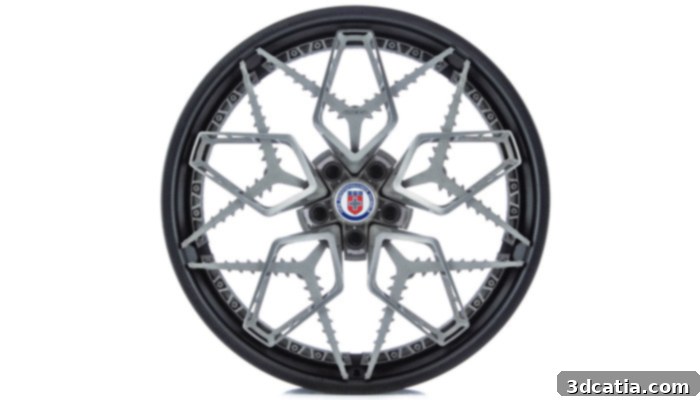
The successful unveiling of the HRE3D+ project garnered significant attention and praise within the automotive and additive manufacturing communities. HRE President Alan Peltier articulated the profound significance of this development, stating, “This is an incredibly exciting and important project for us as we get a glimpse into what the future of wheel design holds.” His remarks underscore the transformative potential of additive manufacturing to redefine conventional design paradigms. Peltier further elaborated on the invaluable partnership, adding, “Working with GE Additive’s AddWorks team gave us access to the latest additive technology and an amazing team of engineers.” The AddWorks team, GE Additive’s specialist consultancy service, played a crucial role, providing expert guidance and technical support throughout the entire development cycle, from conceptualization to the final physical product. The impact of HRE’s innovation was undeniable, especially as they presented their revolutionary concept mounted on a stunning McLaren P1, instantly captivating audiences and demonstrating the aesthetic and performance potential of the HRE3D+. While the HRE3D+ is not currently intended for commercialization, this initiative serves a critical purpose: it is a powerful proof-of-concept, a tangible demonstration of the unparalleled possibilities that metal additive fabrication offers for high-performance automotive components. It’s a vision of the future, showcasing how complex, lightweight, and high-strength parts can be produced with unprecedented efficiency and design freedom. Further details and insights into the project are available on the dedicated HRE project page.
The implications of projects like HRE3D+ extend far beyond a single product; they signal a fundamental shift in manufacturing philosophy. For the automotive industry, the ability to produce highly complex, lightweight components with minimal material waste opens doors to advancements in vehicle performance, fuel efficiency, and sustainability. Lower unsprung weight, achieved through lightweight rims, directly translates to improved handling, enhanced acceleration, and more efficient braking, making vehicles safer and more enjoyable to drive. Moreover, the design freedom offered by EBM technology allows engineers to create intricate internal lattice structures that optimize strength while further reducing material, leading to a rim that is not only lighter but also potentially stronger and more resilient than its traditionally manufactured counterparts. This level of customization and performance optimization was previously unimaginable or economically unfeasible. As additive manufacturing technologies continue to evolve, the prospect of mass-producing such advanced components becomes increasingly viable, promising a future where personalized, high-performance, and environmentally conscious automotive solutions are the norm.
The collaboration between HRE and GE Additive also highlights the growing trend of cross-industry partnerships that leverage specialized expertise to drive innovation. HRE’s deep understanding of wheel design and automotive performance, combined with GE Additive’s mastery of metal additive manufacturing, created a synergistic environment for breakthrough development. Such partnerships are vital for pushing the boundaries of what is technologically possible and for translating advanced concepts into real-world applications. The HRE3D+ project serves as a beacon, illustrating that the future of automotive engineering will be characterized by lighter, stronger, and more sustainable components, enabled by the relentless pursuit of innovation through advanced manufacturing techniques like 3D printing. It challenges conventional manufacturing wisdom and paves the way for a new era of automotive design and production, where efficiency, performance, and environmental responsibility go hand in hand.
What are your thoughts on this revolutionary 3D printed titanium rim? We invite you to share your perspectives and insights in the comments section below or engage with us on our Facebook and Twitter pages! Don’t miss out on the latest advancements and news in the dynamic world of 3D printing. Be sure to sign up for our free weekly Newsletter, delivering all the essential updates and breakthroughs straight to your inbox every week!