

Rocket Lab Goes Public: Fueling the Future of Space Exploration and Commercialization with Neutron Rocket
Rocket Lab USA, a recognized global leader in end-to-end space solutions, has officially announced its transition to a publicly traded company. This significant move follows a definitive merger agreement with Vector Acquisition Corporation, a special purpose acquisition company (SPAC). The transaction is set to position Rocket Lab for accelerated growth within the burgeoning space market, which is projected to reach an astounding $1.4 trillion by 2030. This expansion underscores the company’s commitment to advancing its capabilities across launch services, space systems, and innovative space applications.
With a proven track record, Rocket Lab has already made substantial contributions to the space industry. To date, the company has successfully deployed 97 satellites across 16 orbital missions for a diverse range of clients, including both government agencies and private enterprises. These missions highlight Rocket Lab’s reliability and its pivotal role in enabling critical space-based operations that impact global connectivity, security, and scientific research. The company’s commitment to delivering accessible and efficient space solutions has made it a go-to provider for various orbital deployment needs.
Since its inaugural orbital launch in 2018, Rocket Lab’s Electron rocket has rapidly ascended to become the second most frequently launched orbital rocket in the United States. This impressive cadence demonstrates the company’s operational efficiency and its ability to meet the increasing demand for dedicated and rideshare launch services. Beyond current orbital operations, Rocket Lab has ambitious plans for future deep-space exploration, with missions already scheduled for the Moon, Mars, and Venus. These endeavors signify Rocket Lab’s expansion beyond low-Earth orbit, aiming to push the boundaries of humanity’s reach into the solar system.
Peter Beck, CEO and Founder of Rocket Lab, articulated the profound impact of space on human progress and the company’s mission. “Space has defined some of humanity’s greatest achievements, and it continues to shape our future,” Beck stated. He further emphasized the practical applications of Rocket Lab’s work: “The satellites we build and launch are keeping countries connected and borders protected, monitoring weather and managing waste, providing insights on climate change, and helping us manage resources for future generations.” This perspective underscores the broad utility and societal benefits derived from space technology, an area where Rocket Lab is a key enabler. The company’s integrated approach, encompassing both launch vehicles and satellite platforms like Photon, allows for tailored solutions that address specific client needs, from Earth observation to advanced scientific experiments.

Rocket Lab Photon Spacecraft in Orbit (Photo Credit: Rocket Lab)
The strategic importance of this merger was succinctly captured by Alex Slusky, CEO of Vector Acquisition Corporation and Founder & Chief Investment Officer of Vector Capital. Slusky remarked, “Rocket Lab is ideally positioned to continue to capture market share in the rapidly expanding space launch, systems and applications markets.” This sentiment highlights the significant growth opportunities available in the commercial space sector, where Rocket Lab’s comprehensive capabilities provide a distinct advantage. The company’s valuation at an implied pro forma enterprise value of $4.1 billion, coupled with a projected pro forma cash balance of approximately $750 million at closing, reflects strong investor confidence in its future potential. Furthermore, Rocket Lab itself projects to exceed $1 billion in revenue by 2026, signaling a robust financial outlook and aggressive growth targets. Slusky reiterated his firm’s enthusiasm, stating, “Vector is thrilled to partner with Rocket Lab as it seeks to capitalize on unprecedented commercial and government spending in the bourgeoning space economy.” This partnership is expected to provide Rocket Lab with the capital and strategic support needed to scale its operations and cement its leadership position in the global space industry.
Indeed, Rocket Lab’s distinct competitive advantage stems from its vertically integrated capabilities, encompassing both in-house launch vehicle manufacturing and advanced space system development. This end-to-end approach allows for greater control over mission timelines, costs, and quality, a critical factor in the high-growth space applications market. This market segment currently accounts for approximately $320 billion of the total $350+ billion space industry Total Addressable Market (TAM). By owning both the launch infrastructure and the satellite technology, Rocket Lab can offer highly efficient, customized, and reliable solutions to its clients, differentiating itself from competitors who may rely on third-party providers for various mission components. Peter Beck summarized the strategic implications of going public, stating, “This milestone accelerates Rocket Lab’s ability to unlock the full potential of space through our launch and spacecraft platforms and catalyzes our ambition to create a new multi-billion-dollar business vertical in space applications.” This vision highlights Rocket Lab’s strategy to not only transport payloads but also to provide comprehensive, integrated services that leverage its unique ecosystem of technologies and expertise.
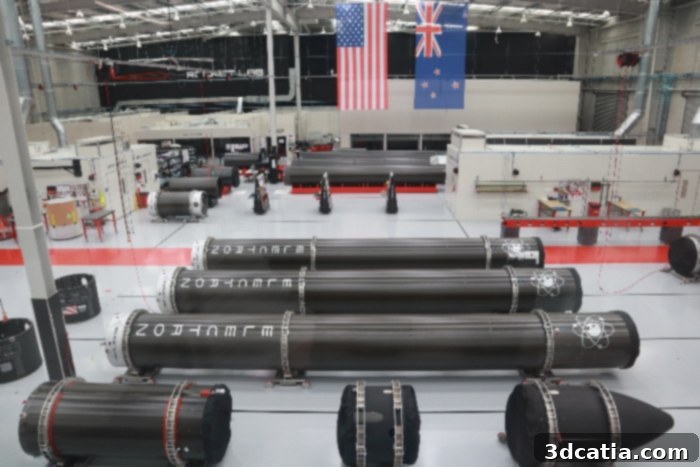
Rocket Lab Production Complex (Photo Credit: Rocket Lab)
Further solidifying its long-term strategy and commitment to innovation, Rocket Lab has also unveiled its advanced, next-generation Neutron rocket. This ambitious new launch vehicle represents a significant leap forward in the company’s capabilities, designed to serve a broader range of missions and disrupt key market segments. The Neutron is an advanced reusable launch vehicle, a critical feature in the evolving space industry, which aims to drastically reduce launch costs and increase mission flexibility. With an impressive 8-ton payload lift capacity, Neutron is specifically catered to deploy large satellite mega-constellations, facilitate deep space missions, and even support human space flight. This strategic development positions Rocket Lab to compete in a higher payload class market, complementing its existing Electron rocket which serves smaller satellite deployments.
The Neutron rocket is slated to begin launching through 2029, promising to disrupt the high-growth constellation market by offering significantly lower costs per launch compared to traditional expendable rockets. The reusability aspect of Neutron is a game-changer, mirroring industry trends towards more sustainable and economical space access. This innovation will enable the deployment of vast networks of satellites for global internet coverage, advanced Earth observation, and other critical services at an unprecedented scale and affordability. The development of Neutron underscores Rocket Lab’s vision to not only facilitate access to space but to make it more efficient, cost-effective, and ultimately, more accessible for a wider array of commercial and scientific endeavors. You can find more comprehensive information on Rocket Lab’s diverse offerings and future plans by visiting their official website HERE.
The move to become a publicly traded company, combined with the groundbreaking development of the Neutron rocket, marks a pivotal moment for Rocket Lab. It signifies a bold expansion strategy designed to capitalize on the burgeoning demand for space-based services and infrastructure. By offering an integrated suite of launch solutions, satellite manufacturing, and space applications, Rocket Lab is not merely participating in the space economy; it is actively shaping its future. This strategic positioning allows the company to address the critical needs of governments, commercial entities, and research institutions seeking reliable, efficient, and innovative access to space. As the space industry continues its exponential growth, Rocket Lab is poised to remain at the forefront, driving technological advancements and enabling humanity’s continued exploration and utilization of the final frontier.
If you are interested in the transformative role of Additive Manufacturing (AM) in the aerospace sector, we invite you to our next virtual event, ADDITIV Aerospace! This event will delve into how advanced manufacturing techniques are revolutionizing the design, production, and performance of space components and vehicles, including those like Rocket Lab’s. You can register for free HERE to gain valuable insights and network with industry experts. We’d love to hear your thoughts on Rocket Lab’s latest developments and its future impact on the space industry. Please share your comments below or engage with us on our Facebook, Twitter and LinkedIn pages! Stay informed about the latest advancements in 3D printing and space technology by signing up for our free weekly Newsletter here, delivered straight to your inbox!