
Stratasys Elevates Prince’s “The Beautiful Collection” with Groundbreaking 3D Printed Displays at Paisley Park
The legendary musician Prince, an icon whose influence continues to resonate across the globe, was known not only for his revolutionary music but also for his distinctive style. This unique aesthetic extended notably to his extensive collection of footwear, which often served as a profound extension of his vibrant personality. Paisley Park, Prince’s private estate, studio, and now a museum and archival complex in Chanhassen, Minnesota, plays host to an extraordinary exhibition titled “The Beautiful Collection.” This special showcase, originally announced last summer and now extended through 2022 due to overwhelming public interest, features an astounding 300 pairs of Prince’s quintessential shoes. To truly honor and highlight these sartorial masterpieces, the curators at Paisley Park sought an innovative display solution that transcended traditional museum presentation. They found their perfect partner in Stratasys, a global leader in additive manufacturing, originally founded in Minnesota in 1989 and now headquartered in Israel. Stratasys embarked on a groundbreaking project, creating one-of-a-kind 3D-printed display units that not only exhibit the shoes but also deeply resonate with Prince’s artistic spirit and personal narrative.
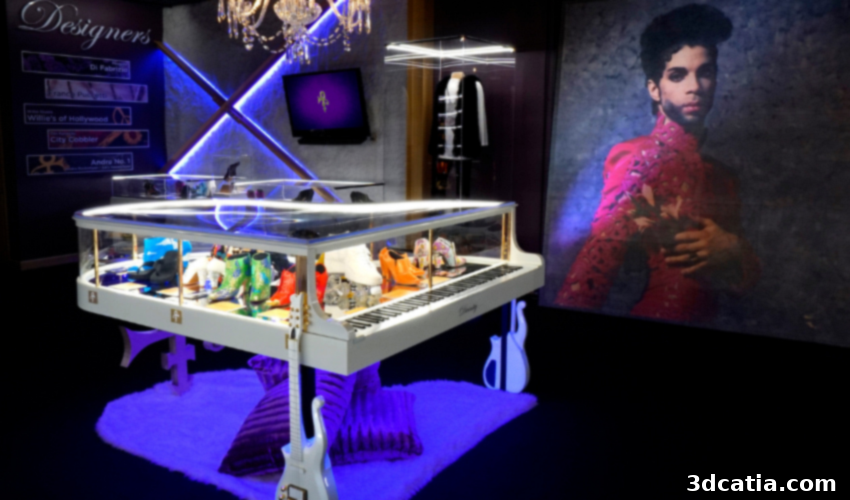
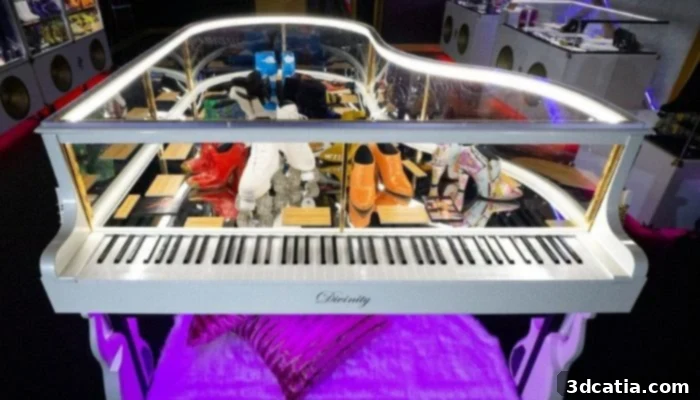
From the outset, the goal was to craft display cases that were as unique and memorable as Prince himself. Rather than generic pedestals, the vision was to transform iconic elements from Prince’s world into functional, artistic showcases. Stratasys rose to this challenge by meticulously modeling two central display units after Prince’s very own cherished possessions: a guitar and a baby grand piano. These were not merely decorative elements; they were retrofitted as intricate 3D-printed display cases designed to draw visitors deeper into Prince’s universe. The grand piano display case, in particular, features exquisitely designed legs that brilliantly replicate Prince’s famous Cloud Guitar, a symbol synonymous with his artistic identity. This attention to detail ensures that every aspect of the exhibition reflects the artist’s inimitable legacy and profound connection to his instruments.
To bring these complex designs to life, Stratasys leveraged a combination of its advanced 3D printing technologies: Fused Deposition Modeling (FDM) and PolyJet. The entire grand piano display unit alone is composed of 45 individual 3D-printed pieces, a testament to the intricate engineering involved in creating such a detailed and functional structure. The guitar display case holds particular symbolic weight, representing the iconic “love symbol” that Prince famously adopted as his name in 1993, highlighting his defiance and artistic evolution. Pat Carey, Senior Vice President of Strategic Growth for Stratasys, remarked on the project’s ambition: “The level of 3D printing innovation on display at Paisley Park is incredible. In everything we created for this exhibit, we pushed the boundaries of our technology. In addition to being able to showcase and compliment Prince’s shoes through the creation of these amazing 3D printed pieces, we can also highlight how 3D printing can be utilized beyond its typical use cases.” This statement perfectly encapsulates the spirit of the collaboration – moving beyond mere utility to artistic expression and experiential design.
Beyond the shoe displays, Stratasys took on an even more ambitious artistic endeavor for the exhibition: producing a monumental 9’ x 9’ image of the legendary artist. This impressive piece, claimed by the company as the largest 3D-printed canvas ever created, stands as a stunning backdrop to the collection. The canvas image is an intricate mosaic composed of 56 individual pieces of white denim. Upon these fabric panels, an estimated 347,000 unique PolyJet dots were precisely deposited, building up the image layer by layer with incredible fidelity and vibrant color. This project pushed the limits of Stratasys’ PolyJet technology, demonstrating its capacity for large-scale artistic applications and proving that 3D printing onto fabric, while done before by Stratasys, could achieve unprecedented scales and detail, creating a truly unique visual experience for visitors.
The Power of PolyJet and FDM: Technologies Behind the Exhibition
Stratasys’ choice of FDM and PolyJet technologies was strategic, leveraging the unique strengths of each for different components of the exhibition. Fused Deposition Modeling (FDM), a robust and widely utilized additive manufacturing process, is ideal for producing strong, durable, and functional prototypes and parts. It works by extruding thermoplastic filaments, layer by layer, through a heated nozzle to build a three-dimensional object. For the Paisley Park project, FDM was predominantly used for the structural components of the guitar and piano display units, where strength, stability, and load-bearing capabilities were paramount. The structural elements of the Cloud Guitar replication, for instance, were printed using Nylon12 Carbon Fiber, a high-performance composite material known for its exceptional strength-to-weight ratio, rigidity, and resistance to impact. This ensured the complex structures could support the valuable artifacts they housed. Meanwhile, non-load-bearing aesthetic enhancing covers were fabricated with ASA Black material, offering excellent UV resistance, a sophisticated matte finish, and smooth surface quality suitable for exhibition aesthetics. Stratasys deployed its industrial-grade FDM printers, specifically the Stratasys F900 3D printer and the Stratasys Fortus 450 3D printer, renowned for their precision, reliability, and ability to handle demanding applications with large build volumes and a variety of engineering-grade thermoplastics.
PolyJet 3D technology, on the other hand, stands as a versatile and visually stunning additive manufacturing method, often described as the most similar to traditional 2D inkjet printing among all 3D printing technologies. Also known as material jetting, this sophisticated process operates by jetting hundreds of micro-droplets of ultraviolet (UV) light-sensitive liquid photopolymer resin onto a build tray. These minute droplets are then immediately hardened or cured by a UV light source, solidifying them layer by layer to form a highly detailed and precise object. This process shares conceptual similarities with stereolithography, another resin-based 3D printing method. What makes PolyJet exceptionally attractive for applications in the arts, design, and entertainment industries, such as the movie industry and museum exhibitions, is its unparalleled ability to produce parts with multiple colors and a range of material properties (from rigid to flexible, opaque to transparent) in a single print job. While objects made with PolyJet resin may not always possess the extreme mechanical strength required for heavy industrial purposes, their aesthetic quality, fine detail resolution, smooth finishes, and vibrant color capabilities are unmatched. Stratasys has been a pioneer in this technology, having acquired the originators of the process in 1999, continually refining its capabilities to deliver vibrant, full-color, and multi-material output that opens new frontiers for designers and artists.
For the Paisley Park exhibition, PolyJet was instrumental in creating the intricate details of the piano keys for the display unit, which were printed on the Stratasys J850 3D printer. Utilizing VeroUltra White and VeroUltra Black materials, Stratasys achieved such impressive color accuracy, deep saturation, and flawless finish that no post-print painting or additional surface treatment was required. This capability saved significant time and labor while ensuring perfect consistency and an authentic representation of a grand piano’s keys. The capacity of PolyJet to directly print these vivid, true-to-life colors and textures was crucial in authentically replicating the aesthetics of a musical instrument central to Prince’s identity.
A Deep Dive into the Manufacturing Process and Scale
The creation of these intricate display pieces was an immense undertaking, demanding hundreds of hours of dedicated 3D printing and meticulous post-processing to achieve the museum-quality finish required for such a prestigious exhibition. The replication of Prince’s iconic Cloud Guitar, a focal point of the exhibition, alone required approximately 9 hours of continuous print time for its various structural and aesthetic components. This was followed by an additional 50 hours of meticulous post-processing, highlighting the intricate craftsmanship involved in sanding, smoothing, and assembling these highly detailed parts to meet exacting standards. The total combined print time for both the guitar and piano displays stretched over an astonishing 751 hours, demonstrating the sheer scale and complexity of Stratasys’ commitment to this ambitious project.
The material consumption for the entire display project was substantial, underscoring the volume of work involved in bringing these concepts to fruition. Stratasys utilized a total of 40.1 lbs (18.2 kg) of PolyJet resin for the multi-colored, highly detailed, and aesthetically critical components, alongside an impressive 2,150 cubic units of FDM material for the robust structural elements that provide stability and support. Even the groundbreaking 3D-printed canvas, with its massive scale and intricate dot matrix design, required 76 hours of continuous printing, a testament to the efficiency, reliability, and endurance of Stratasys’ industrial-grade printing systems. This continuous operation ensured that all exhibition components were ready within the demanding timelines of a major museum installation, without compromising on quality or artistic vision.
The collaboration between Paisley Park and Stratasys exemplifies how additive manufacturing can revolutionize museum exhibitions, offering unprecedented opportunities for personalization, artistic expression, and immersive storytelling. By leveraging cutting-edge 3D printing technologies, the exhibition not only preserves Prince’s invaluable legacy but also brings it to life in a dynamic, engaging, and utterly unique way that resonates deeply with visitors. This innovative approach elevates the entire viewing experience, transforming static displays into interactive conversations about art, technology, and identity. Visitors to Paisley Park now have the exclusive opportunity to witness this remarkable fusion of art, technology, and musical history, experiencing Prince’s iconic shoes displayed within these stunning, custom-made 3D-printed marvels that pay homage to his extraordinary world.
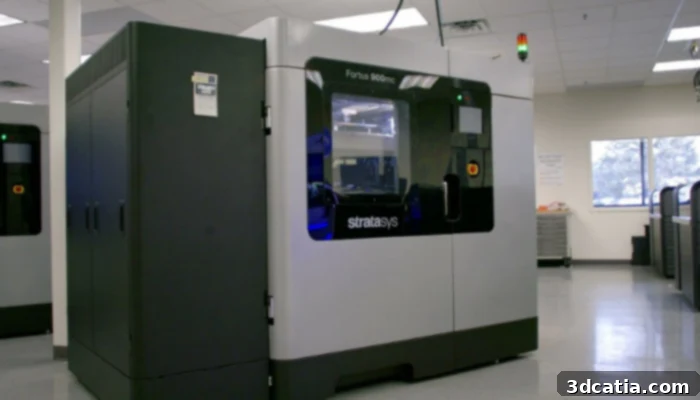
Parts were printed using Stratasys’ F900 FDM printer among others (Photo Credit: Stratasys)
Experience “The Beautiful Collection” at Paisley Park
This extraordinary partnership between Stratasys and Paisley Park has set a new benchmark for museum exhibition design, proving that 3D printing is far more than an industrial tool; it is a powerful medium for artistic expression, creative storytelling, and historical preservation. The “The Beautiful Collection” exhibition, with its captivating 3D-printed displays and monumental canvas, offers an unparalleled glimpse into the world of Prince through his footwear and personal artifacts, presented in a manner as innovative and unique as the artist himself. If you find yourself in or near Minnesota, this unparalleled cultural and technological experience is not to be missed. Tickets to witness this remarkable collection, including the innovative 3D-printed instruments and canvas, can be purchased directly through the Paisley Park official website HERE.
What are your thoughts on Stratasys’ pioneering display work for Paisley Park? How do you envision 3D printing transforming future museum exhibitions or artistic installations, pushing the boundaries of what’s possible in cultural preservation and presentation? We invite you to share your insights and comments below, or engage with us on our social media platforms: Linkedin, Facebook, and Twitter pages! For the latest updates and breaking news in the additive manufacturing world, don’t forget to sign up for our free weekly Newsletter here, delivered straight to your inbox. You can also discover all our insightful videos and exclusive content on our YouTube channel.
Cover Photo Credit: Stratasys