

DEEPTIME Ionic Sound System: The World’s First 3D Printed Sand Speakers Redefine Audiophile Design
DEEPTIME Limited, an innovative manufacturer based in the Czech Republic, continues to push the boundaries of audio technology and design. Known for their pioneering spirit, they previously made headlines by unveiling the world’s first speakers crafted using a 3D printed wooden composite. Now, they are once again at the forefront of innovation with the introduction of their latest audio marvel: the Ionic Sound System. This limited-edition product features speakers that are exquisitely 3D printed entirely from sand, marking a significant advancement in material science and additive manufacturing for high-fidelity sound reproduction. While DEEPTIME is undoubtedly a leader, the concept of 3D printed speakers isn’t entirely new; we previously reported on the OWA Speaker, which captivated audiences at CES 2018. However, DEEPTIME’s commitment to unique materials and aesthetic integration distinguishes their offerings in a rapidly evolving market.
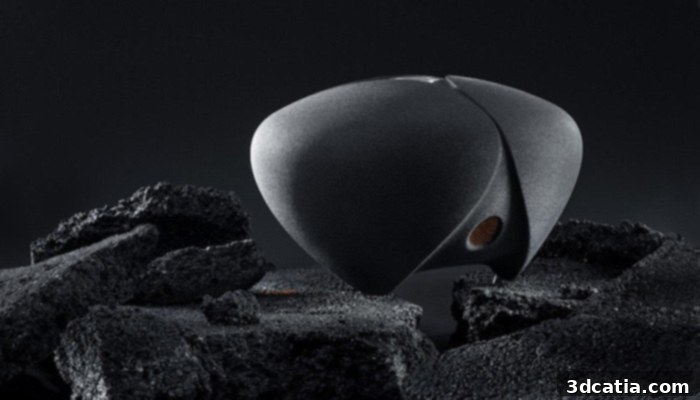
Photo credits: DEEPTIME
The visionary design and technology studio behind this groundbreaking sound system was established in the heart of the Czech Republic by its esteemed founders, Martin Hreben and Andrej Chotovinsky. Their shared philosophy centers on creating products that transcend conventional functionality, aiming to captivate a dual audience: not only the discerning audiophile who prioritizes pristine sound quality but also the ardent design fanatic who seeks aesthetic excellence and innovative artistry. The Ionic Sound System stands as a testament to this philosophy, seamlessly merging breathtaking organic design with the revolutionary capabilities of industrial 3D printing technology. This fusion creates an audio device that is as much a sculptural art piece as it is a high-performance sound emitter, challenging preconceived notions of what home audio systems can and should look like.
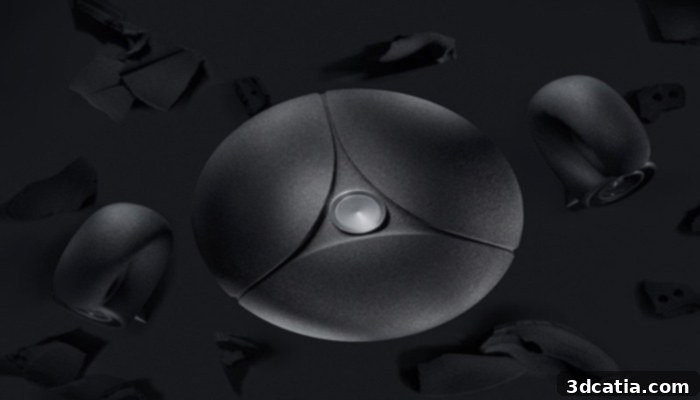
Photo credits: DEEPTIME
At the core of DEEPTIME’s innovation lies a sophisticated technological process that transforms raw sand into acoustically optimized enclosures. This proprietary method employs specially formulated hardeners and pigments, meticulously turning the granular sand prints into structures that are remarkably airtight and completely resonance-free. The resulting material, while visually echoing the natural beauty and texture of sandstone, is engineered for superior acoustic performance. The absence of resonance is paramount in high-fidelity audio, as it prevents unwanted vibrations within the speaker cabinet that can color or distort the sound. By achieving an airtight and non-resonant build, DEEPTIME ensures that sound waves are accurately reproduced, delivering a pure and unadulterated listening experience. Furthermore, each speaker enclosure is crafted as a single, seamless piece, eliminating any visible split lines or bolts that typically hold together conventionally constructed enclosures. This commitment to a monolithic, organically shaped design not only enhances the aesthetic appeal but also contributes significantly to the structural integrity and acoustic purity of the system, allowing the sound to flow unimpeded by internal discontinuities.
The dedication to custom manufacturing extends throughout the entire Ionic Sound System. Every single component, from the intricate internal electronics to the finely crafted control rings and bespoke connectors, has been custom-designed and produced to DEEPTIME’s exacting standards. While the company maintains a level of discretion regarding the precise specifics of their manufacturing process, they have confirmed that as many components as feasible were fabricated using advanced binder jetting technology. Binder jetting is a prominent additive manufacturing technique where a liquid binding agent is selectively deposited onto a powder bed, layer by layer, to build a three-dimensional object. This process is particularly renowned for its ability to create highly complex geometries and intricate internal structures that would be challenging or impossible to achieve with traditional manufacturing methods. Although binder jetting is predominantly recognized for its applications in 3D printing molds for metal casting – allowing for rapid production of intricate sand molds for foundries – DEEPTIME’s innovative application demonstrates its versatility for producing functional, high-performance components for sophisticated audio equipment. This choice of technology underscores their commitment to optimizing every aspect of the speaker’s construction, ensuring both aesthetic integrity and acoustical superiority.

Photo credits: DEEPTIME
Martin Hreben, one of DEEPTIME’s visionary founders, eloquently articulated the core philosophy guiding the design of their speakers: “For us, the design means looking for the form that reflects the nature and function of the product and builds on the benefits of the newest available technologies. We don’t want just to embellish existing standard solutions. That is the reason why our speakers do not use the standard cube or block shaped enclosures. Instead, we employ organic shapes designed to enhance the sound quality.” This statement encapsulates DEEPTIME’s radical departure from conventional speaker aesthetics. Historically, speaker enclosures have predominantly adopted rectangular or cubic forms, often dictated by manufacturing limitations and perceived acoustic neutrality. However, these traditional shapes can inadvertently introduce acoustic compromises, such as internal standing waves and reflections that interfere with sound purity. DEEPTIME’s adoption of organic, flowing geometries is a direct response to these challenges. By moving away from rigid, parallel surfaces, they ingeniously mitigate internal acoustic distortions. The curvilinear forms are not merely aesthetic choices; they are functional designs engineered to guide sound waves more effectively, minimize diffraction, and ensure that the sound emanating from the drivers is as clean and precise as possible. This approach leverages the unparalleled design freedom offered by 3D printing, allowing form to truly follow function in an acoustically optimized manner, rather than being constrained by traditional production methods.
The acoustic engineering principles embedded within the Ionic Sound System are profoundly influenced by this innovative material and design philosophy. The pursuit of an “acoustic friendly” environment within the speaker cabinet is paramount for high-fidelity audio. The chosen sand composite material, with its tailored hardeners and pigments, creates a dense, inert structure that resists vibrations far more effectively than typical wood or plastic enclosures. This minimizes energy loss and prevents the enclosure itself from becoming a secondary source of sound, which would otherwise introduce coloration and blur the audio image. Coupled with the organic, single-piece design, DEEPTIME’s speakers excel at eliminating internal standing waves and reflections that plague traditional box-shaped speakers. These acoustic phenomena can lead to frequency response irregularities and a less detailed soundstage. By carefully shaping the internal volume and eliminating sharp corners, DEEPTIME ensures that sound waves disperse smoothly, allowing the drivers to perform optimally and deliver a more accurate, immersive, and natural sound reproduction. This meticulous attention to both material science and acoustic geometry sets a new benchmark for what is achievable in speaker design.
DEEPTIME’s Ionic Sound System represents more than just a new product; it signals a significant shift in the audio industry’s approach to design, materials, and manufacturing. By marrying the artisanal quality of custom design with the precision and flexibility of additive manufacturing, DEEPTIME is carving out a unique niche in the high-end audio market. The “limited edition” status of the Ionic Sound System further underscores its exclusivity and the meticulous craftsmanship involved in each unit. This strategy appeals to collectors and connoisseurs who value both sonic excellence and design rarity. Beyond the immediate product, DEEPTIME’s innovations also highlight the broader potential of additive manufacturing to create more sustainable and efficient production cycles. While sand is a natural resource, the ability to print complex shapes with minimal material waste, compared to subtractive methods, offers an intriguing pathway towards more environmentally conscious manufacturing practices in the future. Their work not only serves as a beacon for what’s possible in audio but also inspires a re-evaluation of material application across various industries.
Looking ahead, DEEPTIME has revealed exciting plans for the expansion of the Ionic Sound System line. The company intends to introduce speakers of varying sizes, catering to diverse spatial requirements and listening preferences, from compact desktop systems to powerful floor-standing units. This expansion will allow their unique aesthetic and acoustic benefits to reach a broader audience. Furthermore, the introduction of multiple color variants and surface finishes will provide unprecedented customization options, enabling customers to integrate these avant-garde audio systems seamlessly into their personal living spaces and design schemes. This commitment to variety and personalization demonstrates DEEPTIME’s understanding of contemporary consumer demands, where individualized expression is as valued as performance. These future developments promise to solidify DEEPTIME’s position as a leader in innovative audio solutions that skillfully blend art, technology, and superior sound quality. You can delve deeper into the innovative Ionic Sound System and its features by visiting the official DEEPTIME page HERE.
The advancements pioneered by DEEPTIME are part of a larger trend within the audio industry, where 3D printing is progressively transforming how sound equipment is conceived and manufactured. Beyond unique speaker enclosures like the Ionic Sound System or the OWA Speaker unveiled at CES 2018, additive manufacturing is being explored for a multitude of applications. This includes the creation of custom-fit ear tips for in-ear monitors, allowing for unparalleled comfort and passive noise cancellation, as well as the prototyping and production of complex components for headphones, microphones, and even musical instruments. The ability to rapidly iterate designs, integrate multiple functions into single parts, and experiment with novel materials opens up endless possibilities for engineers and designers. From bespoke sound guides to intricate internal structures that optimize airflow and resonance, 3D printing empowers audio innovators to overcome traditional manufacturing limitations, leading to superior acoustic performance and personalized user experiences.
In conclusion, DEEPTIME Limited exemplifies the powerful synergy between cutting-edge technology and a profound understanding of acoustic principles. Their Ionic Sound System, with its innovative sand-based 3D printing and organic design, is not merely a pair of speakers but a statement piece that redefines the aesthetic and performance benchmarks for high-fidelity audio. This bold step forward highlights the immense potential of additive manufacturing to unlock unprecedented design freedom and material innovation in the pursuit of sonic perfection. Their work serves as a compelling example of how advanced manufacturing techniques can empower designers to create products that are both visually stunning and acoustically superior, pushing the boundaries of what consumers expect from their audio experiences.
Are you inspired by this innovative design and groundbreaking technology? We’d love to hear your thoughts! Share your comments below or connect with us on our Facebook and Twitter pages. And don’t miss out on the latest advancements in 3D printing – sign up for our free weekly Newsletter to have all the news delivered straight to your inbox!