
Top 5 3D Printing Innovations: Weekly Additive Manufacturing Breakthroughs and IMTS 2022 Highlights
As another week draws to a close, it’s time once again to dive into the most exciting developments in the world of 3D printing and additive manufacturing. Our weekly roundup brings you the top five videos showcasing groundbreaking technologies and strategic shifts that are shaping the future of production. This week’s selection is particularly compelling, featuring key insights from IMTS 2022, one of the most significant manufacturing technology shows globally. From the integration of traditional machining with additive processes to the commercial launch of highly anticipated metal 3D printing solutions, and from advanced composite manufacturing for aerospace to innovative ceramic applications and smart industrial production, these videos offer a comprehensive look at where the industry is headed. Join us as we explore the ingenuity and progress driving the additive manufacturing sector forward, promising a future of enhanced efficiency, unprecedented capabilities, and sustainable solutions. We sincerely hope you find these innovations as captivating as we do and wish you a rejuvenating weekend and a productive start to your new week!
Top 1: SolidCAM Expands into Additive Manufacturing, Bridging Traditional and Future Production
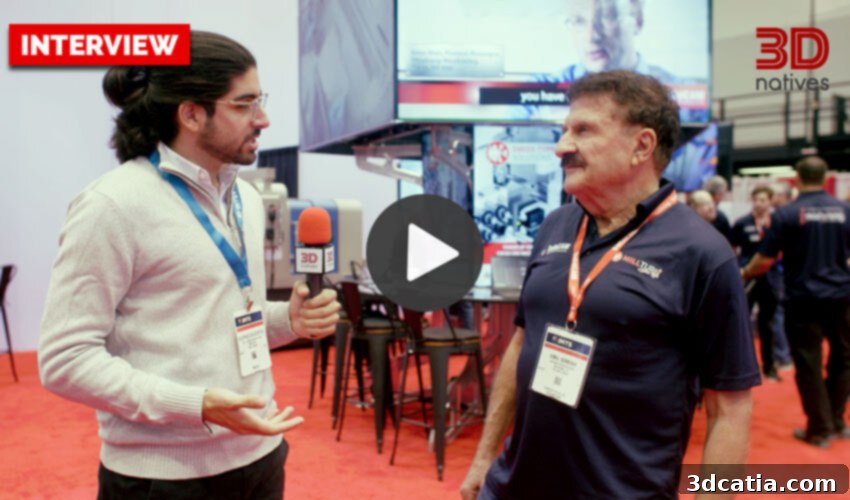
Our journey into this week’s top 3D printing innovations begins with a significant development from IMTS 2022, where 3Dnatives had the exclusive opportunity to witness the latest advancements firsthand. Among the many exciting updates, SolidCAM, a well-established and respected leader in the traditional Computer Numerical Control (CNC) and Computer-Aided Manufacturing (CAM) software market, made a pivotal announcement: their strategic expansion into metal 3D printing. This move is not merely an adoption of new technology but a conscious effort to integrate the precision and efficiency of CNC and CAM with the design freedom and material possibilities of metal additive manufacturing. We were privileged to sit down with Dr. Emil Somekh, CEO and Founder of SolidCAM, and Anthony Calderone, the company’s Head of AM, to gain deeper insights into this transformative approach. They elaborated on how hybrid manufacturing systems, combining subtractive and additive processes, are set to redefine industrial production, enhancing capabilities and streamlining workflows for manufacturers worldwide. Their vision emphasizes seamless data flow and process control, which are crucial for unlocking the full potential of both worlds. This interview offers a fascinating glimpse into the convergence of traditional and advanced manufacturing, highlighting how SolidCAM is leading the charge in creating more robust and versatile manufacturing ecosystems. Don’t miss our exclusive video to understand the full scope of their innovative strategy!
Top 2: HP Unleashes Its Commercial Metal Jet S1000 Additive Manufacturing Solution
Next on our list is a long-anticipated announcement that marks a major milestone in the industrial adoption of metal 3D printing. First unveiled as a concept back in 2018, HP’s ambitious metal AM solution faced various challenges and delays, partly due to global events. However, the wait is finally over! At IMTS 2022, HP proudly announced the commercial availability of its groundbreaking metal additive manufacturing solution: the HP Metal Jet S1000. This powerful system is designed to empower manufacturers with the ability to produce high-quality, complex metal parts rapidly and cost-effectively, moving beyond traditional manufacturing constraints. HP’s Metal Jet technology, leveraging binder jetting, promises to revolutionize industries by making series production of intricate metal components more accessible and efficient. The company’s vision is to enable users to create “one-of-a-kind” metal parts at scale, fostering innovation across diverse sectors, including automotive, industrial, and medical. This commercial launch signifies HP’s serious commitment to expanding its influence from traditional 2D printing into high-volume, advanced 3D manufacturing. The implications for streamlined supply chains, customized product development, and accelerated time-to-market are immense. Witness the technology in action and understand its operational mechanics in the video provided below, which illustrates how the Metal Jet S1000 is poised to transform metal part production.
Top 3: Northrop Grumman’s Innovation in Scalable Composite Robotic Additive Manufacturing for Aerospace
Considering the critical and expanding role of additive manufacturing within the aerospace and defense sectors, it comes as no surprise that one of the industry’s leading global players, Northrop Grumman, is at the forefront of adopting and advancing this transformative technology. This next video highlights Northrop Grumman’s pioneering efforts in the rapid development of high-performance, high-temperature materials through its innovative Scalable Composite Robotic Additive Manufacturing Carbon/Carbon (SCRAM C/C) process. This sophisticated technology is described as a unique blend of fused filament fabrication (FFF) and automated fiber placement (AFP), combining the strengths of both methods to create structures with unparalleled material properties. SCRAM C/C leverages robotic precision to strategically lay down continuous carbon fibers, embedding them within a high-temperature polymer matrix which is then converted into robust carbon/carbon composites. The company firmly believes that this advanced technology will be instrumental in the continued development of next-generation hypersonic and high-speed weapons systems, where extreme temperatures and structural integrity are paramount. The ability to rapidly prototype and produce complex composite structures with tailored properties opens up new frontiers for aerospace design and performance. This innovation not only addresses current manufacturing challenges but also pushes the boundaries of what is possible in extreme-environment applications, promising lighter, stronger, and more resilient components crucial for future defense capabilities. Explore how this intricate process works and its potential impact in the comprehensive video below.
Top 4: CerAMfacturing’s Comprehensive Solutions for High-Performance Ceramic 3D Printing
While ceramics may have historically played a niche role in the early stages of additive manufacturing, their importance and popularity in the sector have surged dramatically in recent years. Today, the use of ceramic materials in 3D printing is becoming increasingly vital for applications demanding exceptional properties, particularly high temperature and wear resistance, chemical inertness, and superior hardness. Fraunhofer IKTS, a renowned research institution specializing in ceramic technologies, is at the forefront of this evolution, offering complete, end-to-end solutions for the production of advanced ceramic components through its cutting-edge CerAMfacturing system. This holistic approach covers every crucial stage of the additive manufacturing process for ceramics, ensuring optimal performance and reliability. Their expertise spans from the initial development of specialized ceramic powders, suspensions, and feedstocks to the meticulous selection of the most suitable manufacturing technology for specific applications. Beyond printing, Fraunhofer IKTS also focuses on the subsequent functionalization of the printed parts, enhancing their specific properties, as well as comprehensive characterization and rigorous assessment of the cerAMfactured components and systems. This integrated methodology ensures that clients receive not just a printed part, but a fully optimized ceramic solution engineered for demanding industrial environments, medical implants, or advanced technological systems. The ability to create complex geometries with these advanced materials is unlocking new possibilities across various industries, from aerospace and automotive to electronics and biomedical engineering. Discover the depth of their expertise and the versatility of their ceramic solutions in the detailed video presentation.
Top 5: Siemens Showcases Advanced Additive Manufacturing for Electric Vehicles at IMTS 2022
Concluding our top five videos for the week, we bring you highlights from IMTS 2022 in Chicago, North America’s largest and most influential manufacturing technology show, which recently wrapped up. In our final insightful segment, Adam Hiller, a distinguished expert in additive and design stage solutions at the multinational German technology giant Siemens, provides an in-depth walkthrough of the intricate production process for a lightweight component designed specifically for an electric vehicle (EV). This demonstration, prominently featured at Siemens’ expansive booth at IMTS 2022, underscores the critical role of additive manufacturing in addressing key challenges within the automotive industry, particularly in the rapidly evolving EV sector. Lightweighting is paramount for electric vehicles as it directly impacts battery range, energy efficiency, and overall performance. Adam Hiller meticulously guides viewers through each stage, from initial concept and generative design optimization using advanced software, through material selection and the additive manufacturing process itself, all the way to post-processing and quality assurance. This showcase not only illustrates Siemens’ formidable capabilities in integrating additive manufacturing into a comprehensive digital enterprise but also highlights their commitment to driving innovation for sustainable mobility. Siemens’ holistic approach, often utilizing their digital twin technology, ensures that every aspect of the component’s lifecycle, from design to production and operation, is optimized for peak performance and efficiency. This demonstration serves as a powerful testament to how sophisticated software, automation, and advanced manufacturing techniques are converging to create the next generation of transportation. Witness the future of automotive manufacturing and Siemens’ pivotal contribution in the video below.
We hope this detailed exploration of the week’s top 3D printing videos has provided valuable insights into the dynamic and ever-evolving landscape of additive manufacturing. From the strategic integration of AM into traditional workflows by SolidCAM, the commercial launch of HP’s pioneering metal binder jetting technology, and Northrop Grumman’s advancements in composite robotic additive manufacturing for extreme aerospace applications, to CerAMfacturing’s comprehensive solutions for high-performance ceramics, and Siemens’ innovative lightweighting for electric vehicles – each highlight underscores the incredible pace of innovation. These developments are not just incremental improvements but represent significant leaps forward, promising to transform industries, streamline production, and unlock new possibilities for design and functionality. What are your thoughts on this week’s top additive manufacturing breakthroughs? We encourage you to share your opinions and insights in the comments section below, or join the conversation on our LinkedIn, Facebook, and Twitter pages! For those who wish to stay at the forefront of 3D printing news, don’t forget to sign up for our free weekly newsletter here, delivering the latest updates directly to your inbox. You can also explore our full library of videos on our dedicated YouTube channel for more engaging content. Thank you for being a part of our community as we continue to track the exciting journey of additive manufacturing!