
Empowering Warfighters: On-Demand Additive Manufacturing Revolutionizes Military Logistics and Field Readiness
The landscape of modern defense is rapidly evolving, and at its forefront is the transformative potential of additive manufacturing (AM). Projections indicate a significant surge in its adoption, with the value of additive manufacturing in the defense sector expected to reach a staggering $1.7 billion by 2027. This impressive growth isn’t merely speculative; it’s driven by tangible, strategic advantages that AM technologies offer. These benefits include significantly faster production times, substantial cost reductions, and the ability to achieve highly customizable outcomes tailored to specific operational needs. Unlike traditional manufacturing methods, AM allows for the creation of complex geometries and on-demand parts, drastically shortening supply chains and enhancing responsiveness in critical situations.
While 3D printing for military applications has typically been the domain of specialized experts and dedicated facilities, the US Army envisioned a bolder, more decentralized approach. They posed a crucial question: could a soldier with no prior background in additive manufacturing be trained rapidly enough to produce a vital part in a short timeframe? The implications of such an capability are profound: parts could be manufactured directly on the battlefield or at forward deployment locations precisely when they are most needed, bypassing the lengthy and often vulnerable traditional logistics networks. To rigorously test this innovative concept, a pivotal exercise was conducted at the University of Tennessee, Knoxville, spanning from August 5th to the 16th. The demonstration proved to be an unequivocal success, signaling a new era for military readiness and supply chain resilience.
This groundbreaking collaboration brought together a diverse consortium of key players, each contributing their unique expertise to the project. Leading the initiative from the government side were the US Army Combat Capabilities Development Command (DEVCOM) and the Army Research Laboratory (ARL). These agencies are at the forefront of military research and development, constantly seeking innovative solutions to enhance soldier capabilities and operational efficiency. Industry leadership was provided by SPEE3D, a renowned metal additive manufacturing company, working alongside VCR Metal Systems. Their role was critical in supplying the cutting-edge AM technology and technical support necessary for the demonstration. The University of Tennessee, Knoxville, graciously served as the academic host for the demonstration, providing a controlled yet realistic environment for the exercise. Crucially, the 278th Armored Cavalry Regiment (ACR) acted as the site host, providing the invaluable participation of active-duty soldiers who would be the ultimate end-users of this technology. This multi-faceted partnership underscored the collaborative spirit required to push the boundaries of military technology and logistics.
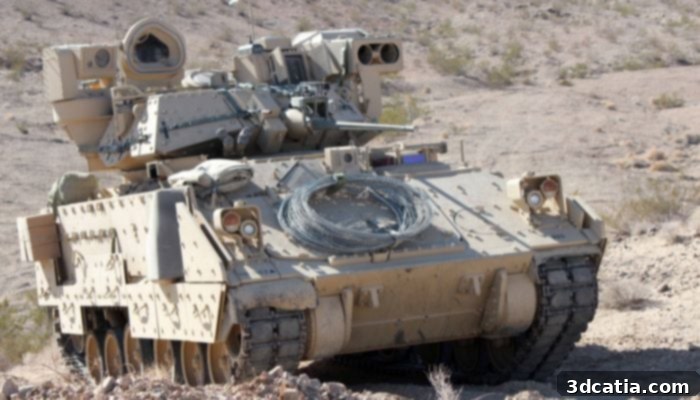
This is a Bradley Fighting Vehicle, similar to the one for which the soldier 3D printed a transmission mount, though not the same vehicle. (Photo Credit: Sgt. Eric Garland, Public domain, via Wikimedia Commons)
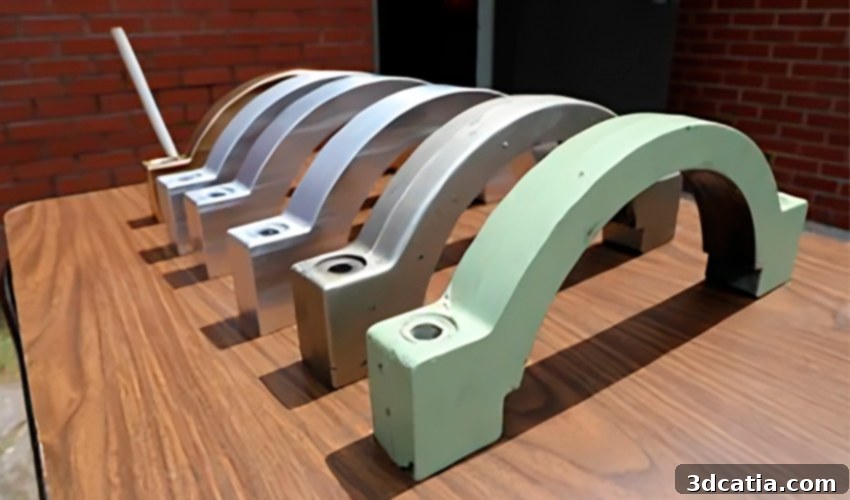
The heart of this trial focused on a critical vehicle component: a Bradley Fighting Vehicle’s transmission mount. This particular part was chosen not only for its functional importance but also as a challenging test case, representing the kind of essential, robust components needed for military hardware. For this unprecedented exercise, a soldier with absolutely no prior experience in additive manufacturing was selected and underwent targeted, brief training. This soldier quickly learned the intricacies of operating the advanced WarpSPEE3D printer, successfully fabricating the transmission mount using state-of-the-art metal 3D printing technology. The success of this initial phase was a testament to the user-friendliness of the SPEE3D system and the soldier’s rapid adaptability.
Following the successful printing, the 3D printed transmission mount was meticulously installed into the Bradley Fighting Vehicle. The real test then began: a series of rigorous test drives designed to simulate demanding operational conditions. The vehicle was subjected to various maneuvers and terrains, pushing the newly installed component to its limits. Upon the vehicle’s return and subsequent inspection, the results were conclusive and highly encouraging: the 3D printed part showed absolutely no degradation. This remarkable outcome validated the strength, durability, and functional integrity of the additively manufactured component. The mission was declared a resounding success, demonstrating that a soldier, armed with only brief training and a portable AM system, could effectively restore a critical vehicle’s capabilities in the field. This capability has profound implications for maintaining operational readiness and significantly reducing downtime for essential military assets, directly impacting mission success rates and troop safety.
At the core of this success was the advanced technology provided by SPEE3D, a globally recognized leader in metal additive manufacturing. For the demonstration, SPEE3D deployed its cutting-edge WarpSPEE3D printer, which utilizes Cold Spray Additive Manufacturing (CSAM) technology. CSAM stands apart from other AM methods due to its unique approach to material deposition. Instead of melting powders with lasers or electron beams, CSAM involves a high-velocity gas jet that sprays metal powder particles onto a substrate. The key to its effectiveness lies in the incredible speed at which these particles are accelerated—reaching velocities up to four times the speed of sound. This extreme kinetic energy causes the metal particles to bond instantaneously upon impact, primarily through a combination of mechanical interlocking and metallurgical bonding, without the need for melting.
The “cold” aspect of this process is particularly advantageous; because the metal doesn’t melt, it avoids the thermal stresses and material property changes often associated with high-temperature additive manufacturing. This ensures that the original properties of the metal are largely preserved, resulting in parts with excellent mechanical integrity. CSAM can be used for either coating surfaces or, as demonstrated in this exercise, creating entire, fully dense parts from scratch. This technology is renowned for its relative speed, significantly reducing production lead times compared to traditional methods or even other AM techniques. Furthermore, CSAM offers remarkable versatility in the types of metals that can be processed, including aluminum, copper, and various steels, making it adaptable for a wide range of military applications where material properties are paramount. Its ruggedness and ability to operate in less-than-ideal environments also make it an ideal candidate for deployed military scenarios.
Bryon Kennedy, CEO of SPEE3D, articulated the company’s vision and the significance of this demonstration, stating, “SPEE3D intends to make additive manufacturing accessible as a quick, cost-effective, and easy way to print crucial metal parts that otherwise would not be available at the point of need. Having a soldier with no previous additive manufacturing experience learn our technology within a week certainly meets that goal.” This statement underscores the core objective of decentralized manufacturing: empowering personnel with minimal specialized training to produce essential components precisely when and where they are required. The ability to rapidly train a soldier, who is already skilled in critical field operations but new to AM, to successfully print a mission-critical part within a week represents a monumental leap forward in achieving true battlefield self-sufficiency. It transforms the concept of localized repair and supply from an aspirational goal into an achievable reality, significantly reducing reliance on vulnerable, extended supply lines and external manufacturing support.
The broader implications of this success extend deeply into military operational strategies. If 3D printing can be practically and reliably achieved by deployed soldiers or those operating directly on the front lines, it signifies a paradigm shift in how parts, repairs, and even customized tools could be completed the very moment they are needed. This immediate availability can drastically improve response times, minimize equipment downtime, and enhance the overall agility of military operations. Michael Nicholas, Materials Engineer at DEVCOM ARL, further elaborated on this transformative impact, explaining, “This demonstration successfully illustrated how cold spray technology can be utilized to positively impact the warfighter in expeditionary scenarios. Expeditionary cold systems provide added repair and manufacturing capabilities which can address supply chain challenges as would be expected in a contested logistics environment. Overall, this advanced manufacturing demonstration was extremely successful due to our amazing partnerships with industry, academia, and future technology users.” Nicholas’s remarks highlight the strategic value of such technologies in “expeditionary scenarios,” which typically involve rapid deployment to austere or remote locations with limited infrastructure. In a “contested logistics environment,” where traditional supply lines are constantly under threat and highly vulnerable, the ability to manufacture parts locally becomes not just an advantage, but a critical necessity for sustaining operations. The success of this demonstration, attributed to strong partnerships across government, industry, and academia, lays the groundwork for future advancements that will redefine military logistics and empower soldiers with unprecedented levels of autonomy and readiness. For a deeper dive into the official details, the original press release can be found here.
This groundbreaking demonstration at the University of Tennessee, Knoxville, serves as a powerful testament to the transformative potential of additive manufacturing within the defense sector. By proving that complex, mission-critical metal parts can be produced on-demand by soldiers with minimal training, the US Army, in collaboration with SPEE3D and other partners, has opened up exciting new avenues for military logistics and field readiness. This capability promises to significantly reduce equipment downtime, enhance operational flexibility in remote or hostile environments, and bolster overall supply chain resilience against unforeseen disruptions. As additive manufacturing technologies continue to evolve, their integration into military operations will undoubtedly play a crucial role in shaping the future of national defense, ensuring that warfighters have the tools and parts they need, precisely when and where they need them.
What are your thoughts on the immense potential of AM technology in the field of defense? Do you envision a future where every deployed unit has its own 3D printing capabilities? We encourage you to share your insights and engage in the conversation by leaving a comment below or by connecting with us on ourLinkedIn,Facebook, andTwitter pages! To stay abreast of the very latest developments and innovations in the 3D printing world, don’t forget to sign up for our free weeklyNewsletter here, delivering the most relevant 3D printing news straight to your inbox! Additionally, you can explore all our fascinating videos and interviews on our dedicatedYouTube channel.