
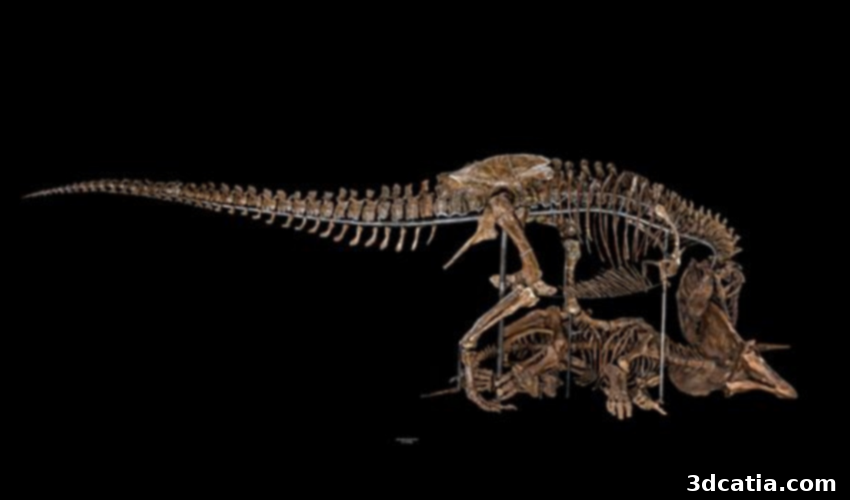
Smithsonian’s Digital Frontier: Revolutionizing Museum Access with 3D Scanning and Printing for Global Education
The recent global health crisis profoundly impacted our ability to engage with cultural institutions, leaving many longing for the rich experiences of museum visits and educational activities. However, the Smithsonian Institution in Washington D.C., a beacon of knowledge and discovery, has spearheaded an innovative solution: leveraging the power of 3D printing and 3D scanning technologies to bring its vast collections directly to you. This initiative underscores how advanced digital tools are not only revolutionizing sectors like medical training – where 3D printing facilitates personalized surgical education – but are also democratizing access to cultural heritage and knowledge on an unprecedented scale.
At the heart of this groundbreaking effort lies the Smithsonian’s 3D Program, a dedicated team working tirelessly to digitally capture and preserve the millions of artifacts housed across their 19 museums, 9 research centers, zoo, and extensive storage facilities. These meticulously created 3D scans are then made available to the public, offering a virtual gateway to an incredible world of discovery. Visitors from across the globe can now explore these priceless objects through online viewing platforms or, more remarkably, download the 3D models to print at home, transforming passive observation into active, tactile engagement. This bold step ensures that the pursuit of knowledge remains accessible, regardless of geographical barriers or unforeseen circumstances.
The Smithsonian’s Grand Digital Vision: Pioneering 3D Scanning
The journey into the digital realm for the Smithsonian began with the establishment of the Digitization Program Office (DPO) in 2009. As the world’s largest museum, education, and research complex, the Smithsonian boasts an awe-inspiring archive of material – a staggering 155 million objects, specimens, volumes, and historical archives. Yet, a challenging reality persists: less than 1% of this colossal collection can be physically displayed at any given time. The DPO was founded with the ambitious mission to overcome this limitation, striving to find innovative ways to showcase and make accessible the vast treasures held within its walls.
Integral to this expansive project is the formation of the 3D Program. Greeting visitors to their dedicated website with the inspiring words, “Welcome to the 3D Scanning Frontier,” the 3D program stands as a testament to the Smithsonian’s commitment to education. Its primary objective is to enlighten and engage individuals globally with the extraordinary artifacts that define human history, natural science, and cultural diversity, all meticulously preserved within the Smithsonian’s extensive collections. This digital initiative transforms static objects into dynamic, interactive learning experiences, fostering a deeper connection with our shared heritage.
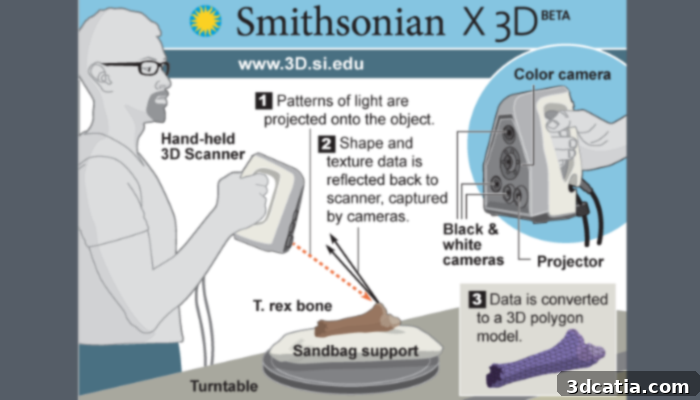
An infographic showing the process the team at the Smithsonian used to 3D scan a T.rex (photo credits: Smithsonian)
Unlocking Knowledge: The Power of Open-Access 3D Data
The 3D Program’s mission, as articulated on their website, defines their core purpose: “The 3D program is a small group of technologists working within the Smithsonian Institution’s Digitization Program Office. We focus on developing solutions to further the Smithsonian’s mission of ‘the increase and diffusion of knowledge’ through the use of three-dimensional scanning technology, analysis tools, and our distribution platform.” This statement perfectly encapsulates their dedication to leveraging cutting-edge technology for public benefit. Perhaps the most exciting aspect of this initiative is the institution’s commitment to open access.
The Smithsonian has embraced an open-access policy, meaning the vast majority of these digital scans are available for public use without restriction. Users are free to download, transform, modify, and share thousands of Smithsonian 3D objects for virtually any purpose, including personal 3D printing projects, academic research, or creative endeavors. This incredible freedom is granted through the “CC0” (Creative Commons Zero) license, which effectively waives all copyright to the extent allowed by law. This liberates the data, empowering educators, students, researchers, artists, and hobbyists worldwide to interact with and learn from these artifacts in ways never before possible.
As of its latest update, the Smithsonian’s 3D portal boasts an impressive collection of 2544 digital scans, with a remarkable 2346 of these designated with the CC0 license. This includes a breathtaking array of historically and scientifically significant artifacts. Imagine holding a 3D-printed replica of the Apollo 11 Command Module in your hands, exploring the intricate details of a Triceratops horridus Marsh skull, examining a prehistoric mammoth, or studying the dignified features of Abraham Lincoln’s bust. These are just a few examples of the invaluable pieces of history and science that are now accessible to anyone with an internet connection and a 3D printer.
While a significant portion of this digital collection originates from the Smithsonian’s Natural History Museum’s vertebrate zoology mammals division, the project’s scope is incredibly diverse. Users can also discover artifacts from the National Air and Space Museum, delving into the history of flight and space exploration; the American Art Museum, exploring masterpieces of American creativity; and the National Museum of African American History and Culture, offering profound insights into the African American experience, among many other contributing institutions. This multidisciplinary approach ensures a rich and varied digital learning experience for all.
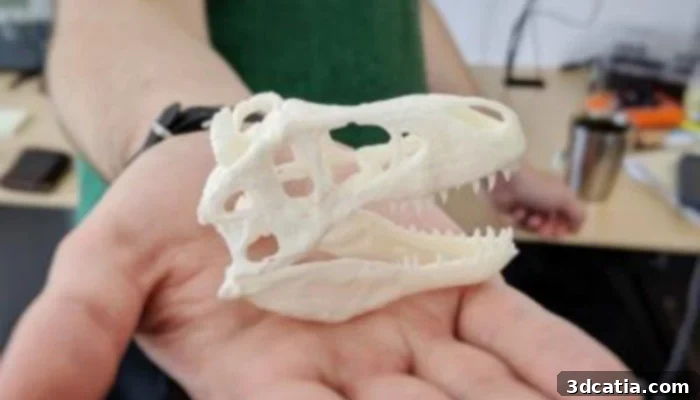
A 3-D printed T. rex skull (Photo Credits: Smithsonian Digitization Program Office)
3D Printing and Scanning: Catalysts for Educational Innovation
The transformative potential of 3D printing and scanning in education is truly immense. Traditionally, education relies heavily on visual aids and written descriptions, but 3D technologies add a crucial tactile and interactive dimension. While 3D printing has notably advanced medical training, providing realistic anatomical models for surgical and other medical training, its application in cultural education is equally profound. With museums, galleries, and educational centers facing closures during the COVID-19 pandemic, the Smithsonian’s open-access collection became an indispensable resource, allowing people of all ages to access the vast knowledge held within these revered institutions from the safety and comfort of their homes.
The impact extends far beyond simple viewing. These 3D models empower educators to create dynamic, immersive lesson plans. Students can manipulate historical objects digitally, zoom in on minute details, and even 3D print scaled replicas for hands-on learning experiences. This is particularly beneficial for kinesthetic learners and those with visual impairments, for whom tactile interaction can significantly enhance comprehension and engagement. Imagine a history class where students can physically hold a miniature replica of the Apollo 11 module, or a biology lesson where they can examine the cranial features of a Triceratops skull with their own hands – this brings abstract concepts to life in an incredibly tangible way.
Furthermore, the website highlights the diverse and practical applications of this 3D data across various disciplines. It states, “Researchers in the field can now come back not only with specimens, but also 3D data documenting entire sites. Curators and educators are using 3D data as the basis for telling stories and sending students on quests of discovery. Conservators are using 3D data to track the condition of a collection item over time using 3D deviation analysis tools, showing exactly what changes have occurred to an object.” These insights reveal the multifaceted benefits of the program.
For researchers, 3D data offers a non-invasive method for detailed analysis, comparative studies, and the creation of precise digital archives, enriching scientific and historical understanding. Curators and educators gain powerful tools for storytelling, developing interactive exhibits, and designing educational quests that foster curiosity and critical thinking among students. Meanwhile, conservators benefit from unparalleled precision, using 3D deviation analysis to monitor the subtle degradation or structural changes in artifacts over time, thus informing preservation strategies and ensuring the longevity of our cultural heritage. This comprehensive approach underscores the invaluable role of 3D technology in both preserving the past and shaping the future of education and research.
Ultimately, whether you aspire to simply explore the extensive collection of digital scans or to 3D print a precise replica of a priceless historical artifact, the Smithsonian’s pioneering project offers an unparalleled opportunity. It democratizes the museum experience, making it accessible to everyone, everywhere, and fostering a deeper appreciation for history, science, and art while remaining safely at home. This initiative exemplifies how digital innovation can bridge gaps, inspire learning, and preserve our collective human story for generations to come. You can find out more information about this inspiring project and explore its vast digital collections HERE.
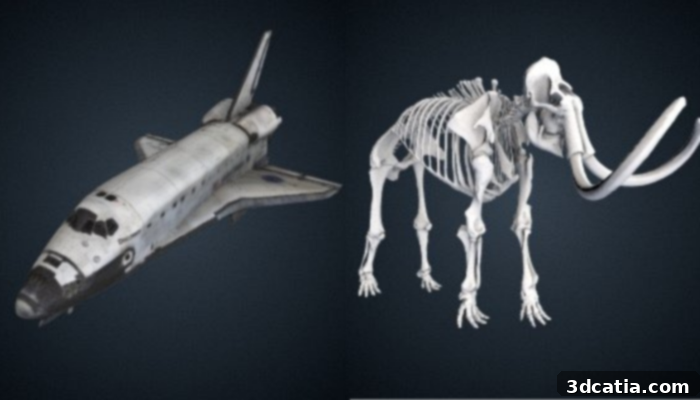
The space shuttle, Orbiter, and a mammoth, two of the scans available on the 3D portal (photo credits: Smithsonian Digitization Program Office)
What are your thoughts on the groundbreaking 3D project at the Smithsonian? How do you envision these digital artifacts shaping the future of education and cultural engagement? We’d love to hear your perspectives in a comment below or join the conversation on our Facebook and Twitter pages! For the latest updates and breaking news in the world of 3D printing and additive manufacturing, don’t forget to sign up for our free weekly Newsletter here, delivered straight to your inbox!
*Thumbnail photo credits: Smithsonian Magazine