
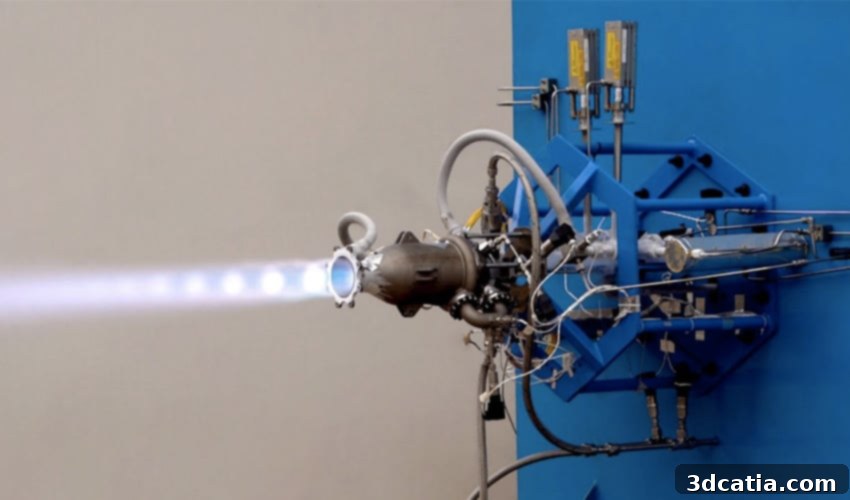
Skyroot Aerospace Unveils Dhawan-II: India’s Powerful 3D Printed Cryogenic Rocket Engine Revolutionizing Space Access
The ambitious landscape of global space exploration is undergoing a rapid transformation, largely driven by innovative private companies pushing the boundaries of technology. Among these trailblazers, Skyroot Aerospace, an Indian private space launch vehicle company, has consistently demonstrated its commitment to leveraging cutting-edge manufacturing techniques, particularly 3D printing, to develop next-generation propulsion systems. It was in 2020 that the aerospace community first learned about Dhawan-I, Skyroot’s pioneering fully 3D printed cryogenic engine. This initial achievement marked a significant milestone, clearly showcasing the immense potential of additive manufacturing in crafting complex, high-performance components crucial for modern spaceflight. Now, three years later, Skyroot Aerospace has once again captured international attention with the unveiling of its highly anticipated and significantly improved successor: the Dhawan-II.
The new Dhawan-II engine has successfully completed a rigorous testing phase, signaling a major leap forward in both Skyroot’s capabilities and the broader Indian private space sector. Much like its groundbreaking predecessor, the Dhawan-II is a sophisticated 3D printed cryogenic rocket engine. Cryogenic engines are highly valued in aerospace for their superior efficiency, primarily due to their use of propellants such as liquid natural gas (LNG) and liquid oxygen (LoX). While these propellants offer a high specific impulse – meaning they generate more thrust per unit of propellant mass – they also present formidable engineering challenges. Their storage and operational requirements demand extremely low temperatures, often plummeting below -150°C, necessitating advanced material science and design. The successful tests of the Dhawan-II were conducted at Solar Industries’ state-of-the-art propulsion test facility in Nagpur, India, a key indicator of the nation’s burgeoning infrastructure dedicated to advanced aerospace research and development.
The Transformative Impact of Additive Manufacturing on Aerospace
The past few years have unequivocally cemented additive manufacturing, commonly known as 3D printing, as a truly transformative technology for the aerospace sector. Its unparalleled ability to produce intricate geometries, optimize parts for both weight reduction and enhanced performance, and dramatically shorten manufacturing lead times makes it an ideal solution for the complex components required in rockets and spacecraft. Numerous groundbreaking projects around the world serve as compelling evidence of this trend. For instance, Relativity Space achieved a monumental feat with the inaugural launch of its almost entirely 3D printed rocket, the Terran 1. This historic event demonstrated the viability of scaling 3D printing for large-scale structural components of launch vehicles, effectively charting a course for faster, more cost-effective, and agile rocket production cycles.
Beyond commercial ventures, national space agencies are also making substantial investments in this innovative technology. NASA, for example, has unveiled its revolutionary Rotating Detonation Rocket Engine (RDRE), a highly sophisticated 3D printed rocket engine specifically engineered for future deep space missions. The RDRE holds the promise of significantly higher efficiency and reduced fuel consumption, attributes that are absolutely critical for long-duration interplanetary travel. Furthermore, recognizing the immense potential and strategic importance of this manufacturing paradigm, NASA has even established a dedicated new center focused on promoting the widespread adoption of metal 3D printing across a diverse array of aerospace applications. This strategic initiative is designed to accelerate the integration of 3D printed components into vital systems, ranging from engines and airframes to various satellite parts. Ultimately, this will lead to increased efficiency, substantial cost reductions, and the enablement of more complex and innovative designs throughout the entire aerospace value chain.
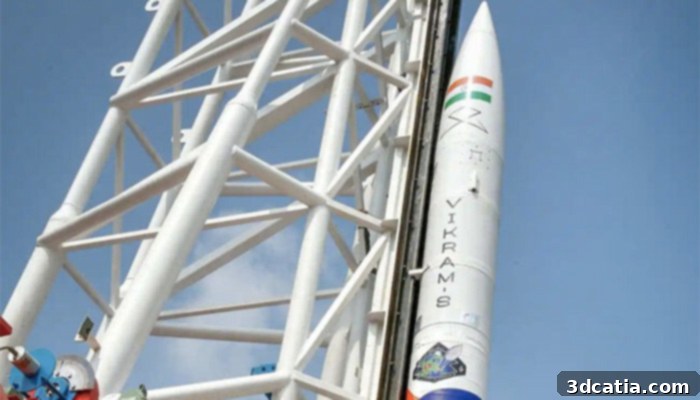
Last November, Skyroot Aerospace launched the Vikram-S rocket (photo credits: Skyroot Aerospace)
Dhawan-II: A Significant Leap in Cryogenic Propulsion and Rocket Performance
The successful development and rigorous testing of the Dhawan-II engine represent a pivotal advancement for Skyroot Aerospace, fundamentally building upon the pioneering work established with its predecessor. This exceptionally powerful 3D printed cryogenic engine is meticulously designed for integration into the upper stage of the Vikram-II, which is projected to be the heaviest and most capable launch vehicle in the Indian company’s burgeoning fleet. The strategic decision to deploy a cryogenic engine in such a critical stage is driven by its inherent ability to dramatically enhance the rocket’s payload capacity. Cryogenic propellants, despite the complexities associated with their handling and storage, offer a superior energy density compared to more traditional solid or storable liquid propellants. This fundamental advantage translates into the generation of more thrust from a comparatively smaller mass of fuel, thereby allowing the Vikram-II to carry heavier payloads into orbit or achieve higher orbital altitudes, significantly expanding Skyroot’s service offerings for satellite deployment and space missions.
In terms of raw power and performance, the Dhawan-II marks a substantial and impressive improvement over the Dhawan-I. While the Dhawan-I successfully demonstrated a maximum thrust of 1 kN, effectively setting a crucial baseline for Skyroot’s cryogenic ambitions, the new Dhawan-II engine achieves a remarkable maximum thrust of 3.5 kN. This represents an extraordinary 250% increase in thrust, a critical factor for substantially boosting the overall performance and capabilities of the Vikram-II launch vehicle. During the recent series of endurance tests, the propulsion system operated flawlessly for an extended duration of 200 seconds, equivalent to approximately 3.5 minutes of continuous firing. According to official statements from Skyroot Aerospace, these results are not merely encouraging but are indeed truly impressive, unequivocally validating the engine’s robust design, the precision of its additive manufacturing process, and its operational reliability under simulated flight conditions. The proven ability to sustain such high thrust levels for an extended period is paramount for critical orbital insertion maneuvers, and Dhawan-II’s stellar performance bodes exceptionally well for the success of the Vikram-II rocket’s future missions.
The Unparalleled Advantages of 3D Printing for Advanced Rocket Engines
The deliberate choice of 3D printing for the manufacture of sophisticated engines like Dhawan-II transcends mere novelty; it is a profoundly strategic decision that offers unparalleled advantages for the entire rocket engine development lifecycle. Traditional manufacturing methods for highly complex components such as thrust chambers, injectors, and turbopumps typically involve a multitude of individual parts, extensive and intricate welding processes, and lengthy assembly timelines. Additive manufacturing fundamentally transforms this paradigm by consolidating these numerous components into single, highly integrated structures. This drastically reduces the total part count, minimizes potential points of failure, and significantly streamlines the entire supply chain. The net result is the creation of lighter, more durable, and inherently more reliable engines that are also faster and notably less expensive to produce, offering a competitive edge in the rapidly expanding space industry.
Furthermore, 3D printing empowers engineers with the unprecedented capability to design and fabricate highly optimized internal geometries that would be utterly impossible to achieve using conventional machining or casting methods. This includes, but is not limited to, intricate and highly efficient cooling channels precisely integrated within the combustion chamber walls, or innovative injector designs that maximize propellant mixing and combustion efficiency. The rapid prototyping capabilities inherent to 3D printing also facilitate quicker design iterations and accelerated testing cycles, dramatically shortening the overall development timeline and enabling Skyroot to innovate at an unprecedented pace. For a company dedicated to providing affordable, reliable, and frequent space launch services, these profound manufacturing efficiencies and design freedoms are not merely beneficial but are absolutely vital to achieving their strategic objectives and remaining competitive in the global market.
Skyroot Aerospace: Pioneering India’s Private Space Sector and Beyond
Pawan Kumar Chandana, co-founder and CEO of Skyroot Aerospace, articulated the monumental significance of this latest achievement, stating, “The successful testing of the Dhawan-II engine is a landmark achievement for Skyroot and the Indian private space sector. We are proud to be at the forefront of developing advanced cryogenic technologies and pushing the envelope with advanced technologies, such as 3D printing and green thrusters.” This powerful statement not only underscores the technical prowess and innovation demonstrated by Skyroot but also highlights the strategic vision that positions the company at the forefront of leveraging cutting-edge advancements to establish a strong and sustainable foothold in the global space industry. Their unwavering commitment to adopting advanced technologies like 3D printing and developing environmentally friendly green thrusters clearly showcases a forward-thinking approach that prioritizes efficiency, optimizes performance, and embraces sustainability as core tenets of their development philosophy.
Skyroot Aerospace’s trajectory is characterized by clear ambition and a well-defined roadmap for future success. Following the successful sub-orbital flight of the Vikram-S rocket last November – a mission that, while not intended for orbital insertion, provided invaluable flight data and served as a critical precursor for subsequent endeavors – the company is diligently preparing for its next series of major milestones. The highly anticipated first orbital flight with the Vikram-I rocket is projected to take place by the end of this year, marking a truly significant step towards achieving full operational capability and offering commercial launch services. Looking further ahead, the launch of the Vikram-II, which will be powered by the advanced 3D printed cryogenic Dhawan-II engine, is firmly scheduled for 2024. These eagerly awaited upcoming missions are poised to solidify Skyroot’s position as a leading player not only within the vibrant Indian private space sector but also as a significant and emerging contributor to global launch services. To delve deeper into Skyroot’s innovative projects, strategic plans, and future aspirations, interested readers are encouraged to explore their official website by clicking HERE.
The Future of Space Propulsion: A 3D Printed Reality in Motion
The successful development, rigorous testing, and imminent integration of Skyroot Aerospace’s Dhawan-II engine vividly illustrate the profound and transformative impact that 3D printing is having on the aerospace industry. From significantly reducing manufacturing complexity and associated costs to enabling radically new and optimized designs, and crucially, accelerating development cycles, additive manufacturing is undeniably shaping the very future of rocket propulsion. As pioneering companies like Skyroot continue to innovate and push technological boundaries, we can realistically anticipate the dawn of a new era defined by more efficient, more reliable, and ultimately more accessible space travel. This ongoing technological revolution is not only empowering private enterprises to effectively compete with long-established giants in the space sector but is also fostering a vibrant and dynamic ecosystem of innovation that will ultimately benefit humanity’s broader aspirations in space exploration and scientific discovery.
What are your thoughts on this powerful 3D printed cryogenic engine and the rapidly increasing role of additive manufacturing in shaping the future of spaceflight? We genuinely invite you to share your valuable insights, perspectives, and comments below. You can also connect with our community and join the discussion on our various social media platforms, including LinkedIn, Facebook, and Twitter. To stay comprehensively informed about the very latest advancements in 3D printing technology and its diverse applications across industries, don’t forget to sign up for our free weekly Newsletter here, which will be delivered directly to your inbox. For even more engaging and informative video content, we encourage you to explore our extensive and growing library on our dedicated YouTube channel.
*Cover photo credit: Skyroot Aerospace