
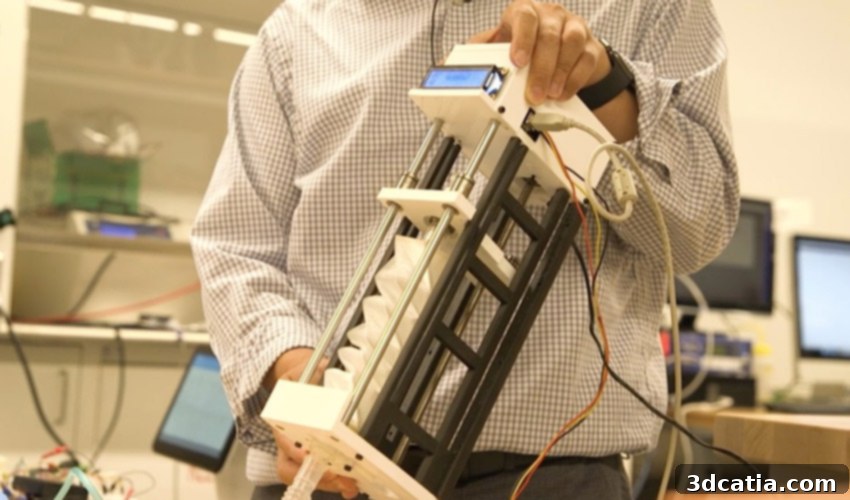
Origami-Inspired Innovation: SFU’s 3D-Printed Portable Ventilator Revolutionizes Global Healthcare Access
The recent global health crisis unequivocally exposed critical vulnerabilities within our medical supply chains and highlighted the urgent need for innovative, accessible, and resilient healthcare solutions. In response to this pressing challenge, a pioneering team of researchers at Simon Fraser University (SFU) in Canada, led by the esteemed Professor Kim Woo Soo, has developed a groundbreaking 3D-printed ventilation system. This ingenious device draws profound inspiration from the ancient Japanese art of paper folding, famously known as origami, transforming intricate artistic principles into life-saving medical technology.
By integrating origami design philosophies, the SFU team has successfully engineered a portable ventilator that significantly reduces the weight, size, and production cost compared to traditional units. A remarkable testament to the power of additive manufacturing, this system comprises an astonishing 95% 3D-printed parts. Such a lightweight and compact design makes this portable ventilation system invaluable for patients requiring easily transportable respiratory support outside conventional hospital settings. This includes individuals residing in isolated rural areas, regions with limited access to advanced healthcare infrastructure, developing countries striving to bolster their medical capabilities, or even overburdened healthcare establishments experiencing an unprecedented surge in patient volume during health emergencies.
Addressing Healthcare Gaps with Additive Manufacturing
The COVID-19 pandemic served as a stark reminder of how rapidly global events can strain medical resources and expose the weaknesses of centralized manufacturing. During the peak of the crisis, when traditional supply chains faltered, additive manufacturing – commonly known as 3D printing – emerged as a rapid and agile solution, providing short and medium-term answers to critical shortages. From readily available respiratory masks and essential medical equipment components like ventilator valves, to even some complete ventilation systems, 3D printing showcased its unparalleled ability to decentralize production and accelerate access to vital care solutions.
Even as global mandates have eased and daily activities have regained a semblance of normalcy, the threat of COVID-19 and other respiratory illnesses remains ever-present, keeping the medical sector vigilant and on alert. In proactive preparation for potential future waves or other public health challenges, researchers like those at Simon Fraser University are continually pushing the boundaries of medical innovation. Their dedication has culminated in this sophisticated yet simplified ventilation system, designed to be both more economical to produce and significantly easier to transport than its conventional counterparts. This forward-thinking approach underscores a paradigm shift towards more adaptable and resilient healthcare technologies.
The Ingenuity of Origami: A Foundation for Mechanical Resilience
At the heart of SFU’s innovative ventilator lies a core principle that marries ancient art with modern engineering: origami. This system was specifically conceived to deliver effective assisted breathing, and its design brilliance is most evident in the integration of a specialized 3D-printed tube, structured using origami principles. This unique approach allows for a dramatic reduction in the overall size of the machine while simultaneously enhancing its mechanical resistance and structural integrity. Unlike rigid, bulky components, origami-inspired structures can be highly compact in their folded state and robust when expanded, offering superior strength-to-weight ratios.
Professor Kim Woo Soo elaborates on the cost-efficiency, stating: “In our origami portable fan, more than 95% of the components can be 3D printed, which is why it is truly cost-effective. Other portable devices can cost over $2,000, but our 3D-printed fan can be produced for around $200.” This tenfold reduction in cost is not merely an economic advantage; it represents a monumental leap towards democratizing access to life-saving medical technology. By bringing down the financial barrier, this ventilator opens doors for wider adoption in low-resource settings and enables healthcare providers to equip more facilities and individuals with critical respiratory support without prohibitive investment. The inherent scalability of 3D printing also means that production can be localized and adapted to specific regional needs, further strengthening global healthcare resilience.
Unprecedented Portability and Material Innovation
The system’s exceptional portability is further underscored by its remarkably low weight of only 4.5 kilograms (approximately 9.9 pounds). This feather-light design is attributed, in part, to the judicious selection and use of ultralight materials throughout its construction. While the research team did not explicitly detail the specific 3D printing process employed, it is highly probable that an extrusion technology, such as Fused Deposition Modeling (FDM), was utilized. FDM is renowned for its cost-effectiveness, accessibility, and ability to print with a wide range of lightweight yet durable thermoplastics like PLA, ABS, or PETG, which are ideal for producing strong, functional prototypes and end-use parts quickly. This combination of lightweight materials and an efficient manufacturing process ensures that the device can be easily transported by medical personnel, first responders, or even family members, making it suitable for deployment in challenging environments where larger, heavier equipment would be impractical.
This groundbreaking device holds immense promise for patients who lack immediate access to a nearby hospital or specialized medical facility. Imagine the impact in remote villages, during humanitarian crises, or in the homes of individuals with chronic respiratory conditions who require continuous but flexible support. The SFU team’s vision extends beyond just ventilation; Professor Kim and his colleagues have also initiated parallel research into the manufacturing of 3D-printed origami dry electrodes. These advanced electrodes are designed to detect and continuously monitor vital physiological signals, including body temperature, heart rate, and muscle movement. This integrated approach points towards a future where portable, interconnected, and origami-inspired medical devices could offer comprehensive, cost-effective health monitoring and intervention, truly transforming the landscape of distributed healthcare.
The Broader Impact: A Paradigm Shift for Global Healthcare
The development of SFU’s origami-inspired 3D-printed ventilator signifies more than just a technological advancement; it represents a paradigm shift in how we approach global healthcare challenges. By embracing innovative design principles like origami, coupled with the transformative capabilities of additive manufacturing, researchers are paving the way for a new generation of medical devices that are not only effective but also inherently sustainable, accessible, and resilient. This approach directly addresses the inequities in healthcare access that plague many parts of the world, offering a tangible solution for those who are most underserved.
The economic implications of producing a life-saving ventilator for merely $200 cannot be overstated. It empowers governments, NGOs, and local communities to invest in essential medical infrastructure on a scale previously unimaginable. Furthermore, the ability to rapidly manufacture these units using 3D printing allows for quick deployment in emergency situations, ensuring that critical care can reach those in dire need without being hampered by slow global supply chains. This localized, on-demand production model builds regional self-sufficiency and strengthens preparedness against unforeseen health crises.
The synergy between art, science, and engineering, exemplified by Professor Kim Woo Soo’s team at SFU, illustrates the profound potential for interdisciplinary collaboration in solving complex societal problems. The ventilator, born from a fusion of ancient folding techniques and cutting-edge 3D printing, stands as a beacon of hope for a future where high-quality medical care is not a luxury but an accessible right for everyone, everywhere. This ongoing research, including the parallel work on origami dry electrodes, promises to unlock even more possibilities for smart, portable, and integrated health solutions that can monitor, diagnose, and treat with unprecedented efficiency and affordability.
For more detailed information on this remarkable innovation and the ongoing work at Simon Fraser University, you can find further insights HERE.
*Thumbnail Photo Credits: Simon Fraser University
What are your thoughts on this revolutionary 3D-printed ventilation system and its potential to transform global healthcare? Share your insights and opinions in a comment below, or engage with us on our Facebook and Twitter pages. Don’t miss out on the latest advancements in additive manufacturing – be sure to sign up for our free weekly newsletter, delivering all the essential 3D printing news directly to your inbox!