

Revolutionizing Additive Manufacturing: INEOS Styrolution’s PolySLS Project Unlocks Significant Energy Savings with Sustainable Styrenics
INEOS Styrolution, a global leader in the production and supply of styrenics, has announced groundbreaking findings from its innovative R&D initiative, the PolySLS project. This ambitious undertaking was specifically designed to pioneer a new generation of energy-saving, styrenics-based materials tailored for the rapidly evolving field of additive manufacturing. Renowned for its commitment to high-quality products and cost-effective, diverse operational facilities, INEOS Styrolution plays a pivotal role across numerous industries, including advanced manufacturing techniques like 3D printing. The PolySLS project, significantly bolstered by funding from the German Ministry for Economic Affairs and Energy (BMWi), focused intensely on developing and rigorously testing a novel styrene-based polymer compound for Selective Laser Sintering (SLS) technology. A core objective was to meticulously research and optimize both the energy consumption and material requirements throughout the additive manufacturing process, addressing critical challenges within the industry.
The imperative for such innovative materials is underscored by the well-documented environmental challenges associated with conventional polymers, particularly polystyrene. While incredibly versatile, polystyrene is notorious for its extremely slow degradation rate, estimated at a staggering 500 years, posing a significant long-term threat to ecosystems. Furthermore, its manufacturing processes are often linked to a substantial portion of hazardous waste generation, directly contributing to the global climate crisis. Beyond the environmental footprint of the material itself, the additive manufacturing sector faces its own unique waste dilemma. A comprehensive report by industry giants Materialise and BASF highlighted that approximately half of the powder utilized in the Selective Laser Sintering process typically ends up as waste. This considerable material loss represents not only an economic inefficiency but also an added environmental burden. Given these pressing concerns, INEOS Styrolution’s PolySLS project emerges as a critically important initiative, aiming to mitigate these impacts through sustainable material innovation.
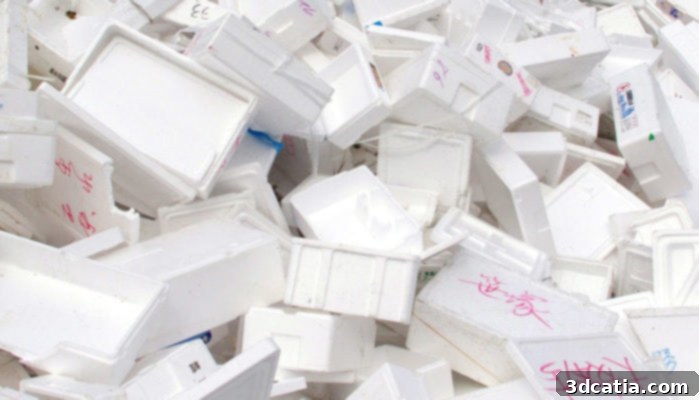
Each year around 150,750 tonnes (45% of total produced) of expandable polystyrene is landfilled in the EU.
Leveraging over 90 years of unparalleled experience in styrenics and operating world-class production facilities, INEOS Styrolution embarked on the PolySLS project in 2017, culminating in its completion in November of last year, after three intensive years of research and development. The recently released report from INEOS Styrolution delves into the initial, highly encouraging results of this project, primarily focusing on the remarkable energy savings achieved with their newly developed styrenics polymer, specifically engineered for 3D printing applications. The findings are nothing short of impressive: the project demonstrates a direct energy saving of more than 27% when using the innovative styrenics polymer in the SLS process. This significant reduction is a testament to the material’s superior processing characteristics. What’s even more compelling is that these savings escalate dramatically when considering the entire life cycle of the material. When compared to Polyamide 12 (PA12), which has traditionally been the go-to material for many SLS applications, the total energy savings can reach an astounding 67%. This holistic perspective, encompassing production, processing, and potential end-of-life implications, highlights the profound environmental and economic advantages of this new styrenics solution for sustainable manufacturing.
These substantial energy efficiencies are largely attributed to the intrinsic properties of the new styrenics polymer and its synergistic interaction with advanced 3D printing technology. Researchers utilizing specialized 3D printing equipment were able to achieve a direct energy saving of 25% with the novel styrenics polymer. This was primarily a result of the material requiring lower process temperatures during sintering, along with significantly shorter heating and cooling phases during the build process. These optimized thermal cycles directly translate into reduced energy consumption and enhanced operational efficiency. Furthermore, the overall process time experienced a notable improvement, being 7.5% shorter compared to printing with PA12. Yvonne van Veen, Market Innovation Strategy Director at INEOS Styrolution, expressed the company’s enthusiasm for these developments: “With the additive manufacturing industry growing at very high rates, we are excited we have developed a material that not only contributes to energy saving and sustainable production but also is an easy material to handle in the printing process.” This emphasis on ease of use is critical for broader industry adoption, reducing the learning curve and operational complexities for manufacturers looking to integrate these advanced materials into their workflows.
Photo Credit: INEOS Styrolution
The implications of INEOS Styrolution’s PolySLS project extend far beyond mere energy reduction; they herald a significant shift towards more sustainable and efficient practices within the additive manufacturing sector. By offering a high-performance material that not only reduces energy consumption during printing but also contributes to more sustainable production cycles, this innovation addresses two of the most pressing challenges facing modern industry. The potential for a material that is “easy to handle” further enhances its appeal, removing a common barrier to entry for new technologies and encouraging wider adoption across various applications, from automotive and aerospace to consumer goods and medical devices. The success of PolySLS demonstrates the power of targeted R&D, especially when supported by strategic funding from governmental bodies like the BMWi, to drive forward material science and create tangible environmental benefits. This project paves the way for a future where high-quality 3D printed components can be produced with a drastically reduced carbon footprint, aligning perfectly with global efforts to combat climate change and promote a circular economy.
The development of this advanced styrenics polymer positions INEOS Styrolution as a vanguard in the sustainable material revolution for additive manufacturing. As the industry continues its exponential growth, the demand for innovative, eco-friendly, and high-performing materials will only intensify. The PolySLS project’s findings suggest a promising pathway for styrenics to become a preferred choice for Selective Laser Sintering, challenging the dominance of traditional materials like PA12. This shift can lead to not only direct energy savings but also potentially influence the entire supply chain, fostering more environmentally conscious material sourcing, processing, and waste management strategies. INEOS Styrolution’s commitment to combining scientific excellence with practical, industry-applicable solutions underscores its leadership and vision for a more sustainable future in manufacturing. This breakthrough serves as an inspiring example of how dedicated research can transform established industrial processes into greener, more efficient, and economically viable operations, benefiting both businesses and the planet.
In conclusion, INEOS Styrolution’s PolySLS project represents a monumental step forward for sustainable additive manufacturing. The significant energy savings – over 27% directly and up to 67% over the material’s lifecycle compared to PA12 – coupled with improved process efficiency and ease of use, positions this new styrenics-based polymer as a game-changer for Selective Laser Sintering. This innovation not only addresses critical environmental concerns related to waste and energy consumption but also provides a practical, high-performance solution for an industry that is continually striving for greater efficiency and ecological responsibility. As the demand for advanced 3D printing solutions continues to surge, materials like those developed through PolySLS will be instrumental in shaping a more sustainable and technologically advanced manufacturing landscape worldwide.
What do you think about INEOS Styrolution’s PolySLS project and its potential impact on sustainable additive manufacturing? We invite you to share your thoughts and insights in a comment below, or join the conversation on our Facebook and Twitter pages! For the very latest 3D printing news, delivered straight to your inbox, don’t forget to sign up for our free weekly Newsletter here.