
Revolutionary 3D Printed Beak: Formlabs BioMed White Resin Saves Endangered Hornbill from Cancer
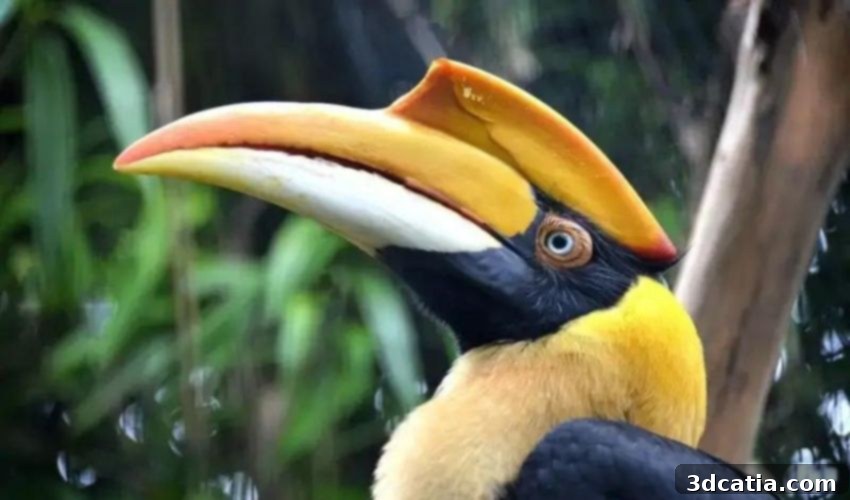
Additive manufacturing, commonly known as 3D printing, has consistently demonstrated its profound value across various medical disciplines, frequently offering solutions that were once considered impossible. Its capacity to create highly customized, precise, and biocompatible components has revolutionized patient care, extending its benefits from human medicine to innovative veterinary applications. In remarkable instances, this cutting-edge technology directly contributes to saving lives, as powerfully illustrated by the extraordinary case of Crescent, a Great Indian Hornbill residing at ZooTampa in Florida. Faced with a life-threatening condition, Crescent’s story highlights the transformative potential of 3D printing. A dedicated team of medical professionals and veterinarians, leveraging Formlabs’ advanced BioMed White Resin, successfully designed and fabricated a 3D printed prosthetic beak. This pioneering intervention not only averted a fatal outcome but also secured a second chance at life for this magnificent bird, setting a new precedent in wildlife conservation and veterinary medicine.
The challenging journey began when astute caretakers at ZooTampa first observed a concerning lesion on Crescent’s casque. The casque is the distinctive, prominent helmet-like structure located on the upper part of the Great Indian Hornbill’s beak, crucial for species recognition, display, and sometimes even for structural integrity. Further diagnostic investigations revealed a grim prognosis: the 25-year-old bird had developed what veterinarians suspected to be a squamous cell carcinoma. This aggressive form of skin cancer is unfortunately common, not only in birds but also in humans, and is known for its invasive nature. While this particular endangered species, the Great Indian Hornbill, exhibits a genetic predisposition to such diseases, a diagnosis of squamous cell carcinoma of the casque is, tragically, almost always fatal. The veterinary team at ZooTampa was confronted with an agonizing dilemma; traditional treatments offered little hope. After extensive deliberation and consultation, they concluded that the sole viable path to save Crescent’s life was the radical surgical removal of the entire infected section of the beak. However, this critical procedure presented its own set of severe complications: excising the diseased casque would inevitably leave a substantial, exposed void, directly exposing Crescent’s delicate sinus cavities to environmental pathogens and injury, posing a significant threat to her survival and overall well-being.
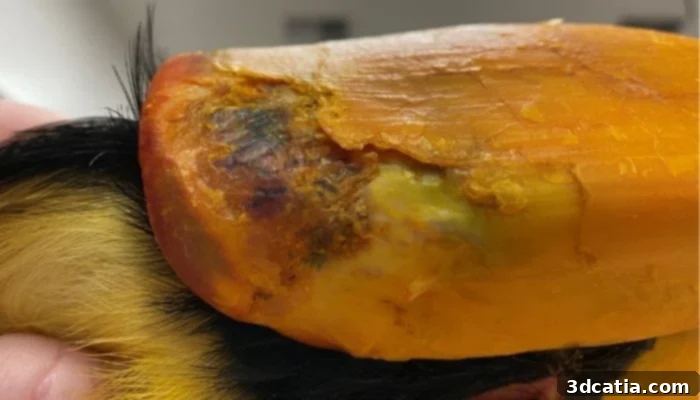
The squamous cell carcinoma often ends fatal (photo credits: Formlabs)
In a testament to their unwavering commitment to Crescent’s survival, the veterinarians at ZooTampa reached out to the renowned medical team at the University of South Florida (USF) for specialized assistance. This collaboration marked a crucial turning point. Dr. Summer Decker, the esteemed Director of 3D Clinical Applications within USF’s Radiology Department, emerged with an innovative and audacious proposal: to utilize the power of 3D printing technology to fabricate a custom prosthetic replacement for the missing section of Crescent’s casque. Dr. Decker was no stranger to the transformative capabilities of additive manufacturing, having extensively employed 3D printing for the creation of intricate and patient-specific prosthetics in human medicine. Her prior successes imbued her with profound confidence that this groundbreaking technology could yield equally positive outcomes when applied to the unique anatomical challenges presented by the oversized bird. This bold idea laid the foundation for an unprecedented cross-disciplinary effort, merging the specialized knowledge of zoological veterinarians with the advanced medical imaging and additive manufacturing expertise of a leading university hospital. The very concept of designing and 3D printing a functional and aesthetically appropriate prosthetic for an endangered bird represented a significant leap forward in both veterinary science and biomaterials engineering, offering a beacon of hope in a seemingly dire situation.
What ensued was an extraordinary collaborative project, bringing together a diverse and highly skilled team comprising hospital physicians, experienced veterinarians, and innovative biomedical engineers. Together, these experts meticulously crafted a complex and multi-faceted plan aimed at saving Crescent’s life. The initial and arguably most critical step involved pre-surgical planning. The USF radiology team performed highly detailed computed tomography (CT) scans of Crescent’s existing casque. These scans were absolutely paramount, providing a precise, three-dimensional digital blueprint of the bird’s unique anatomy. This intricate data was then used to accurately 3D print an exact-fitting prosthetic, ensuring optimal integration and functionality. Beyond the prosthetic itself, the invaluable CT scan data was also instrumental in the development and printing of a bespoke surgical guide. This guide, acting as a crucial template, significantly enhanced the precision of the surgical procedure for the doctors, streamlining the tumor removal process and minimizing potential complications during the delicate operation. Following this meticulous planning phase, the surgeons embarked on the challenging task of carefully removing the cancerous tumor from Crescent’s beak, a procedure requiring immense skill and steady hands. In the subsequent, equally critical step, the expertly fabricated 3D printed prosthetic was meticulously applied and secured. This involved using specialized dental acrylic, a biocompatible adhesive known for its strong bonding properties, which was then further reinforced and safely secured with small, medical-grade titanium screws. These screws provided the necessary long-term stability and structural integrity, crucial for the bird’s future well-being and function.
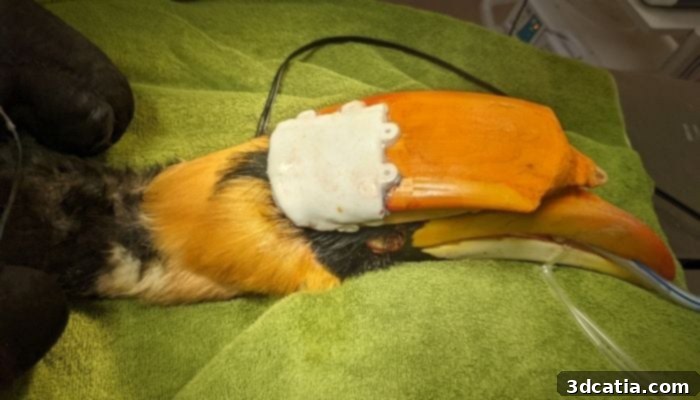
The 3D printed prosthetic covers the exact spot (photo credits: Formlabs)
Formlabs’ Innovative BioMed White Resin: A Game-Changer for Animal Prosthetics
To ensure the absolute optimal application and efficacy of 3D printing technology in this pioneering surgery, the medical team proactively established contact with the specialists at Formlabs. Recognized globally for its leadership and innovative contributions within the 3D printing industry, Formlabs enthusiastically embraced the mission. The company generously provided not only their cutting-edge printing technologies but also introduced a brand-new, specially formulated and compatible material: BioMed White Resin. At the time of Crescent’s surgery, this material had not even been officially released to the public market, underscoring its novel status. However, its unique properties and advanced composition proved to be exceptionally well-suited and, indeed, optimal for this highly unique and demanding veterinary situation.
The selection of materials for any prosthetic intended for use on a living subject, whether human or animal, is governed by incredibly stringent standards. For 3D printed medical devices, especially those implanted or in long-term contact with tissue, biocompatibility is paramount. BioMed White Resin, Formlabs’ groundbreaking material, stands out due to its exceptional qualities. It boasts USP Class VI certification, which is a rigorous standard signifying that a material is suitable for medical devices with prolonged contact with the body, ensuring non-toxicity and safety. This particular high-quality material delivers unparalleled performance, critical for the durability and resilience of a beak prosthetic that will endure daily wear and tear. Its inherent biocompatibility guarantees that it will not provoke adverse reactions or rejections from Crescent’s living tissues, a vital factor for long-term health. Furthermore, BioMed White Resin offers remarkable long-term stability, ensuring the prosthetic retains its structural integrity and aesthetic over time. All these characteristics are absolutely crucial to ensure safe, effective, and enduring results for the animal. Additionally, the resin is specifically engineered for applications where opaque materials are preferred, a key consideration for mimicking the natural appearance of the hornbill’s casque. Its combination of superior functionality and aesthetic quality made it the ideal choice for this complex surgery, undeniably contributing significantly to its resounding success and paving the way for future advancements in animal prosthetics.
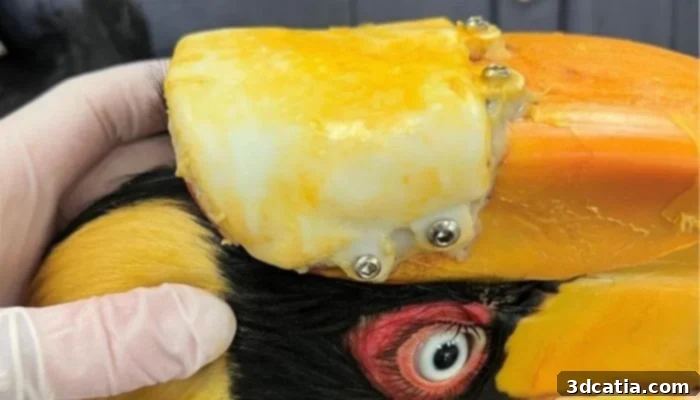
The prothesis after surgery (photo credits: Formlabs)
A New Lease on Life: Crescent’s Remarkable Recovery and the Future of Additive Manufacturing in Animal Care
In the aftermath of the complex and groundbreaking surgery, Crescent’s recovery was nothing short of remarkable. Not long after the successful completion of the procedure, she quickly began to regain her strength and has since made a full transition back to her normal behaviors and routines within her habitat at ZooTampa. The veterinary team, along with her dedicated caretakers, observed with immense satisfaction that Crescent displayed no signs of discomfort or perception that her new prosthetic was abnormal. She resumed eating, preening, and interacting with her environment as healthily and naturally as ever, a clear indication of the prosthetic’s successful integration and her full acceptance of it. This specific procedure, a 3D printed beak prosthetic for a Great Indian Hornbill, holds monumental significance beyond Crescent’s individual case. It is distinguished as the very first of its kind ever performed in the United States, and notably, only the second such operation to be successfully completed in the entire world. This incredible achievement stands as yet another powerful demonstration of how additive manufacturing continues to push the boundaries of what’s possible, not just in human healthcare but increasingly in advanced veterinary medicine, making profound improvements to the lives of animals, especially those from endangered species.
The success of Crescent’s surgery heralds a new era for animal care, opening up exciting possibilities for treating complex injuries and diseases in wildlife through customized prosthetics and surgical guides. This case provides invaluable data and a successful precedent for future interventions involving compromised animal anatomy, offering hope for countless other creatures. The ethical considerations and logistical challenges of applying such advanced technologies to animals are considerable, but the positive outcome for Crescent underscores the immense potential when human ingenuity and compassion converge. It reinforces the idea that innovative technologies like 3D printing can play a vital role in conservation efforts, providing tools for individual animal rehabilitation that contribute to the broader goal of species preservation. This landmark achievement will undoubtedly inspire further research and development in biocompatible materials and 3D printing techniques tailored for the unique physiological needs of various animal species. To delve deeper into Formlabs’ cutting-edge technologies and their innovative biocompatible resins, including the BioMed White Resin that played such a crucial role in Crescent’s recovery, interested readers are encouraged to visit the company’s official website HERE.
What are your thoughts on this incredible life-saving 3D printed beak prosthetic? We invite you to share your comments and opinions below, or engage with us on our Linkedin, Facebook, and Twitter pages! Don’t forget to sign up for our free weekly Newsletter here, ensuring you receive all the latest 3D printing news straight to your inbox! You can also explore all our compelling videos on our dedicated YouTube channel.
*Cover Photo Credits: ZooTampa