

Exploring the World of Additive Manufacturing: An Innovation Engineer’s Journey at Cobra Puma Golf
Welcome back to our #Working3D series, where we offer a unique, first-hand look into the diverse professions shaping the 3D printing sector. In this edition, we delve into the dynamic daily life of an additive manufacturing innovation engineer. This pivotal role, intricately linked to advanced product design and development, involves meticulously identifying groundbreaking opportunities and architecting integrated, technology-driven solutions. The goal is always innovation and sustainability, with a specific focus on applications within 3D printing. To illuminate this fascinating career path, we recently sat down with Drew Whited, an accomplished Innovation Engineer at Cobra Puma Golf. Drew operates at the exciting intersection of additive manufacturing and the sports industry, particularly specializing in the development of cutting-edge golf equipment. We explored his professional responsibilities, the essential qualifications for such a role, and what a typical day entails in his innovative world.
Could you please introduce yourself and your role?
My name is Drew Whited, and I currently serve as an Innovation Engineer within the dedicated Innovation team at Cobra Puma Golf. My academic journey began at Eastern Washington University, where I earned a B.S. in Mechanical Engineering. Following this, I pursued and completed an M.S. in Sports Product Design at the University of Oregon. During my time at UO, I honed my expertise in equipment design, culminating in a thesis project that focused on the ambitious task of designing and constructing a complete set of golf clubs specifically tailored for the niche world of Urban Golf – essentially, golf played in unconventional street environments. This unique project proved instrumental in opening doors to the golf industry, leading directly to my rewarding career at Cobra Puma Golf. Here, my primary focus is on spearheading the creation of novel design and manufacturing workflows. These innovative workflows seamlessly integrate advanced computational design techniques with both traditional and additive manufacturing methods, all with the ultimate goal of developing truly innovative and exceptionally high-performing golf equipment for our consumers.
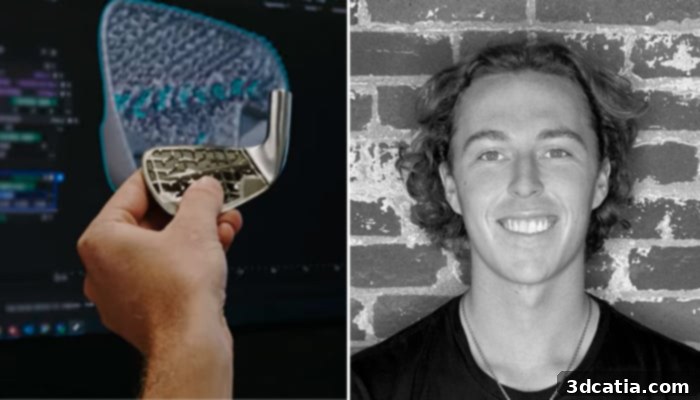
On the right, Drew Whited, Innovation Engineer at Cobra Puma Golf, demonstrating his work in additive manufacturing.
How did you first discover additive manufacturing?
My initial, groundbreaking introduction to additive manufacturing occurred during my undergraduate capstone project. Our team was presented with the challenge of designing and manufacturing a hydraulically controlled prosthetic foot for a fellow teammate. This project became a profound learning experience, quickly revealing the immense advantages of additive manufacturing’s rapid iteration capabilities. We were able to swiftly print various components, allowing for immediate shape validation and precise tolerance verification. This agility dramatically accelerated our design cycle, enabling us to test and refine our concepts with unprecedented speed. Furthermore, additive manufacturing played a crucial role in our final design, significantly contributing to weight savings and a reduction in manufacturing costs. By utilizing a continuous carbon fiber-reinforced nylon, printed via Fused Deposition Modeling (FDM), we achieved a component that not only minimized overall weight and expenditure but also offered impressive strength, comparable to certain traditional metals. This early exposure vividly demonstrated the transformative power of 3D printing in engineering applications.
My understanding and engagement with additive manufacturing deepened further during my Master’s thesis project, which provided an intensive introduction to metal additive manufacturing. For this project, all three golf clubs I designed – a putter, an iron, and a driver – were meticulously printed using 316L stainless steel through a binder jetting process. This choice was revolutionary, as it liberated me from the conventional design restrictions inherent in traditional manufacturing methods such as casting or forging. Metal 3D printing allowed for the creation of intricate geometries and internal structures that would simply be impossible to achieve otherwise, pushing the boundaries of golf club engineering. Moreover, this approach dramatically cut down on both development time and prototyping costs, primarily by eliminating the need to manufacture expensive and time-consuming casting or forging tools. The ability to directly print functional metal prototypes accelerated the design-test-iterate cycle significantly, proving invaluable for my thesis and setting the stage for future innovations.
What does your current role as an Innovation Engineer at Cobra Puma Golf involve? What is a typical day like?
As an Innovation Engineer, my role within our dedicated innovation team is fundamentally about envisioning and bringing to life the next generation of revolutionary ideas for future golf clubs. This encompasses exploring entirely new materials, refining processing techniques, pioneering unique shaping and construction methods, and, crucially, advancing manufacturing processes, particularly through additive manufacturing. Our journey begins with intensive brainstorming sessions and creative ideation, where no idea is too outlandish. These concepts then progress through rigorous design and manufacturing phases. Each design is meticulously validated through a variety of testing methods – from robotic swing tests to on-course player feedback – to ensure that all predefined design goals, whether for distance, forgiveness, or feel, are not just met, but exceeded. This comprehensive approach ensures that our innovations translate into tangible performance benefits for golfers.
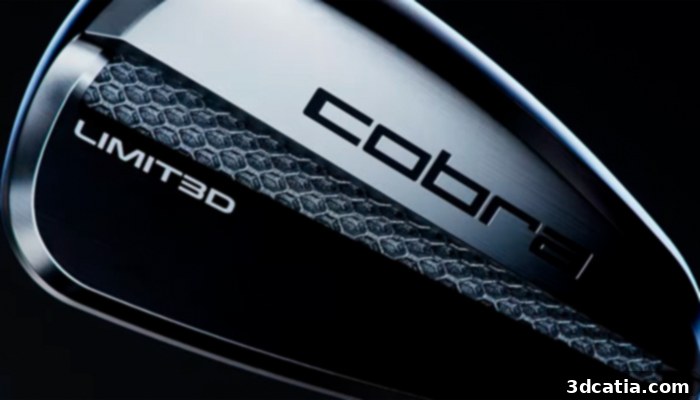
The Limit3d iron, a groundbreaking product created with advanced additive manufacturing techniques by Cobra Puma Golf.
A significant portion of my daily work involves the design and implementation of sophisticated computational design workflows. These workflows are intricate systems that seamlessly incorporate multiple different software packages, all interconnected and controlled through a powerful coding environment. This sophisticated framework empowers us to rapidly iterate through an almost limitless array of design possibilities. By setting specific design goals as inputs, we can achieve an optimized design in a mere fraction of the time typically required by conventional Computer-Aided Design (CAD) methods. The advantages are manifold: we can evaluate a far greater number of designs in significantly less time, allowing for a more thorough exploration of the design space. More importantly, this frees our team to concentrate on the truly creative aspects of the design process, rather than being bogged down by the often tedious and time-consuming CAD work that can traditionally slow innovation. Cobra Puma Golf proudly stands as a leader in leveraging additive manufacturing within the competitive golf equipment sector. A prime example of this leadership is our latest innovation, the Limit3d iron – notable as the first 3D printed iron made available directly to the consumer. The Limit3d perfectly exemplifies the power of these advanced workflows, enabling the manufacture of revolutionary new designs and complex geometries that are simply unachievable with traditional forging and casting techniques. This capability truly differentiates our products and drives performance to new heights.
What qualifications and experience are required to work as an Innovation Engineer in this field?
For most CAD engineers at Cobra Puma Golf, a foundational background in mechanical engineering is a highly valuable starting qualification. This discipline provides a robust understanding of mechanics, materials, and manufacturing processes, which are all critical in golf club development. However, beyond formal education, the most paramount and sought-after characteristics are an insatiable desire to learn and the skill to adapt rapidly. Within the highly specialized golf industry, we must maintain a holistic focus on every facet of the club, including the intricate interplay of materials, manufacturing processes, aesthetic and functional design, rigorous testing protocols, and efficient production methods. While a deep, comprehensive knowledge across all these domains would be immensely beneficial, it is largely an unattainable goal for any single engineer. Therefore, the ability to constantly adapt, learn new technologies, and anticipate future possibilities is indispensable. Our mission is to continuously push the boundaries of what’s possible to ultimately create a better-performing club for golfers of all skill levels.
Demonstrating a proven track record of encountering complex problems and effectively overcoming those challenges is arguably the most crucial characteristic we look for. It’s not just about finding the perfect solution every time; it’s about the journey and the lessons learned. Even if a desired solution isn’t immediately reached, the process of problem-solving itself inevitably teaches unexpected lessons and refines one’s approach, preparing an engineer much better to tackle subsequent obstacles. This iterative learning through challenges is fundamental in a rapidly evolving field like additive manufacturing. We value individuals who are proactive, resilient, and possess an inherent curiosity to explore uncharted territories in design and production. A strong portfolio showcasing innovative projects and effective problem-solving methodologies, even from personal projects or academic work, can speak volumes about a candidate’s potential to thrive as an Innovation Engineer.
What are the biggest challenges you face in your role?
In the dynamic and highly competitive golf industry, we are perpetually engaged in a delicate balance between aesthetics and function. This represents one of the most significant and persistent challenges. Golfers, regardless of their skill level, inherently expect a high-performing club – one that will tangibly help them improve their game, whether through increased distance, enhanced forgiveness on off-center hits, superior spin control, or a more satisfying feel. Simultaneously, there’s a strong expectation for this precision piece of equipment to possess the visual appeal and craftsmanship of a piece of jewelry, even though it will be repeatedly struck into the ground. This dichotomy creates a complex design dilemma: it’s possible to engineer a club that achieves the absolute highest performance metrics for a specific design goal, yet its resulting form factor might be so unconventional or aesthetically displeasing that golfers simply wouldn’t consider using it. For instance, a clubhead optimized purely for maximum forgiveness might become exceptionally large or strangely shaped, making it visually unappealing to a discerning player.
Conversely, one could design a golf clubhead that is undeniably small, sleek, and visually stunning – an absolute marvel to behold for the golfer. However, when placed in the hands of an elite player, such a club might fail to deliver the consistent performance or precise feedback required at that level. This ongoing struggle between visual appeal and tangible performance has historically presented a significant hurdle in golf club design. Fortunately, additive manufacturing provides an unprecedented capability to bridge this gap more effectively than ever before. Through the strategic utilization of new multi-material constructions and innovative weight-saving methods, particularly incorporating complex lattice structures, we can now engineer clubs that offer the forgiving mass properties typically found in game-improvement clubs, but with the refined, player-preferred aesthetics of a more compact iron. This technological advancement allows us to satisfy both the golfer’s desire for peak performance and their appreciation for exquisite design, truly pushing the boundaries of what’s possible in golf equipment development.
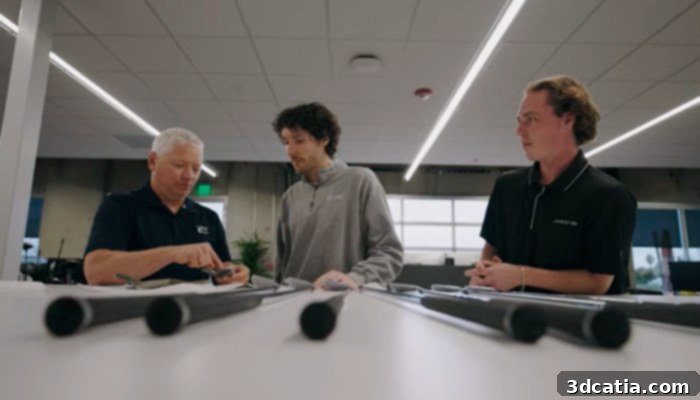
Advanced golf club designs by Cobra Puma Golf, leveraging cutting-edge manufacturing techniques.
What advice would you give to someone hoping to work as an Innovation Engineer in additive manufacturing?
My foremost advice for anyone aspiring to become an Innovation Engineer in additive manufacturing is to cultivate an unwavering readiness to learn and adapt quickly. The landscape of additive manufacturing is evolving at an astounding pace; new machines, innovative materials, and refined process methods are being introduced constantly. This relentless advancement continuously unlocks new design capabilities and expands the horizons of what can be produced. In any competitive industry, and particularly within the demanding world of golf equipment, the ability to rapidly and effectively adopt new technologies is absolutely essential for consistently producing high-level, innovative products. The good news is that additive manufacturing is finally gaining significant traction and support within the golf industry, which is an incredibly exciting development. However, as with any nascent or rapidly emerging technology, this also brings forth a unique set of challenges and constraints that must be thoroughly understood and mastered.
Consider the example of lattice structures: prior to our groundbreaking Limit3d irons, no golf products had successfully integrated complex lattice designs within their construction. This pioneering effort presented numerous technical obstacles that required immediate and innovative solutions. We had to rapidly address critical factors such as the optimal lattice type for specific performance characteristics, appropriate beam thickness for structural integrity and weight distribution, precise positioning within the clubhead, ideal lattice orientation for strength and feel, and the most effective print orientation to ensure manufacturing success and part quality. To ensure these clubs not only delivered exceptional performance but also adhered to stringent product development timelines, all these intricate factors had to be learned, tested, and optimized at an accelerated pace to facilitate a successful product launch. This imperative for rapid learning and agile problem-solving holds true across virtually every industry that is now leveraging additive manufacturing. With each new technological advancement, there will inevitably be new challenges, demanding a swift and proactive approach to learning and problem-solving to arrive at effective, market-ready solutions. Embrace continuous learning, be curious about new processes, and always be prepared to tackle unforeseen obstacles with an innovative mindset.
What are your thoughts on the pivotal position of an innovation engineer within the additive manufacturing landscape, especially in an industry like sports equipment? We invite you to share your insights in a comment below or connect with us on our LinkedIn, Facebook, and Twitter pages! Don’t miss out on the latest 3D printing news – remember to sign up for our free weekly newsletter here, delivered straight to your inbox! You can also explore all our insightful videos on our dedicated YouTube channel.