
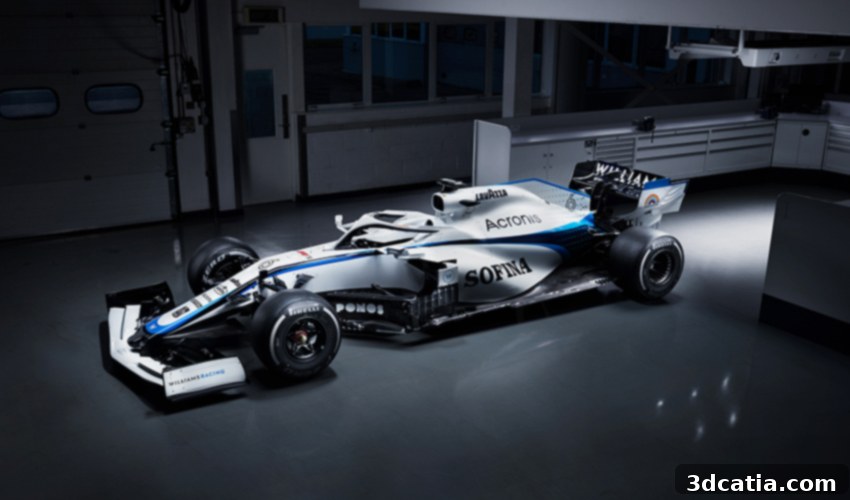
Williams Racing Accelerates Formula One Innovation with Nexa3D’s High-Speed Additive Manufacturing
The relentless pursuit of speed, precision, and efficiency defines Formula One racing. In an environment where every millisecond counts, teams are constantly seeking revolutionary technologies to gain a competitive edge. It comes as no surprise, then, that elite motorsport organizations are increasingly turning to additive manufacturing – commonly known as 3D printing – to redefine their design and production processes. This pivotal shift was once again highlighted on March 10, when the iconic Williams Racing Formula One team officially announced its groundbreaking collaboration with leading resin 3D printer manufacturer, Nexa3D. This strategic alliance marks another significant milestone in the evolving relationship between advanced manufacturing techniques and the pinnacle of motor racing, unequivocally demonstrating the indispensable role 3D printing now plays within the highly demanding automotive sector, particularly in Formula One.
At the core of this partnership, Nexa3D is set to integrate its cutting-edge, fast polymer 3D printing technology into Williams Racing’s formidable infrastructure. This technology is not merely an incremental improvement; according to the manufacturer, it possesses the transformative capability of multiplying productivity by an astounding 20 times. For a team like Williams Racing, which is fundamentally built upon the principle of maximizing speed on the track, the concept of dramatically accelerating its internal production and development cycles is equally critical. In this context, additive manufacturing emerges as the unequivocal, optimal solution, enabling the team to achieve unprecedented levels of agility and innovation.
The Indispensable Role of 3D Printing in High-Performance Automotive
The meteoric rise in popularity and adoption of 3D printing within the automotive industry, especially in the hyper-competitive realm of Formula One, is far from accidental. This advanced manufacturing technology offers vehicle manufacturers a compelling array of advantages that directly address the core challenges of modern engineering and production, most notably in areas such as design flexibility, speed of iteration, and significant cost efficiencies. Traditional manufacturing methods, often reliant on costly tooling and lengthy lead times, simply cannot keep pace with the dynamic demands of F1.
With the integration of Nexa3D’s technology, Williams Racing gains the ability to rapidly produce intricate, lightweight components – often within mere minutes or hours, a stark contrast to the days or even weeks required by conventional processes. This dramatic reduction in manufacturing time is an enormous asset, particularly crucial in the fast-paced, highly competitive Formula One environment where design iterations occur almost daily, and every small advantage can mean the difference between victory and defeat. The capacity to quickly prototype, test, and implement new designs is paramount for aerodynamic optimization and overall vehicle performance.
Al Peasland, Head of Technical Partnerships and Innovation at Williams Racing, articulated the team’s enthusiasm for this collaboration: “We’re extremely excited to announce our partnership with Nexa3D and look forward to enhancing our additive manufacturing capabilities with their innovative high-speed printing technologies. Formula One is a challenging environment that demands a continuous improvement philosophy in order to remain competitive. Our partnership will enable the team to continue to push boundaries in 3D printing, and present new opportunities for Nexa3D to further advance their revolutionary technology.” This statement underscores Williams Racing’s commitment to leveraging state-of-the-art technologies to maintain its competitive edge and highlights the symbiotic nature of the partnership, where both entities stand to benefit from mutual advancement.

The NXE400 3D printer from Nexa3D in action, revolutionizing production processes (photo credits: Nexa3D)
Nexa3D’s NXE400: Setting New Standards in Ultra-Fast Polymer 3D Printing
The official deployment of Nexa3D’s technology began at the start of March, with Williams Racing engineers now actively utilizing the NXE400 photoplastic 3D printer. While its applications are extensive, the primary current focus is on the production of highly functional wind tunnel parts. These components are absolutely critical for rigorous aerodynamic testing – a cornerstone of Formula One development where minute adjustments to airflow can yield substantial performance gains on the track. The ability to rapidly produce and test multiple iterations of these parts is a game-changer for aerodynamicists.
What sets the NXE400 apart is its foundational technology: LSPc (Lubricant Sublayer Photo-curing). This proprietary process allows the machine to achieve unprecedented printing speeds, earning it the reputation of an ultra-fast additive manufacturing solution. Nexa3D elucidates that LSPc, when combined with sophisticated structured light technology, dramatically curtails conventional 3D printing cycles. For Williams Racing, this innovation is precisely what they need to accelerate their design-to-race workflow. Beyond sheer speed, this advanced process also contributes to a more sustainable operation by significantly reducing material consumption and waste, aligning with broader industry goals for environmental responsibility.
A Growing Trend: Additive Manufacturing’s Deep Roots in Formula One
This newest collaboration between Williams Racing and Nexa3D is not an isolated incident but rather a powerful testament to a pervasive and expanding trend: the deep integration of 3D printing into the very fabric of Formula One. The list of partnerships between leading additive manufacturing giants and premier F1 teams continues to grow, underscoring a collective recognition of the technology’s immense strategic value. For instance, McLaren, another titan in motorsport engineering, forged a significant four-year contract with Stratasys back in 2017. Similarly, the Renault F1 Team (now Alpine F1 Team) also embraced advanced manufacturing through its partnership with 3D Systems. These high-profile cooperations are indicative of a shared vision that sees additive manufacturing as a cornerstone for future innovation and competitive performance in F1.
These alliances pave the way for a future where 3D printing is not just a supplementary tool but an integral component of the entire Formula One ecosystem, from conceptual design to final race-day parts. Avi Reichental, co-founder and CEO of Nexa3D, perfectly encapsulates this forward-thinking perspective: “Our partnership with Williams Racing represents the fusion of top-tier engineering and race car performance. With its ultrafast production cycles, the NXE400 represents the Formula One of additive manufacturing at scale. Few companies appreciate speed like Williams Racing and they represent the perfect partner for our polymer 3D printing technology.” His statement eloquently draws a parallel between the rapid advancements in 3D printing technology and the very essence of Formula One – the pursuit of unparalleled speed and performance. This synergy is expected to drive both Williams Racing’s on-track success and Nexa3D’s technological evolution, creating a virtuous cycle of innovation.
Beyond Prototyping: The Strategic Impact of AM in F1
While the initial application often revolves around rapid prototyping for aerodynamic components like wind tunnel models, the strategic impact of additive manufacturing in Formula One extends far beyond. F1 teams are increasingly utilizing 3D printing for a diverse range of applications, including:
- Jigs, Fixtures, and Tooling: Custom-designed tools and fixtures can be rapidly produced to optimize assembly processes, ensuring precision and efficiency in the garage and factory.
- End-Use Parts: As materials science advances, 3D printed components are moving from prototypes to functional end-use parts on the race car itself, particularly for complex geometries that are difficult or impossible to manufacture with traditional methods. These can include intricate air ducts, cooling channels, or lightweight structural elements.
- Customization and Personalization: Drivers and mechanics often require highly personalized equipment. 3D printing allows for tailored grips, seat inserts, and other ergonomic components to enhance driver comfort and control.
- Weight Reduction: A perpetual goal in F1 is to reduce weight without compromising strength. Additive manufacturing excels at creating lattice structures and optimized designs that significantly lower component weight, contributing directly to improved lap times.
- Supply Chain Optimization: The ability to print parts on demand reduces reliance on external suppliers and long lead times, offering greater control over inventory and production schedules.
The integration of Nexa3D’s high-speed technology allows Williams Racing to compress its design-to-manufacturing cycle, enabling more iterations, faster testing, and quicker deployment of innovations onto the track. This iterative advantage is crucial in a sport where car development is continuous throughout the season. The speed of Nexa3D’s machines means engineers can test multiple designs for a single component within a day, allowing them to hone in on the most aerodynamically efficient or structurally sound solution far more quickly than ever before.
The future implications of such partnerships are profound. They signal a paradigm shift in how high-performance vehicles are conceived, designed, and manufactured. As additive manufacturing technologies continue to evolve, offering an ever-expanding palette of materials and even greater speeds, their influence in Formula One and the broader automotive industry will only deepen. Teams that embrace these advancements early on, like Williams Racing, are positioning themselves at the forefront of engineering innovation, ready to capitalize on every technological advantage in the pursuit of ultimate performance.
What are your thoughts on the strategic partnership between Williams Racing and Nexa3D? How do you foresee additive manufacturing shaping the future of Formula One and high-performance automotive? Share your insights and join the conversation in a comment below or connect with us on our Facebook, Twitter, and LinkedIn pages! Don’t miss out on the latest advancements in 3D printing; sign up for our free weekly Newsletter here, delivered straight to your inbox!