
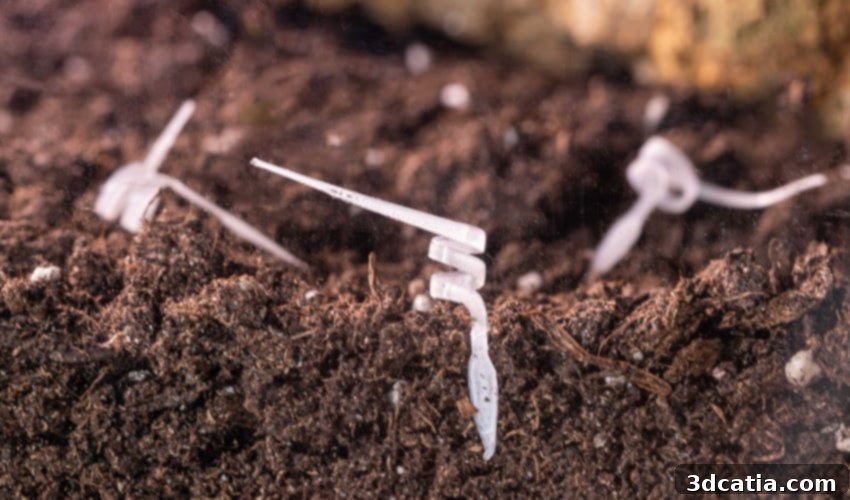
Revolutionizing Environmental Monitoring with I-Seed: Biodegradable, 4D-Printed Bio-Inspired Robots
The Italian Institute of Technology (IIT) is at the forefront of innovation with its bio-inspired robotics laboratory, a hub dedicated to pioneering novel solutions through the ingenious emulation of natural systems. In 2021, this ambitious lab unveiled the I-Seed project, a groundbreaking initiative poised to redefine environmental sensing. The I-Seed project focuses on developing a new generation of robots that are not only flexible and autonomous but also entirely biodegradable and miniaturized, leveraging the transformative power of 4D printing. Drawing profound inspiration from the remarkable mechanics of plant seeds, these robot-seeds represent a harmonious fusion of advanced scientific research and cutting-edge technological design. The ultimate goal of this visionary laboratory is to provide unprecedented capabilities for analyzing and meticulously monitoring air quality and the crucial topsoil environments – the uppermost layer of soil vital for plant life, where essential nutrients are absorbed.
This pioneering endeavor to create biodegradable robot-seeds is a testament to collaborative innovation, undertaken in partnership with the esteemed University of Trento, Italy. Researchers leading the I-Seed project envision a future where these intelligent robot-seeds can autonomously assess a wide range of environmental parameters. Their sophisticated design enables them to accurately determine ambient temperature and soil humidity levels, providing critical data for ecological studies and agricultural applications. Beyond basic measurements, these advanced seed-robots are also equipped to detect the presence of harmful pollutants, such as mercury, and monitor atmospheric CO2 levels, offering vital insights into environmental health and climate change indicators. The initial prototype of the I-Seed robot is ingeniously inspired by the hygromorphic structure of the Pelargonium appendiculatum, a distinctive South African geranium renowned for its unique seed dispersal mechanism. This specific plant’s ability to interact with moisture provides a perfect blueprint for self-actuating, environmentally responsive robotic systems.
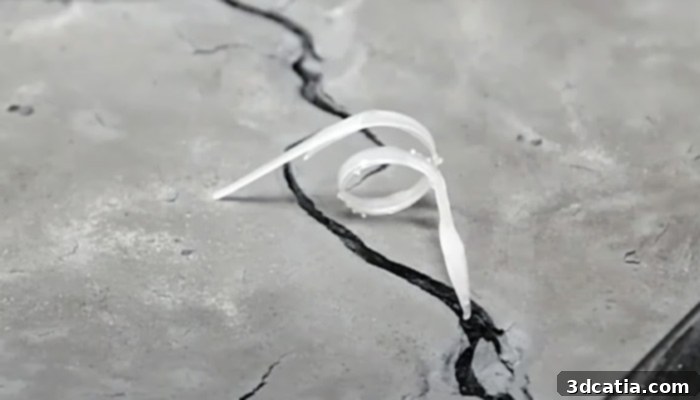
The robot seed changes its morphology according to the humidity (photo credits: Italian Institute of Technology)
An Autonomous, Biodegradable Seed Robot: Mimicking Nature’s Ingenuity
The Pelargonium appendiculatum operates with remarkable precision within its natural habitat, offering a profound lesson in bio-mechanical efficiency. When environmental conditions align favorably, its seeds are released from the parent plant. What makes these seeds truly exceptional are their inherent hygroscopic properties – an intrinsic ability to absorb moisture from the surrounding environment. This moisture absorption triggers a fascinating transformation: the seeds physically change shape, enabling them to actively move, explore, and penetrate the soil. This self-burrowing action is crucial for enhancing the seed’s chances of successful germination, anchoring it securely and providing optimal contact with the earth. To translate this intricate natural process into a functional robotic system, the IIT researchers embarked on an exhaustive scientific investigation. This involved a comprehensive morphometric analysis, detailing the exact dimensions and structural characteristics; a histological examination, delving into the tissue composition; and a biomechanical investigation of the Pelargonium appendiculatum. The aim was to precisely understand and predict its behaviors under varying environmental stimuli.
Following this in-depth understanding of the natural seed’s mechanics, the research team meticulously leveraged these biomechanical specifications to model and fabricate the sophisticated seed-like robot. As previously highlighted, the researchers have achieved this technological feat using advanced 4D printing techniques. Unlike conventional 3D printing, which creates static objects, 4D printing involves printing objects that can change shape or properties over time when exposed to external stimuli like heat, light, or, in this case, moisture. This dynamic capability is central to the I-Seed project’s success. The manufacturing process specifically utilizes the Fused Deposition Modeling (FDM) process, a widely recognized additive manufacturing technique. For the I-Seed, FDM is employed with carefully selected biodegradable polymers, primarily based on polycaprolactone (PCL). PCL is a versatile polyester commonly used in the production of specialty polyurethanes and is particularly valued for its inherent water resistance and its ability to fully biodegrade, minimizing environmental impact.
To endow the robot-seeds with their crucial hygroscopic functionality – the ability to respond to moisture – the extrusion solution used in the FDM process was ingeniously coupled with an electrospinning technique. This method allowed for the creation of fine hygroscopic fibers, composed of polyethylene oxide (PEO) and a core of cellulose nanocrystals. PEO is known for its water solubility and excellent film-forming properties, while cellulose nanocrystals provide structural integrity and enhanced hygroscopicity. The synergistic combination of these materials ensures that the artificial seeds possess the desired self-shaping capabilities. Critically, the researchers have confirmed that these artificial seeds exhibit geometric dimensions and biomechanical performance highly comparable to their natural counterparts. This remarkable congruence validates the bio-inspired design approach and underscores the potential for the I-Seed project to significantly advance environmental analysis and preservation efforts. By mimicking nature so effectively, these devices can offer unparalleled insights into soil health and dynamics.
The implications of this technology are far-reaching. As Luca Cecchini, a PhD student at IIT in collaboration with the University of Trento and the first author of the study, eloquently explains, “These energy-autonomous robots will be used as cordless, battery-less tools for surface soil exploration and monitoring.” This highlights a key advantage: the elimination of batteries drastically reduces the environmental footprint and operational complexity, making them ideal for long-term deployments. He further emphasizes that “This bio-inspired approach has allowed us to create inexpensive instruments that can be used to collect in situ data with high spatial and temporal resolution, especially in remote areas where no monitoring data is available.” The cost-effectiveness and ability to gather precise, localized data in previously inaccessible or unmonitored regions represent a paradigm shift in ecological research and conservation. From monitoring vast agricultural lands for precision farming applications to assessing forest health or tracking pollution spread in challenging terrains, the I-Seed robots offer a versatile and sustainable solution.
The versatility of these smart robot-seeds extends beyond basic soil and air parameters. Their capacity to detect specific pollutants like mercury opens doors for crucial environmental remediation efforts and risk assessment in contaminated sites. Furthermore, continuous monitoring of atmospheric CO2 levels contributes invaluable data to climate change studies, allowing scientists to track trends and evaluate the effectiveness of mitigation strategies. Imagine a future where swarms of these biodegradable robots are deployed to reforest arid regions, not only planting seeds but also monitoring the micro-environmental conditions to ensure optimal growth. This could revolutionize ecological restoration and sustainable land management on a global scale. The ongoing research and development aim to refine their sensing capabilities, broaden the range of detectable pollutants, and enhance their autonomous navigation within complex environments. The potential to reduce reliance on conventional, energy-intensive monitoring equipment and minimize electronic waste makes the I-Seed project a beacon of sustainable technological advancement.
For those interested in delving deeper into the scientific intricacies of this remarkable robot seed, a comprehensive research article detailing the findings and methodologies has been published in the prestigious journal Advanced Science. This publication offers an in-depth look at the experimental setup, results, and the scientific foundation underpinning the I-Seed project. You can explore the full research article HERE for a complete understanding of this innovative work. Additionally, a compelling visual representation of the I-Seed in action can be found below, providing a dynamic overview of its functionalities and the underlying bio-inspiration.
What are your thoughts on the groundbreaking I-Seed project and its potential to transform environmental monitoring? We invite you to share your insights and comments below, or engage with us on our LinkedIn, Facebook, and Twitter pages! Don’t forget to sign up for our free weekly Newsletter here to receive the latest 3D printing news directly in your inbox. You can also find all our captivating videos and technological explorations on our dedicated YouTube channel, offering a visual journey into the world of additive manufacturing and bio-inspired robotics.
*Cover photo credits: Italian Institute of Technology