
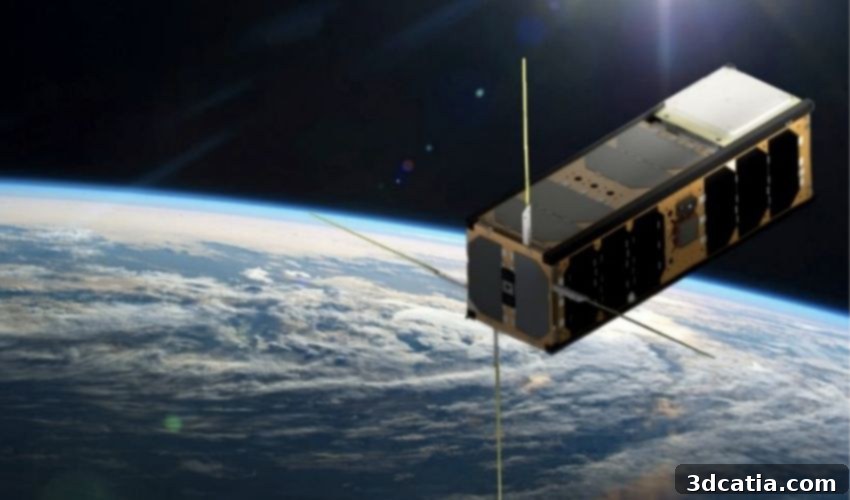
Singapore’s Historic Leap: How 3D Printing Propelled the Zeus-1 Satellite into Orbit
The cosmos has always been a frontier of human endeavor, and the race to explore and utilize space is heating up with renewed vigor. While global giants like SpaceX and NASA frequently dominate headlines with their ambitious space projects, the evolving landscape of space exploration is increasingly welcoming contributions from nations and private entities across the globe. In a significant testament to its growing technological prowess and innovative spirit, Singapore has firmly established itself as a key player in this modern space race. The island nation recently marked a historic milestone with the successful launch of its first 3D-printed component into the vast expanse of space, an achievement that underscores the transformative power of additive manufacturing in the aerospace sector.
This pioneering component was integrated into the Zeus-1 satellite, which embarked on its celestial journey on December 18th. The launch took place from the iconic Cape Canaveral, Florida – a site synonymous with groundbreaking space missions and a primary hub for sending capsules beyond Earth’s atmosphere. The Zeus-1 satellite itself was a payload aboard SpaceX’s formidable Falcon 9 rocket, a vehicle renowned for its reliability and efficiency in deploying satellites and spacecraft into various orbits. This collaboration with SpaceX highlights the global nature of modern space ventures, where expertise and resources are pooled from diverse corners of the world to push the boundaries of what’s possible.
The ambitious Zeus-1 project was spearheaded by Qosmosys, an international private spacetech company that proudly maintains its headquarters in Singapore. Demonstrating a collaborative spirit and a commitment to leveraging local talent and innovation, Qosmosys partnered with NuSpace and Creatz3D Singapore. Together, these entities brought to fruition the first locally developed 3D-printed part to ever reach orbit. The decision to employ additive manufacturing – commonly known as 3D printing – for this critical component was not merely a technological whim; it was a strategic choice born from a clear understanding of its inherent advantages over conventional fabrication methods. Traditional manufacturing processes for aerospace components, such as CNC machining or metal sheet forming, often involve intricate steps like cumbersome folding, precise sawing, and extensive tooling. These methods are typically labor-intensive, time-consuming, and can accumulate significant costs. In contrast, 3D printing offered an undeniably more cost-effective and significantly faster pathway to producing the necessary parts, streamlining the entire development and production cycle.
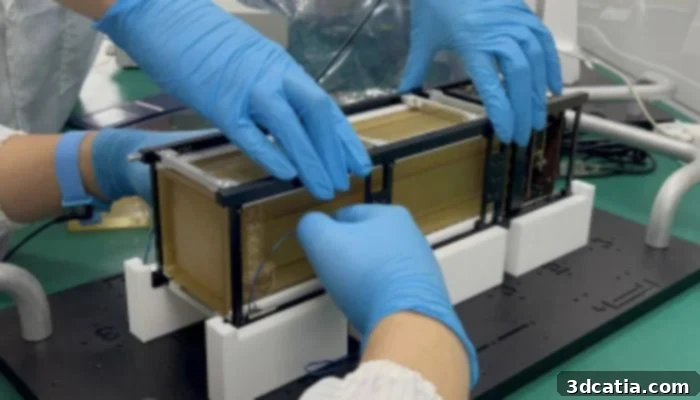
The team designed a gold plate which was added to the satellite
Highlighting the stark difference in manufacturing timelines, Ng Zhen Ning, CEO & Co-Founder of NuSpace, elaborated on the benefits: “The proposed original design was a sheet material, which could cost up to $4,000 to $5,000 and requiring a long lead time of at least three weeks for a machine manufactured component to reach us, whereas 3D-printed parts took only 2 to 3 days.” This astonishing reduction in lead time—from weeks to mere days—is a game-changer for the aerospace industry. It not only accelerates research and development cycles but also enables rapid iteration and modification of designs, allowing engineers to refine components based on real-world testing and feedback without significant delays or cost overruns. Such agility is crucial in the fast-paced and demanding environment of space technology, where every day counts in bringing innovations to fruition.
Beyond the significant reduction in lead time and manufacturing costs, additive manufacturing presented another critical advantage for the Zeus-1 mission: a substantial reduction in the final mass of the component. The 3D-printed part weighed in at a mere 362 grams. This represents a remarkable reduction of at least 50% from the estimated 800 grams the component would have weighed if it had been produced using conventional methods. In the realm of spaceflight, where every gram counts, such weight savings are paramount. Lighter components translate directly into a need for less propellant during launch. This principle is elegantly explained by Newton’s second law of motion, which states that if the same force is applied to two objects, the lighter one will experience greater acceleration. Conversely, to achieve a desired acceleration, a lighter spacecraft requires less force, and therefore, consumes significantly less fuel. This reduction in propellant needs directly translates to lower launch costs, increased payload capacity for other scientific instruments or equipment, and potentially longer mission durations due to extended fuel reserves. The ability of 3D printing to create intricate, optimized geometries – often impossible with traditional methods – allows for topology optimization, where material is strategically placed only where structurally necessary, leading to lighter yet robust parts. This capability is a cornerstone of advanced aerospace engineering and a driving force behind the adoption of additive manufacturing in space applications.
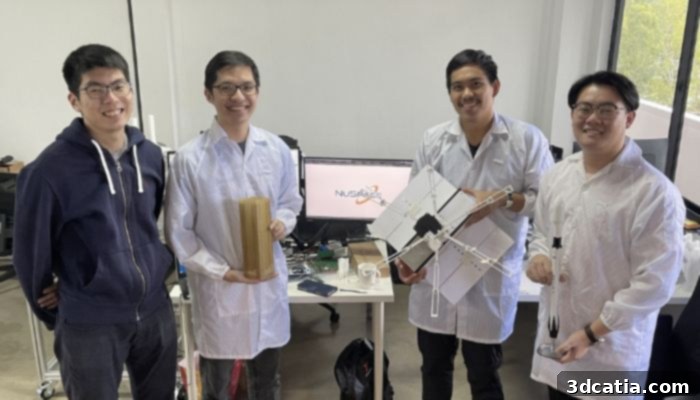
The team responsible for the design of the satellite component
While the Zeus-1 mission marks Singapore’s first foray into utilizing 3D printing for space research, it is crucial to recognize that this is not the nation’s inaugural venture into space itself. The Singapore Space Industry has been steadily expanding its capabilities and offerings, providing a diverse range of services to the global aerospace community. These services include ‘ride-sharing’ opportunities, where smaller satellites or payloads can share space on board a launch vehicle with other countries or commercial entities, making access to space more affordable and accessible. Furthermore, Singapore offers advanced orbital products and sophisticated system integration services, expertly combining various elements such as launch services from one provider with propulsion systems or critical components from others. This holistic approach has positioned Singapore as a reliable and innovative partner in the international space ecosystem. However, the integration of a locally developed, 3D-printed component into a space-bound satellite represents a significant leap forward in the city-state’s technological independence and its contribution to advanced space manufacturing techniques. This groundbreaking development is reminiscent of other pioneering efforts in space, such as the recent satellite launch by Uganda, which carried a 3D bioprinter designed for conducting crucial tissue experiments in the unique environment of zero-gravity. Such endeavors collectively highlight the versatility and immense potential of 3D printing across a broad spectrum of space applications, from structural components to life sciences research.
The successful deployment of a 3D-printed component by Singapore into Earth’s orbit is more than just a technical achievement; it is a powerful symbol of the nation’s commitment to innovation, its embrace of cutting-edge technologies, and its strategic vision for a future increasingly reliant on space-based capabilities. This milestone paves the way for future developments, potentially allowing for the on-demand manufacturing of spare parts in orbit, reducing the need to launch every single component from Earth, and even enabling the construction of lunar or Martian bases with locally sourced materials. As the global space industry continues to evolve, Singapore’s pioneering spirit, bolstered by the efficiencies and design freedoms offered by additive manufacturing, positions it at the forefront of this exciting new era of exploration and industrialization beyond our planet. The collaborative efforts between Qosmosys, NuSpace, and Creatz3D Singapore serve as an excellent model for how partnerships can drive rapid technological advancements and deliver tangible results in high-stakes environments like space exploration.
What are your thoughts on Singapore’s remarkable venture into space, specifically leveraging the transformative power of 3D printing? We invite you to share your insights and comments below. You can also engage with us on our social media platforms, including LinkedIn, Facebook, and Twitter pages. Don’t miss out on the latest advancements and news in the world of additive manufacturing; sign up for our free weekly Newsletter here to receive all the crucial 3D printing updates directly in your inbox! Additionally, you can explore our comprehensive collection of videos and interviews on our YouTube channel, offering deeper dives into the innovative applications of 3D printing across various industries.
*All photo credits: Creatz3D