
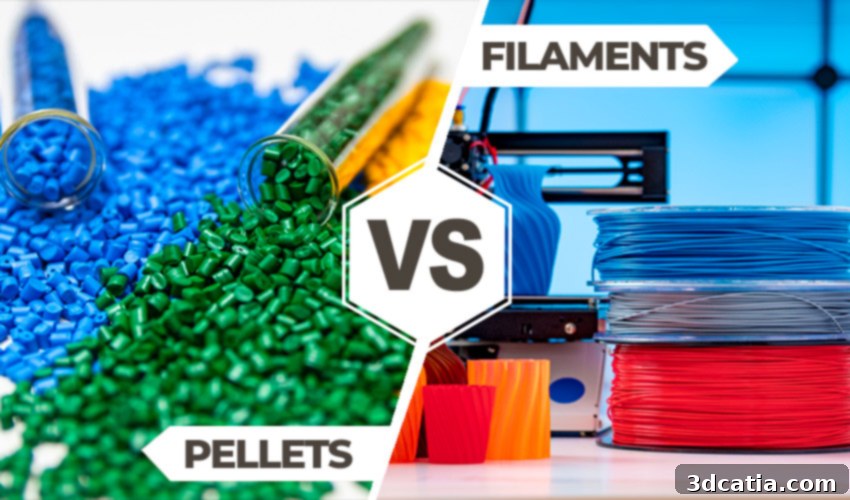
Exploring 3D Printing Filaments vs. Pellets: A Comprehensive Guide to Additive Manufacturing Materials
Plastics stand as an undisputed cornerstone in the realm of additive manufacturing. Their remarkable versatility makes them compatible with a diverse array of 3D printing processes, enabling the creation of parts with an extensive range of properties and characteristics. Whether the application calls for rapid prototyping, robust tooling, or functional end-use components, plastics offer tailored solutions. Available in various forms—including filaments, pellets, powders, and resins—these materials cater to the evolving needs and stringent requirements of manufacturers across virtually all industrial sectors. Following our recent comparison of powders and plastic resins, this article delves deeper into two other pivotal polymer families: filaments and pellets. We will meticulously examine their unique characteristics, explore their diverse applications, identify the specific 3D printing processes they are compatible with, review prominent manufacturers in the market, and discuss the associated material costs. Join us as we uncover everything you need to know about these fundamental additive manufacturing materials.
Filaments and pellets represent two primary forms of plastic material widely adopted in modern 3D printing. While metal and ceramic solutions are expanding, our focus here remains exclusively on plastics. To begin, it’s essential to define each form. A plastic pellet, often referred to as a “nurdle” or “pre-production plastic pellet,” is a small, granular piece of plastic, typically measuring less than 5mm in diameter. These tiny beads serve as the foundational raw material for a vast range of plastic products, capable of being melted, molded, or extruded into countless objects across industries. In additive manufacturing, specific machines are engineered to directly process these pellets.
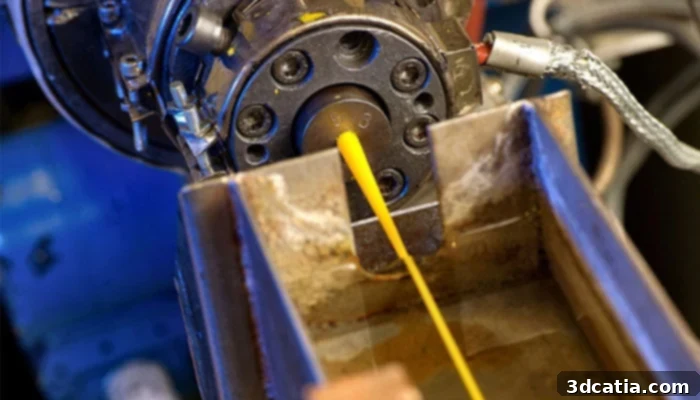
Plastic pellets are the fundamental raw material for manufacturing filaments used in 3D printers (photo credits: Capifil)
Filament, conversely, is a refined thermoplastic product, meticulously manufactured from these plastic pellets or sometimes from ground plastic scrap. The transformation process involves mixing the raw plastic with various additives to achieve desired properties. This mixture is then fed into a specialized filament extruder, which melts the plastic and forces it through a die to create a continuous strand with a precise, consistent diameter, resembling a tube. After several carefully controlled cooling stages, the newly formed filament passes through a coiling machine, where it is wound onto a spool. This spool then becomes the ready-to-use material for many types of 3D printers, particularly those employing Fused Deposition Modeling (FDM) technology.
Characteristics and Properties of 3D Printing Filaments and Pellets
The global plastics industry is an enormous and continually expanding market, demonstrating consistent growth in manufacturing output, employment, and investment over recent years. These plastics emerge from refineries and processing plants in various initial forms, including liquids, powders, or, crucially for our discussion, pellets. Regardless of their initial state, they are subsequently shaped and processed to create an almost endless array of parts, utilizing methods such as molding, injection, thermoforming, or extrusion—the latter being most relevant to 3D printing.
Focusing first on industrial plastic pellets, their market availability is vast, offering an immense spectrum of properties and characteristics directly correlated with their unique chemical compositions. As mentioned, these small granules are also commonly known as nurdles or pre-production plastic pellets. They are precisely defined as “very small pellets of plastic (typically smaller than 5mm) that serve as the fundamental raw material in the manufacturing of plastic products.” Their size, shape, and even color can vary significantly, reflecting their intended end-use and polymer type.
Industrial plastic pellets are not just pure polymers; they are sophisticated mixtures comprising the base polymer itself alongside various chemical additives. These additives are critical, as they impart specific attributes such as UV resistance, flame retardancy, color, increased strength, or improved flow characteristics during processing. A wide range of polymers is utilized in pellet form, including common types like polyethylene (PE), polypropylene (PP), polyethylene terephthalate (PET), polystyrene (PS), and polyvinyl chloride (PVC). Each of these polymers, combined with specific additives, yields plastic pellets with distinct mechanical, thermal, and chemical properties, allowing for highly specialized applications.
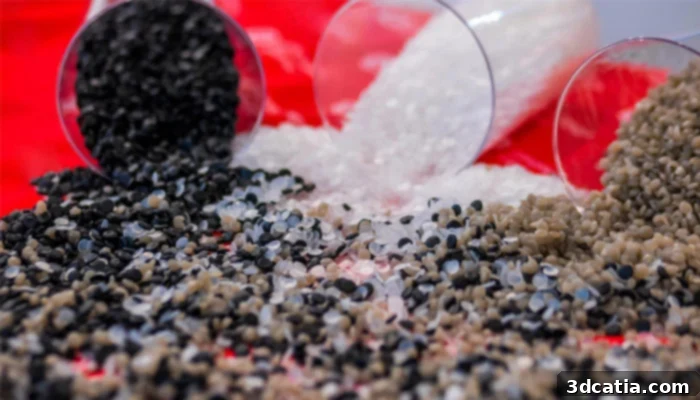
Plastic pellets are readily available in a wide variety on the market, serving as a primary raw material for plastics (photo credits: DEKRA Industrial)
A significant advantage of utilizing pellets directly in 3D printing lies in their pervasive use across more traditional manufacturing technologies, such as injection molding. This inherent compatibility provides a streamlined material qualification pathway. If a manufacturer uses a specific plastic pellet material that has already been qualified and certified for conventional processes like injection molding, they can often use the same material in additive manufacturing without undergoing extensive re-qualification. This represents a substantial benefit, not only for producing “right material” prototypes that accurately reflect the final product’s properties but also for manufacturing finished parts using materials already recognized and approved by industry standards. This accelerates product development cycles and reduces time-to-market.
Turning our attention to filaments, the manufacturing process is inherently more involved and time-consuming, as it requires transforming plastic pellets into the precisely dimensioned, continuous strands suitable for extrusion-based 3D printing. This transformation involves several critical stages: First, raw plastic pellets must be meticulously dried to remove any moisture, which can otherwise lead to defects during extrusion. Next, these dried pellets are melted into a molten polymer state. This molten plastic is then precisely pushed through an extruder, which forces it through a small die to form the characteristic tubular or cylindrical shape of the filament. Once formed, the filament is carefully cooled in a series of water baths or controlled air chambers to solidify and maintain its exact diameter. Finally, it is wound onto a spool, making it ready for use in a 3D printer.
During the complex process of converting pellets into filament, various additives are often incorporated. These additives are deliberately chosen to modify and enhance the raw material’s properties, inevitably altering its chemical composition and performance characteristics. Consequently, when a filament is used to 3D print a part, an additional, crucial step of material qualification is often required to ensure the final printed object meets specific performance criteria. In terms of compatible plastics, filaments offer a broad spectrum of polymers, from common choices like PLA (Polylactic Acid) and ABS (Acrylonitrile Butadiene Styrene), to flexible elastomers and high-performance engineering polymers such as PEEK (Polyether Ether Ketone) or PEI (Polyetherimide). The choice of filament directly dictates the final part’s properties: for instance, if optical transparency is desired, polycarbonate (PC) might be selected, whereas superior mechanical strength and thermal resistance would lead to choosing materials like PEEK or carbon fiber reinforced composites.
It is important to acknowledge that certain plastics, due to their intricate chemical compositions or specific rheological properties, are inherently more challenging or expensive to transform into a consistent, high-quality filament. This manufacturing constraint means that, for a broader and potentially more diverse selection of raw plastic materials, opting for pellet-based 3D printing often provides a wider range of material choices, including specialized or experimental polymer blends that are not readily available in filament form.
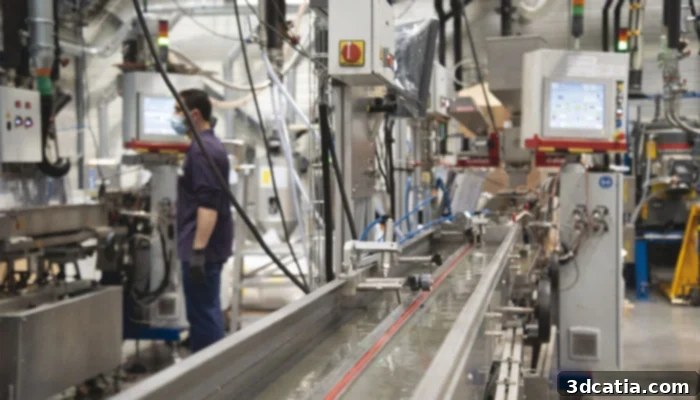
The KIMYA filament production plant, showcasing the sophisticated process of converting pellets into high-quality filaments (photo credits: Hervé Boutet)
Compatible 3D Printing Processes: FDM/FFF vs. FGF
Regardless of whether one chooses plastic pellets or pre-formed filaments, the fundamental 3D printing process employed for both is extrusion-based additive manufacturing. More specifically, filaments are predominantly utilized in Fused Deposition Modeling (FDM) or Fused Filament Fabrication (FFF) systems, while pellets are processed through Fused Granulate Fabrication (FGF) or Direct Pellet Extrusion (DPE). The underlying principle for both technologies remains remarkably similar: the plastic material is first heated to its melting point, then forced through a specialized nozzle before being meticulously deposited layer by layer onto a build platform to construct the final three-dimensional object. The primary distinction between FDM/FFF and FGF lies in the specific mechanism and tooling used to feed and extrude the plastic material.
In the context of filament-based 3D printers, FDM/FFF systems employ a sophisticated extruder assembly. This typically consists of a stepper motor driving a toothed wheel or gears, which precisely grips and pushes (or retracts) the filament strand. The filament then enters a hot end, a heating block that rapidly melts the plastic to its semi-liquid state. Finally, the molten material is extruded through a finely machined nozzle, which generally varies in diameter between 0.4 mm and 0.8 mm. This nozzle, integrated into the print head, moves along predefined paths to deposit the material onto the print bed. The specific type of thermoplastic being used dictates crucial machine configurations and printing parameters. For instance, abrasive or high-temperature materials might necessitate a hardened steel or ruby nozzle instead of brass or copper. Similarly, engineering-grade plastics often require a heated build chamber to prevent warping and a heated print bed for optimal adhesion, ensuring successful print outcomes.
For pellet-based 3D printing, the FGF extrusion process operates somewhat differently. FGF 3D printers are equipped with a hopper system, which acts as a reservoir for the plastic pellets. From this hopper, the plastic beads are fed into a screw-driven extrusion mechanism. The screw conveyor absorbs the pellets and transports them through a heated barrel towards a melting zone. Within this zone, the pellets are gradually softened and melted. The molten plastic is then dynamically ejected through a robust nozzle, which subsequently deposits the material layer by layer onto the printing plate. FGF nozzles generally have larger diameters compared to FDM nozzles, often ranging from 1.0 mm to several millimeters. A significant advantage of FGF systems is their adaptability: this type of extrusion system can often be mounted onto robotic arms or gantry systems, providing a much larger printing envelope and enhanced flexibility for creating extremely large-scale objects, unconstrained by traditional enclosed build volumes.
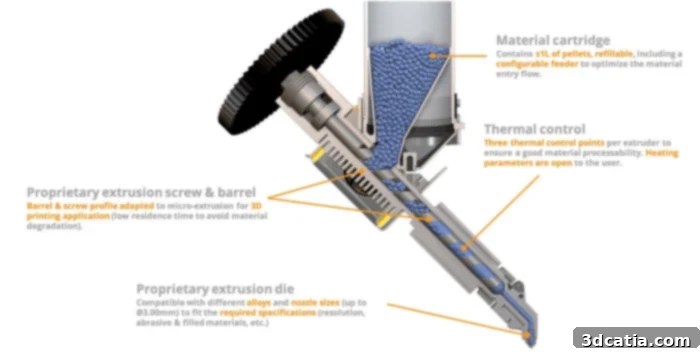
The extrusion system for plastic pellets significantly differs from that used for filaments, impacting print capabilities (photo credits: Pollen AM)
The direct use of plastic pellets in 3D printing offers distinct operational advantages, particularly in terms of production efficiency. Pellet-based systems are capable of achieving significantly higher deposition speeds and extruding larger material volumes compared to filament-based printers. This is largely due to the continuous, bulk feeding of raw material and often larger nozzle diameters, allowing for rapid material laydown. However, this increased speed and volume often come at the expense of precision and resolution, which are typically less critical for very large objects. Consequently, pellet 3D printing is often the preferred choice for manufacturing large-format parts, as it eliminates the need for frequent filament spool changes and enables the machine to extrude a substantial quantity of material without interruption, leading to more efficient large-scale production.
It is crucial to note, however, that most conventional pellet 3D printers lack an active retraction mechanism, unlike their FDM counterparts. In FDM, the extruder can “shrink” or pull back the filament slightly when not actively extruding, preventing unwanted material ooze and stringing. For pellet printers, the continuous flow of molten plastic through the nozzle can be more challenging to precisely control. Without active retraction, interrupting the flow of material effectively might require stopping the extruder or physically blocking the nozzle, which is not ideal for complex geometries. This limitation can lead to diminished detail and precision, as well as potential issues with surface finish and accuracy for intricate features. Therefore, for designs demanding higher complexity, finer details, and superior surface resolution, conventional 3D filament printing remains the more suitable and effective choice, offering granular control over material deposition.
Filament and Pellet Applications in 3D Printing
Broadly speaking, the applications of 3D printing with both pellets and filaments share many commonalities, encompassing a wide spectrum from rapid prototyping and functional tooling to the production of robust end-use parts. However, as highlighted by their distinct characteristics and processing methods, there are several key differences that warrant careful consideration before selecting a material form for a specific project.
Filaments, due to their widespread availability, user-friendliness, and sheer versatility, are employed in an extensive array of applications. They are particularly well-suited for the creation of modest-sized parts, as well as projects that demand a high degree of detail, intricate geometries, and precise dimensional accuracy. Filaments are indispensable in the field of rapid prototyping, enabling designers and engineers to quickly iterate, create conceptual models, and conduct multiple testing cycles to validate designs before committing to final production. Depending on the specific properties of the chosen filament, parts can be fabricated for diverse industries such, as the automotive sector (e.g., dashboard components, custom brackets), aeronautics (e.g., jigs, fixtures, interior elements), food processing (e.g., custom grips, enclosures with food-safe materials), and medical fields (e.g., anatomical models, surgical guides, certain biocompatible devices). The market offers specialized filaments, some providing exceptional fire and smoke resistance for safety-critical applications, others formulated to be biocompatible for medical use, and many reinforced with carbon fibers or glass fibers to achieve superior mechanical strength and rigidity while maintaining a lightweight profile.
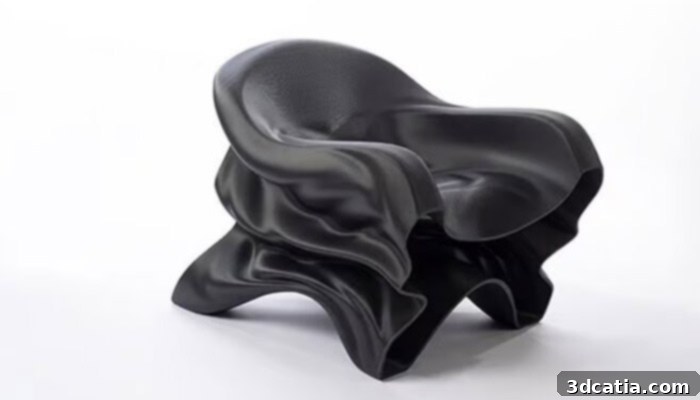
The Steam armchair, a design masterpiece by Slicelab, was efficiently printed using PETG pellets on the EXT 1270 Titan Pellet 3D printer, showcasing large-scale capabilities
When considering plastic pellets, a particularly compelling advantage is the ability to create highly customized, tailor-made material formulations by directly mixing different types of plastic polymers and additives. This remarkable versatility unlocks a multitude of advanced applications. In the healthcare sector, for instance, bespoke biocompatible materials can be developed on-the-fly for the rapid manufacture of personalized prostheses, patient-specific surgical guides, and even custom implants, significantly advancing patient care. For the automotive industry, pellets facilitate the production of customized internal components like dashboard elements, intricate cable trays, durable engine covers, and various mechanical components, drastically accelerating development cycles and reducing manufacturing costs. The design sector also benefits significantly from pellet-based printing, especially for producing larger furniture pieces, unique decorative items, and architectural models, where speed and volume are often prioritized over ultra-fine detail. Furthermore, a crucial and environmentally conscious application of pellets lies in their potential to be derived from recycled materials. This not only promotes the circular economy—a concept increasingly vital in contemporary society—but also allows for the direct re-utilization of waste plastic. Intriguingly, these same recycled pellets can then be further processed and used to produce new filaments, bridging the gap between various manufacturing methods while championing sustainability.
Finally, as previously alluded to, the utilization of pellets in additive manufacturing offers a unique and compelling benefit for material prototyping, especially when a final product is intended for mass production via injection molding. Since the raw material (plastic pellets) is identical for both 3D printing (FGF) and injection molding, an operator can efficiently 3D print prototypes using the same qualified material. These prototypes can then be subjected to rigorous testing and certification processes. Once approved, the manufacturer can seamlessly transition to mass production via injection molding without the need for additional, time-consuming material certification stages for the same base material. This critical advantage significantly streamlines product development, reduces lead times, and offers manufacturers a substantial economic and operational benefit.
The Cost of Materials: Filaments vs. Pellets
When evaluating the economic aspects of 3D printing, the cost of materials is a major factor, and filaments and pellets present different financial profiles. Filaments are widely and readily available on the market, often proving to be the more affordable and accessible option for beginners and hobbyists. This is primarily because they are sold in convenient spool forms, typically weighing around 750 grams or 1 kilogram, making them easy to manage, store, and purchase in smaller quantities. Prices vary considerably based on the type of filament and brand, but generally, a standard spool of PLA, one of the most popular and easy-to-use materials, can be purchased for approximately 20 to 30 euros. However, more specialized filaments, such as flexible materials, engineering-grade composites, or those with unique additives, can be significantly more expensive, ranging from 30 to 50 euros or even higher per spool. Moreover, for users who frequently print large objects or engage in high-volume production, the cumulative cost of filaments can quickly escalate due to the need for multiple spools.
In contrast, plastic pellets are typically sold in much larger, multi-kilogram bags, usually ranging from 5 kg to 25 kg or even industrial-sized super-sacks. This bulk purchasing model means that while the initial investment might be higher—with prices for bags of pellets varying from 50 to 100 euros or considerably more depending on the polymer type, additives, and quantity—the price per kilogram of pellets is almost invariably lower than that of filaments. This cost efficiency is largely attributable to the fact that pellets are the raw, unprocessed form of plastic, bypassing the additional manufacturing steps and energy required to transform them into consistent filament strands. However, acquiring small quantities of plastic pellets can be challenging for individual users or small businesses, as most suppliers cater to industrial volumes, making it difficult to find smaller, more manageable package sizes for experimental or hobbyist use.
Therefore, it is crucial to consider that while the upfront cost of pellets may appear higher due to the necessity of bulk purchases, they often prove to be more financially advantageous in the long run for frequent 3D printing users, particularly those engaged in large-scale or continuous production. The decision between filaments and pellets ultimately hinges on a careful assessment of individual needs, project scale, specific budget constraints, and the desired balance between initial investment and long-term operational costs. For smaller, occasional prints with intricate details, filaments may be ideal, whereas for large, high-volume, or industrial applications, pellets often provide a more cost-effective and scalable solution.
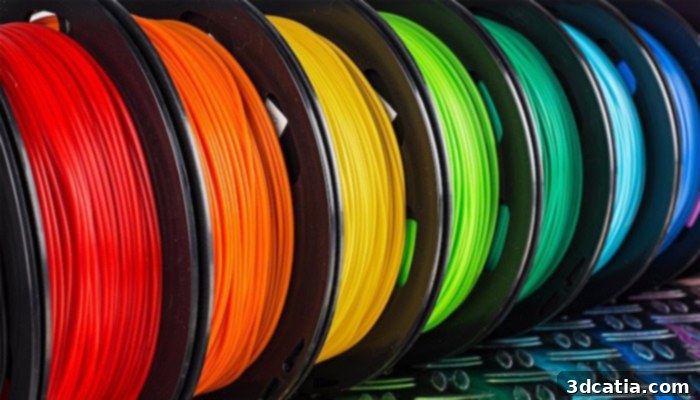
A standard spool of filament remains a relatively accessible and convenient option for many 3D printing enthusiasts (photo credits: La Nouvelle Ecole)
Filament and Pellet Manufacturers on the Market
The 3D printing market is characterized by a vibrant ecosystem of manufacturers catering to both filament and pellet-based additive manufacturing, each contributing significantly to the rapid advancement of this dynamic industry. Filaments, largely due to their ease of use, broad compatibility, and affordability for many users, have a particularly extensive array of dedicated producers. Prominent companies such as Polymaker, 3DXtech, 3D4Makers, Nanovia, ColorFabb, and Kimya offer a vast and diverse portfolio of high-quality filaments, ranging from everyday materials like PLA to PETG and engineering-grade ABS, alongside specialized composites and flexible options. Many major chemical companies, recognizing the growth of additive manufacturing, have also made significant contributions, with some, like BASF and Evonik, developing their own branded lines of advanced filaments, leveraging their deep expertise in polymer science.
When it comes to plastic pellets for 3D printing, the primary manufacturers often include the same large chemical groups that are foundational to the broader plastics industry. Companies like Arkema and SABIC are key players, supplying a vast array of polymer pellets used across various manufacturing sectors, including additive manufacturing. Additionally, specialized additive manufacturing material companies such as Felfil, 3DXtech (who also produce filaments), and Xtellar focus on developing and supplying optimized pellet formulations for 3D printing. It’s also worth noting the emergence of innovators specializing in sustainable solutions, such as the American company re3D, which focuses on producing plastic pellets from recycled waste, thereby promoting a circular economy within 3D printing. Other companies, like KIMYA, strategically engage in both pellet production and the subsequent transformation of these pellets into high-quality filaments, offering a comprehensive material supply chain.
Finally, the landscape of machine manufacturers compatible with these plastic forms is equally diverse. For filament-based 3D printing, the choice is vast, spanning from desktop machines for hobbyists to professional and industrial-grade solutions. Traditional industry leaders such as Stratasys, UltiMaker, and Zortrax continue to innovate, alongside a growing number of new entrants offering increasingly sophisticated and accessible systems. On the pellet-based printing side, the market is more specialized, focusing primarily on industrial-scale applications. Notable manufacturers include Arburg, known for its Freeformer technology, and Pollen AM. Furthermore, major additive manufacturing players like 3D Systems have expanded their capabilities in this area, notably through their acquisition of Titan Robotics in 2022, a company renowned for large-format pellet extrusion systems. AIM3D is another significant manufacturer in this segment, offering robust industrial pellet printers. This list, while highlighting key players, is by no means exhaustive, reflecting the continuous evolution and expansion of both material and machine development in the additive manufacturing space.
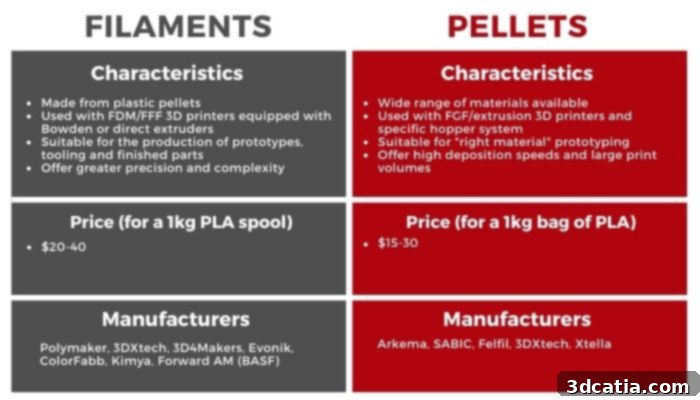
In conclusion, both plastic filaments and pellets offer distinct production advantages and are exceptionally well-suited to different additive manufacturing scenarios. Filaments excel in versatility, precision, and accessibility for smaller, detailed prints, making them ideal for rapid prototyping and intricate functional parts. Pellets, conversely, shine in large-scale, high-volume production, offering greater material choice, lower cost per kilogram, and a seamless transition path for materials already qualified in traditional manufacturing processes. Making an informed decision about the appropriate material form—whether filament or pellet—is crucial for maximizing the efficiency, cost-effectiveness, and ultimate success of your additive manufacturing process. Understanding these nuances empowers manufacturers to leverage the full potential of 3D printing technology.
Do you prefer filaments or pellets for your 3D printing projects? Let us know your thoughts and experiences in a comment below or connect with us on ourLinkedIn,Facebook, andTwitter pages! Don’t forget to sign up for our free weeklyNewsletter here, to receive the latest 3D printing news straight to your inbox! You can also find all our informative videos on ourYouTube channel.