

Revolutionizing Energy: Siemens and E.ON Pioneer 3D Printed Gas Turbine Burners for Sustainable Power
Additive manufacturing, commonly known as 3D printing, has rapidly transformed industrial landscapes, driving significant advancements in production processes and product development across diverse sectors. From the intricate components found in automotive engineering to the high-performance parts critical for the aerospace industry, 3D printing has proven its capacity to innovate. Now, this transformative technology is taking a monumental leap forward, poised to fundamentally reshape the energy sector. By enabling the creation of new, optimized, and more sustainable parts, additive manufacturing is empowering companies to enhance efficiency, reduce environmental impact, and pave the way for a more resilient energy infrastructure.
Siemens: A Global Leader Driving Additive Manufacturing Innovation
Siemens, a venerable global technology powerhouse, has strategically expanded its footprint in the additive manufacturing market over recent years, charting a comprehensive course of development. Their journey into this cutting-edge field began decisively in 2008 with a significant investment in metal 3D printing technology, specifically targeting applications within power generation. This early commitment laid the foundation for Siemens to integrate 3D printing deeply into its core innovation processes. The company has since achieved numerous milestones, including the installation of advanced EOR M280 SLM printers, the production of critical parts for a nuclear power plant, and even the conceptualization of VR-designed cars, showcasing the breadth of their additive manufacturing expertise.
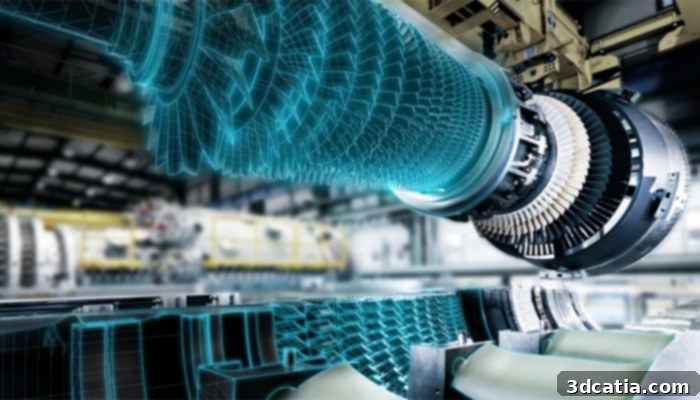
Siemens incorporating digitalisation throughout its business portfolio
Optimizing Turbine Technology with Additive Manufacturing
A substantial portion of Siemens’ additive manufacturing innovation has been channeled into optimizing critical components for turbines, which are central to power generation. This focused effort has yielded impressive results. Siemens pioneered the printing of the first 3D-printed burner tips and swirlers, which were subsequently installed in commercial gas turbines, demonstrating the technology’s viability in real-world, high-stakes environments. Further solidifying its leadership in the field, Siemens acquired Materials Solutions in the UK in 2016, a move that brought a leading additive manufacturing company into its fold. This strategic acquisition significantly bolstered Siemens’ in-house capabilities and expertise. Building on these successes, their experts achieved a groundbreaking feat in 2017 by designing and printing the world’s first gas turbine blades, marking a pivotal moment in the application of 3D printing for critical power generation components. These advancements underscore Siemens’ commitment to leveraging digitalization and additive manufacturing for enhanced performance, efficiency, and sustainability across its entire business portfolio.
E.ON: A Partner Focused on Future-Proof Energy Solutions
E.ON, an international, privately owned energy supplier headquartered in Essen, Germany, stands as another key player in the evolving energy landscape. E.ON strategically focuses on three core businesses: Energy Networks, Customer Solutions, and Renewables. This diversified approach is driven by a clear ambition to become the partner of choice for innovative energy and customer solutions globally. Their commitment to sustainability and efficiency, coupled with a proactive stance on integrating cutting-edge technologies, makes them an ideal collaborator in the pursuit of advanced energy solutions. This shared vision for progress is precisely where the groundbreaking collaboration with Siemens comes into play. Together, these two industry giants have achieved a significant milestone for the entire energy sector: the successful development and operation of the world’s first 3D-printed burner for an SGT-700 gas turbine, setting a new benchmark for innovation in power generation.
A Landmark Collaboration: Developing the World’s First 3D Printed SGT-700 Gas Turbine Burner
The journey toward this remarkable achievement began in 2017 when Siemens initiated intensive work on printing gas turbine burners using sophisticated laser melting technology. These pioneering burners were the first products to emerge from Siemens’ intelligent burner manufacturing program, strategically located in Finspång, Sweden. The traditional manufacturing process for burner heads is incredibly complex and labor-intensive, typically requiring the assembly of 13 individual parts and 18 distinct welds. Additive manufacturing completely revolutionizes this process, streamlining it to produce the entire burner in a single, unified piece. This simplification drastically reduces manufacturing complexity and assembly time, while also opening new avenues for design optimization previously impossible with conventional methods.
Engineering Advantages of Additive Manufacturing for Turbine Components
The application of 3D printing extends beyond mere simplification; it enables profound design improvements that enhance both performance and longevity. A notable example is the integration of the pilot-gas feed directly into the burner head, eliminating the need for an external pipe. This innovative design change allows the operating temperature of the part to be maintained at a significantly lower level. Lower operating temperatures are crucial for extending the operational lifespan of the burner, which in turn contributes to the increased durability and reliability of the entire gas turbine. Such enhancements are critical for reducing maintenance costs, minimizing downtime, and improving the overall efficiency of power generation facilities. The precision and design freedom offered by additive manufacturing facilitate the creation of intricate internal structures that optimize airflow and combustion efficiency, further boosting the performance of the SGT-700 gas turbine.
The collaboration between Siemens and E.ON has been a testament to the power of “co-creation,” where both parties actively contributed and mutually benefited. Siemens leveraged the project to accelerate the development and validation of its innovative design and manufacturing technologies, gaining invaluable real-world application data. E.ON, on the other hand, gained early access to these cutting-edge innovations, integrating them into their processes to enhance their energy solutions and maintain a competitive edge. This symbiotic relationship fostered a rapid iteration cycle, allowing for quicker problem-solving and optimization, ultimately leading to a more robust and efficient final product. The partnership exemplifies how industry leaders can synergize their strengths to push the boundaries of technological advancement in critical sectors.
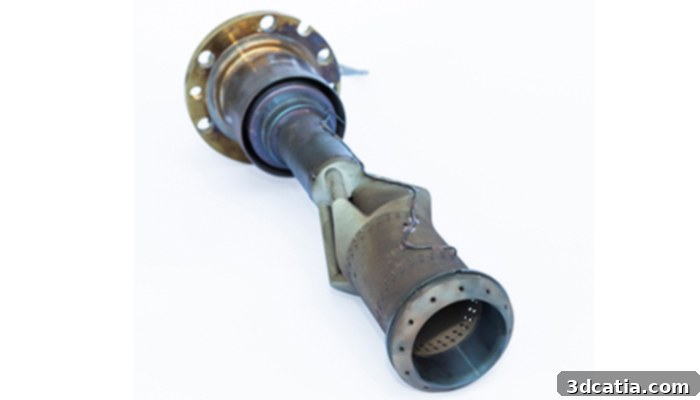
Pictured is Siemens’ 3-D printed gas burner for the SGT-700 gas turbine operating at E.ON’s combined cycle power plant in Philippsthal, Germany.
Tangible Results and Industry Impact
Niklas Lange, the esteemed project manager at E.ON Energy Projects, succinctly articulated the significance of this achievement: “As an energy service provider, precision and consistency are an absolute requirement for us. Additive manufacturing not only delivers this, but in our experience it can even improve performance compared with older models.” He further expressed E.ON’s proactive desire to drive innovation, recognizing the immense potential of Siemens’ Sweden-produced burners. This presented a unique opportunity for E.ON to integrate these advanced components into their turbines, ensuring future operational excellence. The hands-on, collaborative spirit between the two companies has culminated in a highly efficient, low-emission 3D-printed turbine component capable of withstanding higher temperatures. This enhanced temperature tolerance is a key factor in delivering superior performance and greater reliability to end consumers, directly translating into more stable and sustainable energy supply. This success story illustrates how strategic partnerships and advanced manufacturing techniques can collectively drive significant improvements in critical energy infrastructure.
The Broader Impact of Additive Manufacturing on the Energy Sector
The groundbreaking work by Siemens and E.ON with 3D-printed gas turbine burners is not an isolated success but a precursor to a wider transformation within the energy sector. Additive manufacturing offers a plethora of benefits that extend far beyond just turbine components. It enables rapid prototyping of new designs, allowing engineers to test and iterate concepts with unprecedented speed, drastically reducing development cycles and costs. This is particularly valuable in an industry that demands constant innovation to meet evolving energy needs and environmental regulations.
Beyond Turbines: A Wider Application Spectrum
Beyond turbines, 3D printing can revolutionize the production of custom tooling, jigs, and fixtures, making maintenance and repair operations more efficient. It can facilitate the on-demand manufacturing of spare parts, especially for aging infrastructure, mitigating supply chain vulnerabilities and extending the operational life of existing plants. The ability to produce complex geometries that are impossible with traditional manufacturing methods allows for the creation of lightweight, yet robust, components across various energy systems, from wind farms to nuclear facilities. This localized and customized production capability also reduces the environmental footprint associated with transportation and warehousing, contributing to a more sustainable and agile energy industry.
Towards a More Sustainable Future
Perhaps one of the most compelling aspects of additive manufacturing in the energy sector is its inherent contribution to sustainability. By enabling optimized designs, 3D printing significantly reduces material waste during production compared to subtractive manufacturing processes. Furthermore, the ability to create lighter and more efficient components directly translates into lower fuel consumption for gas turbines and increased energy output for renewable systems. This enhanced efficiency leads to reduced greenhouse gas emissions, aligning perfectly with global efforts to combat climate change. The technology also fosters a more circular economy by allowing for the repair and refurbishment of parts rather than outright replacement, thereby conserving resources and minimizing waste. The collaboration between Siemens and E.ON stands as a powerful testament to how industrial additive manufacturing is not just about making things differently, but about making them better, more efficiently, and more sustainably for the future of our planet.
What are your thoughts on the revolutionary 3D printed turbine developed through this partnership? We invite you to share your insights in the comments section below or join the conversation on our Facebook and Twitter pages! Don’t forget to sign up for our free weekly Newsletter to receive all the latest news and advancements in 3D printing delivered directly to your inbox!