
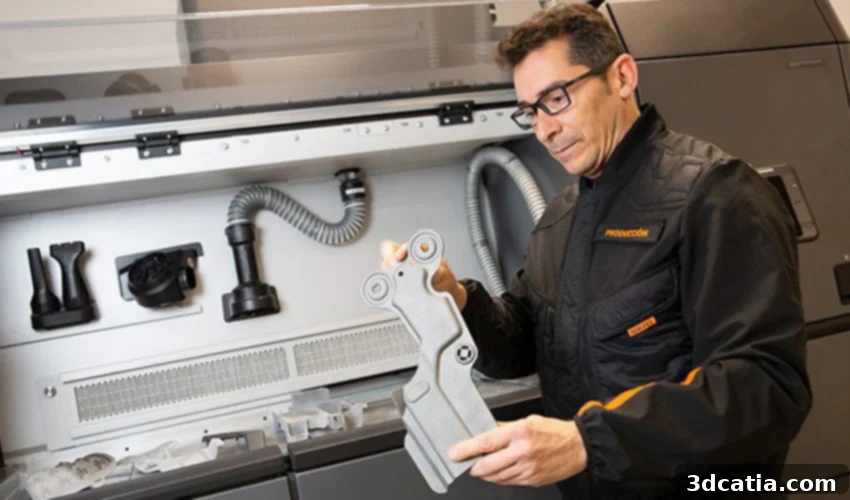
SEAT’s Prototype Development Centre: Pioneering Automotive Innovation with 3D Printing and Virtual Reality
In a significant stride towards future-proofing its vehicle development and manufacturing processes, the renowned Spanish automotive giant, SEAT, has proudly unveiled a state-of-the-art 3,000 m2 facility. This expansive new building is strategically designed to centralize and streamline all critical activities and processes that precede the mass production of a new vehicle model. More than just a new structure, this development represents a profound transformation of SEAT’s Prototype Development Centre (PDC), a vital hub nestled within the sprawling SEAT plant in Martorell. The rejuvenated PDC is set to become a beacon of advanced manufacturing, equipped with cutting-edge virtual reality applications integrated into its machining facilities. Perhaps even more notably, SEAT has allocated a substantial portion of this innovative space to pioneering additive manufacturing projects, demonstrating a firm commitment to leveraging advanced 3D printing technologies. By integrating a multitude of in-house 3D printing solutions, SEAT aims to produce highly advanced parts not only for the rigorous demands of the automotive sector but also for the rapid development of prototypes and pre-series models. This strategic enhancement of the PDC unequivocally underscores the brand’s unwavering commitment to embracing additive manufacturing, a commitment mirrored by other leading car manufacturers globally, such as Porsche and BMW, who are similarly investing heavily in these transformative technologies.
A Legacy of Innovation: The Prototype Development Centre’s Evolution
Since its inception in 2007, the Prototype Development Centre (PDC) has played an indispensable role within SEAT’s operational framework, serving as the crucial link that bridges the company’s extensive Research & Development (R&D) departments with its robust production facilities. Over the years, the PDC has been instrumental in shaping SEAT’s future product line, bringing to life a remarkable total of 13 innovative concept cars. These include iconic models like the IBE (2010), the distinctive Cupster (2014), the rugged Leon Cross Sport (2015), and the powerful CUPRA Ateca (2018), among many others. Its extensive track record also encompasses meticulous work on 5,235 pre-series models, rigorous testing of 2,472 test prototypes, and the meticulous crafting of 224 technical models. This history of high-volume, high-stakes development underscores the necessity for continuous investment and expansion. The strategic investment to transform and enhance the PDC, valued at a substantial €5 billion, is a clear testament to SEAT’s long-term vision and its dedication to not only sustaining but significantly expanding these vital activities. This substantial financial commitment highlights the strategic importance of the PDC as a cornerstone for future automotive innovation and competitive advantage.
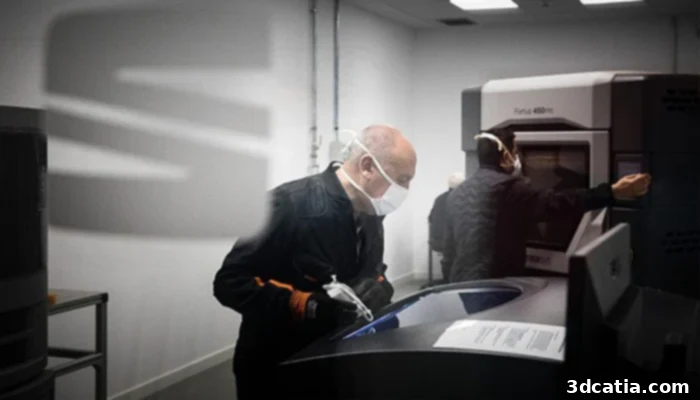
SEAT’s advanced manufacturing capabilities are enhanced by integrating multiple 3D printing solutions in-house, enabling the production of state-of-the-art parts for the automotive sector and for rapid prototyping. | Image via SEAT
Driving Efficiency Through Collaborative Design and Advanced Technologies
The newly established building within the PDC is not merely a structural addition; it is a hub for unparalleled collaboration, exemplified by the inclusion of a dedicated ‘Design for Manufacturing’ (DfM) room. This innovative space fosters an environment where diverse functional areas of the company—including R&D, quality assurance, process engineering, and manufacturing—converge. These critical teams work in close synergy with the more than 250 skilled professionals based at the Prototype Development Centre. The primary objective of this cross-functional collaboration is to meticulously analyze and iteratively improve products right from their earliest stages of conceptualization. This integrated approach is absolutely pivotal in dramatically reducing the time-to-market for future vehicles, while simultaneously boosting operational efficiency across all processes and optimizing resource management. To achieve these ambitious goals, the PDC is harnessing the power of new, transformative technologies. Virtual reality, for instance, is employed to simulate complex mass production processes with astounding accuracy, allowing for early identification and resolution of potential issues without physical constraints. Alongside VR, 3D printing and other advanced Industry 4.0 technologies are seamlessly integrated, enabling rapid iteration, bespoke tooling creation, and the development of highly complex components that would be challenging or impossible with traditional manufacturing methods.
The Power of Additive Manufacturing in Automotive
SEAT’s deepened investment in additive manufacturing technologies within the PDC is a clear indication of its profound understanding of the transformative benefits these innovations bring to the automotive development process. 3D printing, at its core, enables unparalleled design freedom, allowing engineers to create intricate geometries and optimize part performance in ways previously unattainable. For prototyping, this translates into significantly faster iteration cycles, reduced costs, and the ability to test multiple design variations simultaneously. Instead of waiting weeks for traditionally manufactured prototypes, 3D printed parts can be produced in hours or days, dramatically accelerating the product development timeline. Beyond prototyping, SEAT is strategically positioning itself to leverage additive manufacturing for end-use parts, particularly for its future models. This capability offers advantages such as lightweighting components, producing on-demand spare parts, and even enabling mass customization, where parts can be tailored to specific vehicle configurations or customer preferences. The integration of various 3D printing solutions in-house, from stereolithography (SLA) for fine detail and smooth finishes to fused deposition modeling (FDM) for robust functional prototypes and selective laser sintering (SLS) for complex, high-performance components, empowers SEAT with a versatile toolkit for innovation. This internal capacity not only ensures intellectual property protection but also grants the agility to respond swiftly to design changes and market demands.
Leadership Vision: Embracing Digital and Electronic Futures
Anabel Andión, the esteemed Head of SEAT’s PDC, eloquently articulated the strategic significance of these advancements, stating, “The transformation of our Prototype Development Centre enables us to work with total efficiency in the development and launch of new models.” Her insights highlight the efficiency gains and accelerated product launches facilitated by the new infrastructure. She further emphasized SEAT’s long-standing commitment to cutting-edge technologies, noting, “We’ve been working with virtual reality and 3D printing for more than thirteen years. With these new facilities and the unification of the PDC, we intend to invest more than ever in the development of digital and electronic solutions adapted to the car of tomorrow.” This statement underscores a forward-looking vision, recognizing that the automotive industry is undergoing an unprecedented digital transformation. The car of tomorrow will be increasingly connected, autonomous, shared, and electric (CASE), and SEAT’s PDC is being meticulously designed to be at the forefront of these revolutionary shifts. The sustained investment in digital and electronic solutions will ensure that SEAT remains a competitive and innovative force in shaping the future of mobility.
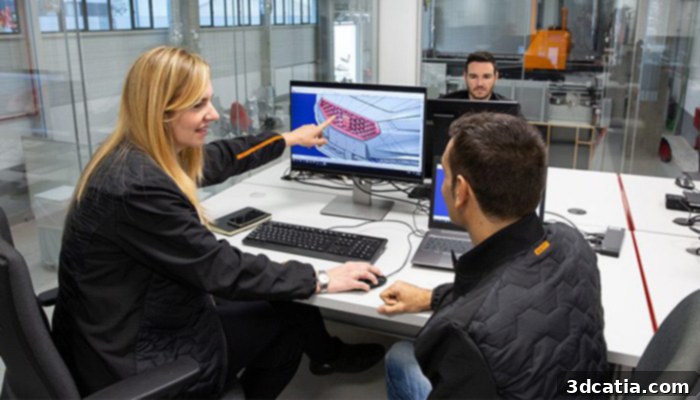
Over 250 dedicated professionals will collaborate and innovate within the advanced facilities of SEAT’s Prototype Development Centre, driving the next generation of automotive development.
PDC: A Pillar for Electrification and Future Mobility
SEAT’s strategic recognition of the profound benefits offered by additive manufacturing technologies extends beyond conventional vehicle development; it is deeply intertwined with the company’s strong focus on electrification. The automotive industry is rapidly transitioning towards electric vehicles (EVs), and SEAT has unequivocally made electrification one of its main pillars for future growth and innovation. The capabilities within the transformed PDC are therefore invaluable for developing components specific to electric powertrains, battery systems, and lightweight structures that are crucial for maximizing EV range and performance. 3D printing allows for the rapid creation of prototypes for battery enclosures, motor housings, and cooling systems, enabling engineers to quickly test and optimize designs. Furthermore, advanced materials compatible with additive manufacturing can facilitate the production of parts that are not only lighter but also possess superior thermal or electrical properties, directly contributing to the efficiency and safety of electric vehicles. This proactive investment in advanced technologies at the PDC ensures that SEAT is well-equipped to design, develop, and validate the next generation of electric and connected cars, solidifying its position as a leader in sustainable mobility. More comprehensive information regarding SEAT’s overarching strategies and innovations can be found HERE.
Connecting with the Future of Automotive Development
The transformation of SEAT’s Prototype Development Centre represents a critical milestone in the journey of automotive innovation. By integrating sophisticated digital tools like virtual reality and embracing the full potential of additive manufacturing, SEAT is not just optimizing its pre-production processes; it is fundamentally reshaping how vehicles are designed, developed, and brought to market. This commitment to Industry 4.0 principles, coupled with a strategic focus on electrification, positions SEAT as a dynamic and forward-thinking player in a rapidly evolving global automotive landscape. The fusion of skilled human talent with cutting-edge technology within the PDC is set to accelerate the realization of advanced, efficient, and sustainable vehicles for tomorrow’s roads. The significant investment and the strategic vision behind these enhancements underscore SEAT’s dedication to maintaining its competitive edge and delivering exceptional products to its customers worldwide. The redesigned PDC stands as a testament to SEAT’s ambition to lead in the new era of automotive manufacturing.
We invite your thoughts and perspectives on this groundbreaking transformation at SEAT’s Prototype Development Centre. What implications do you foresee for the future of automotive development with such advancements? Share your insights and comments below, or engage with us on our social media platforms: find us on Facebook and Twitter! For all the latest news and updates in the dynamic world of 3D printing and advanced manufacturing, don’t forget to sign up for our free weekly Newsletter, delivered straight to your inbox.