
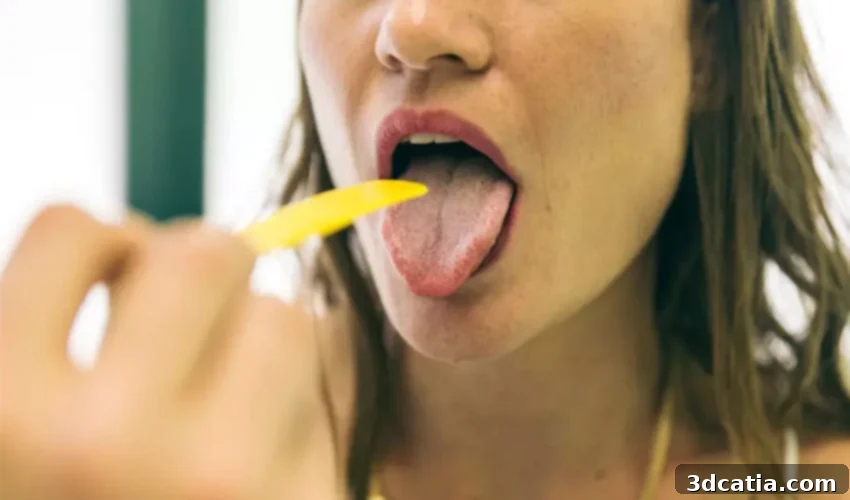
3D Printed Biomimetic Tongue: Revolutionizing Food, Pharma, and Oral Health Research
In a groundbreaking development that promises to reshape various industries, researchers at the University of Leeds, in collaboration with Edinburgh University, have successfully created 3D printed soft synthetic surfaces that intricately replicate the texture and mechanical properties of a human tongue. Utilizing advanced silicone materials, these innovative surfaces are designed to mimic the complex topology, elasticity, and wettability of this vital and highly specialized oral organ. This remarkable innovation opens up unprecedented avenues for rigorous testing of food products, pharmaceuticals, and could significantly deepen our understanding of various oral sensations and conditions, such as dry mouth, all without the need for human subjects. The ability to accurately simulate the oral environment marks a significant leap forward in biomimicry and material science, paving the way for more efficient and ethical research and product development.
The Unparalleled Complexity of the Human Tongue
The human tongue is far more than just a muscle responsible for taste; it is a remarkably sophisticated and versatile organ. Composed of eight interconnected muscles, it boasts an intricate network of blood vessels (highly vascularised) and nerves, making it incredibly sensitive and agile. Its primary role in taste perception is facilitated by thousands of taste buds, nestled within specialized structures called papillae. These papillae cover the entire dorsal surface of the tongue, enabling us to perceive the five basic tastes: sweet, salty, sour, bitter, and umami. Beyond taste, the sense of smell complements our perception of flavour, making eating a multi-sensory experience.
However, the papillae also play a crucial mechanical role. There are four main types: filiform, fungiform, circumvallate, and foliate. While fungiform, circumvallate, and foliate papillae contain taste buds, filiform papillae – the most numerous – primarily provide the tongue with its characteristic rough texture. This roughness is vital for manipulating food during chewing, creating friction to grip and move food boluses efficiently. The combination of these varied papillae, along with the tongue’s inherent softness and flexibility, creates a mechanically intricate landscape. Reproducing such a dynamic and nuanced surface, with its specific tactile properties and fluid-interaction characteristics, has long been a formidable challenge for scientists and engineers. However, the pioneering team at the University of Leeds, leveraging the power of 3D printing technology, has taken on this challenge with remarkable success.
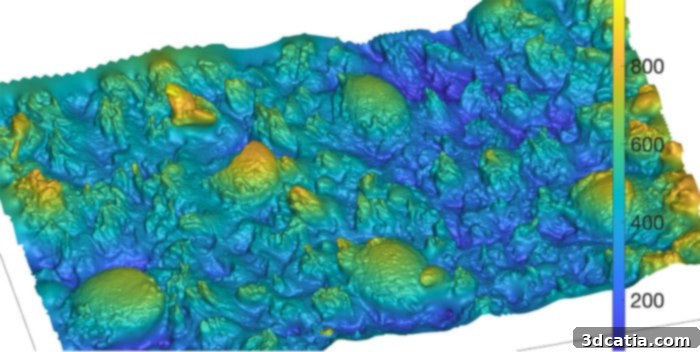
The structure of the human tongue is complex, featuring various papillae that contribute to its unique texture and function | Credits: Anwesha Sarkar
Pioneering the Biomimetic Surface: The 3D Printing Approach
The journey to create this innovative biomimetic tongue surface was spearheaded by dedicated researchers. Dr. Efren Andablo-Reyes, Director of Research on the project, articulated the core challenge: “Recreating the surface of an average human tongue comes with unique architectural challenges. Hundreds of small bud-like structures called papillae give the tongue its characteristic rough texture which, combined with the soft nature of the fabrics, creates a mechanically complicated landscape.” This statement underscores the dual complexity of both microstructure and material properties that had to be overcome. The team’s ambition was clear: to precisely reproduce the critical mechanical characteristics of the human tongue, ensuring that the artificial surface could accurately mimic the pleasant perception of oral sensations and facilitate adequate lubrication essential for swallowing. The ultimate goal was to create a robust, reliable surface that could be easily utilized in a laboratory setting to faithfully reproduce the conditions encountered during oral treatment and consumption processes.
To achieve this ambitious goal, the researchers turned to additive manufacturing, specifically 3D printing. This technology offers unparalleled precision and flexibility in fabricating intricate geometries that traditional manufacturing methods simply cannot replicate. The ability to build up complex structures layer by layer, with fine control over dimensions and textures, made 3D printing the ideal choice for accurately recreating the microscopic details of the tongue’s papillae. This innovative approach allowed the team to move beyond theoretical models, translating natural biological complexity into a tangible, functional scientific tool.
The Meticulous Methodology: From Human Data to Digital Fabrication
The creation of this biomimetic tongue involved a meticulous, multi-stage methodology, beginning with detailed data collection from human subjects. The research team started by taking silicone impressions of the tongue surfaces of fifteen adult volunteers. This crucial first step provided a real-world dataset of tongue topologies, capturing the natural variations in papillae size, density, and distribution across different individuals. These physical impressions were then subjected to high-resolution optical scanning. This process allowed the researchers to accurately map the microscopic details of the papillae, quantifying their exact size, density per unit area, and the average roughness characteristic of human tongues.
With this extensive dataset, the next phase involved sophisticated computational techniques. Using advanced computer simulation and mathematical modelling, the researchers designed a 3D printable mould. This digital design was engineered to randomly reproduce the authentic shapes, dimensions, and spatial arrangement of the different papillae types with astonishing accuracy, ensuring the correct density and distribution across the surface. This computational approach was vital for translating natural biological complexity into a reproducible, engineered blueprint.
Once the digital mould was perfected, the team leveraged a Digital Light Processing (DLP) 3D printer for its fabrication. DLP technology is renowned for its ability to produce highly detailed and smooth surfaces, making it ideal for creating the intricate mould necessary for replicating the microscopic texture of the tongue. After the mould was 3D printed, the final biomimetic tongue surface was cast using specialized elastomers. These materials were carefully chosen and optimized for their flexibility, elasticity, and wettability – properties critical for mimicking the soft, deformable nature of the human tongue and its interaction with fluids. The careful selection of both the printing technology for the mould and the casting material for the final surface underscores the advanced material science and engineering principles applied in this innovative project.
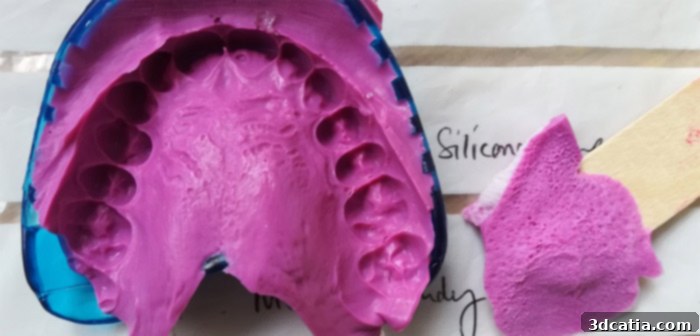
Fifteen detailed silicone impressions were meticulously made to capture the precise texture and topology of human tongues for data collection | Credits: Anwesha Sarkar
Rigorous Validation and Identical Results
To ensure the fidelity and functional accuracy of the 3D printed biomimetic tongue surfaces, a series of comprehensive tests were meticulously carried out. The researchers employed various fluids, each possessing distinct rheological properties and complexities, to evaluate how they interacted with the artificial tongue surface. These fluids were designed to represent a range of substances encountered in oral processing, from thin liquids to more viscous food products and pharmaceutical formulations. The objective was to observe and quantify critical parameters such as fluid retention, spreading characteristics, and lubrication dynamics on the engineered surface.
The results of these rigorous tests were remarkably compelling. The behavior of the different fluids on the 3D printed biomimetic surfaces appeared to be virtually identical to their behavior on the original silicone impressions taken from human tongues. This striking congruence provided strong validation that the artificial tongue not only looked like a human tongue at a microscopic level but also performed functionally in a highly similar manner. This successful validation is a cornerstone of the research, confirming that the developed surface can reliably reproduce the intricate mechanical and fluid-interaction characteristics of the oral cavity, thereby serving as a robust and accurate testing platform for diverse applications.
Transformative Applications: Impacting Food and Pharmaceutical Industries
The potential ramifications of this research project are vast and extend across several critical sectors, most notably the food and health industries. The ability to accurately simulate the oral environment offers unprecedented opportunities for innovation, quality control, and scientific discovery.
Enhancing Food Product Development and Safety
Professor Anwesha Sarkar, the Principal Investigator, highlighted the profound impact on food science: “This project is crucial to understand quantitatively how fluids interact in the oral cavity. The biomimetic surface of the tongue we have created could serve as a unique mechanical tool to help detect counterfeits in food and beverages, based on texture attributes, which is a global concern and can help ensure food safety.” This application alone holds immense value. Food texture and mouthfeel are critical drivers of consumer preference and product success. With the 3D printed tongue, manufacturers can now precisely evaluate how different ingredients and formulations will be perceived orally, optimizing everything from the creaminess of yogurt to the crispness of a biscuit, without extensive and costly human sensory panels in early development stages.
Furthermore, the potential for identifying food counterfeits is a significant breakthrough. Many counterfeit food products attempt to replicate the appearance and taste but often fall short on texture. The biomimetic tongue can provide an objective, quantitative measure of textural authenticity, bolstering global efforts in food safety and protecting consumers from fraudulent products. It can also be used in quality control processes, ensuring consistency in texture across batches of food and beverage products, which is crucial for brand reputation and consumer satisfaction.
Advancing Pharmaceutical Research and Oral Health
Beyond food, the applications in pharmaceuticals and oral health are equally compelling. The 3D printed tongue can significantly aid in the development of new therapeutic technologies and products. For pharmaceutical companies, understanding how orally administered drugs interact with the tongue surface is vital. This includes assessing the dissolution rates of tablets, the adherence of oral gels, and the taste-masking properties of various formulations. The biomimetic tongue provides an *in vitro* platform to test these interactions, potentially streamlining drug development, reducing costs, and accelerating the delivery of new medications to patients.
In oral health, this technology can revolutionize the testing and development of products like toothpastes, mouthwashes, and lozenges. Researchers can evaluate how these products spread, lubricate, and interact with the oral tissues, leading to more effective and pleasant formulations. Moreover, the platform offers a unique tool to better understand challenging oral conditions such as dry mouth (xerostomia). By simulating different levels of hydration and fluid interaction, scientists can gain deeper insights into the mechanisms of dry mouth, paving the way for the development of innovative diagnostic tools and more effective therapeutic interventions to alleviate patient discomfort. This capability to study specific oral pathologies without relying on human trials or complex animal models marks a significant ethical and practical advantage in medical research.
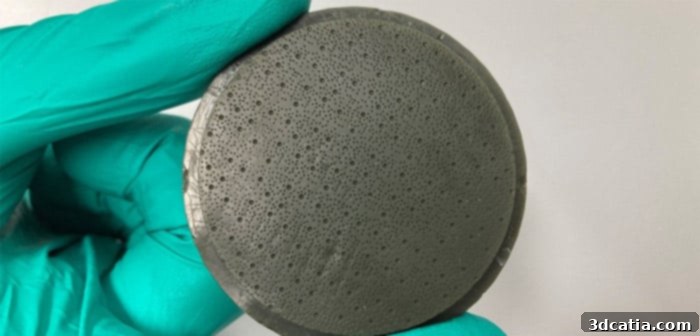
The intricate 3D printed moulds incorporate small holes and structures designed to precisely reproduce the shape, size, and density of human taste buds and papillae | Credits: University of Leeds
The Future of Biomimicry and Soft Materials Engineering
The creation of this 3D printed biomimetic tongue stands as a testament to the advancements in biomimicry and soft materials engineering. This field focuses on drawing inspiration from nature to solve complex engineering challenges, and replicating a human organ with such fidelity is a significant milestone. This research not only provides a valuable tool for specific industrial applications but also pushes the boundaries of what is possible in soft robotics and the creation of lifelike synthetic tissues.
Looking ahead, the methodologies developed by the University of Leeds and Edinburgh University team could be applied to replicate other complex biological surfaces or organs. This could have profound implications for personalized medicine, where patient-specific organ models could be 3D printed for surgical planning or drug efficacy testing. It also opens doors for fundamental research into human physiology, allowing scientists to isolate and study specific mechanical interactions that are difficult to observe *in vivo*. As 3D printing technology continues to evolve, particularly in multi-material printing and the handling of soft, biocompatible substances, we can expect even more sophisticated biomimetic models to emerge, further blurring the lines between the natural and the engineered, and ultimately leading to transformative impacts on health, industry, and scientific understanding.
The successful development of this 3D printed biomimetic tongue surface is a testament to innovative interdisciplinary research. It provides an invaluable mechanical tool that will undoubtedly propel advancements in understanding fluid interactions in the oral cavity, with far-reaching benefits for food safety, pharmaceutical development, and fundamental biological research. This project exemplifies how cutting-edge technology, combined with deep scientific insight, can unlock new possibilities for solving real-world problems and improving human well-being. Find the full study and more details on this pioneering work by the University of Leeds and Edinburgh University team HERE.