
Safran Elevates Aerospace Manufacturing with Additive Industries’ MetalFAB1 Industrial 3D Printer
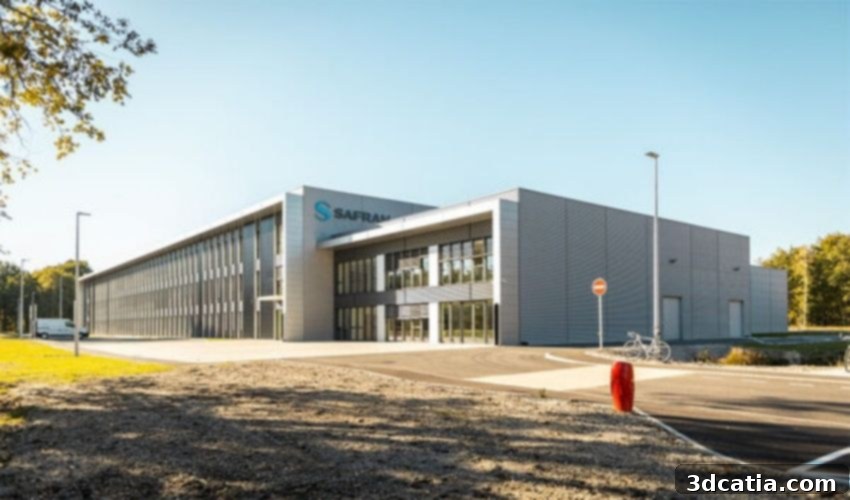
Safran, a global leader among French industrial groups, consistently pushes the boundaries of innovation to meet the intricate and demanding requirements of its international clientele. In an era where advanced manufacturing defines competitive advantage, Safran stands at the forefront, mirroring the strategic investments of other pioneering brands such as BMW and Volkswagen, which have established dedicated centers for additive manufacturing. Safran’s commitment to this transformative technology is exemplified by its state-of-the-art Safran Additive Manufacturing Campus (SAMC). This specialized center is no mere coincidence; for several years, Safran has been a principal proponent and user of additive manufacturing within the highly regulated and complex aeronautics sector. From intricate propeller components to robust landing gear housings, a significant and growing number of critical parts are now being produced through 3D printing by Safran. To further amplify its production capabilities and solidify its leadership in industrial additive manufacturing, the French aerospace giant has strategically integrated Additive Industries’ advanced MetalFAB1 industrial 3D printer into its campus operations.
The integration of the MetalFAB1 system marks a pivotal moment for Safran’s manufacturing strategy. Following an extensive test phase that commenced last June, the MetalFAB1 has now been officially adopted and fully integrated into Safran’s production ecosystem. This significant milestone was met with considerable enthusiasm from Additive Industries. Ian C. Howe, CEO of Additive Industries, expressed his satisfaction and optimism regarding the collaboration: “We are profoundly honored that Safran has chosen MetalFAB1 technology and our company, and we are delighted to enter into a long-term partnership to jointly develop the technology and its applications with the esteemed Safran group.” Howe further elaborated on the strategic alignment of their technologies with Safran’s operational demands: “We are convinced that our technologies are perfectly suited to the highly technical and performance-driven market in which Safran operates. We are deeply committed to contributing to Safran’s relentless efforts to develop new applications with additive manufacturing, particularly those demanding exceptional productivity and uncompromising quality levels, all while ensuring maximum safety for the workforce involved in these advanced manufacturing processes.” This partnership underscores a mutual commitment to advancing metal additive manufacturing, pushing the boundaries of what is possible in aerospace and defense production.
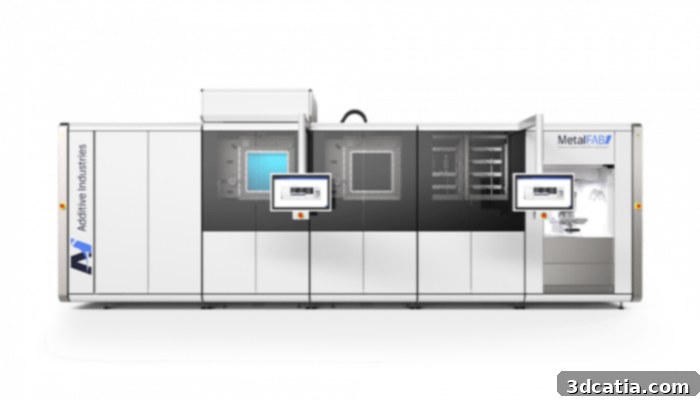
The MetalFAB1 industrial 3D printer, a cornerstone of advanced metal additive manufacturing. (Credit Photo : Additive Industries)
Unveiling the Power of Additive Industries MetalFAB1 for Industrial Production
Additive Industries, established in 2012 near Eindhoven in the Netherlands, has rapidly emerged as a key innovator in the industrial additive manufacturing landscape, renowned for its flagship MetalFAB1 system. This industrial-grade 3D printer represents a significant leap forward in metal additive manufacturing capabilities. Engineered with a modular and scalable architecture, the MetalFAB1 offers unparalleled flexibility, allowing manufacturers to configure systems with up to 11 modules to precisely match their production requirements. At its core, the machine operates on the principle of powder bed laser melting, a highly precise and robust process capable of producing complex metal parts with superior material properties. It boasts a generous print volume of 420 x 420 x 400 mm, accommodating a wide range of component sizes critical for industries like aerospace.
A defining characteristic of the MetalFAB1, and a crucial factor for its adoption in high-stakes sectors, is its comprehensive automation. Additive Industries designed the system to be fully automated, significantly reducing human intervention and, consequently, minimizing the potential for human errors. This level of automation is pivotal for enhancing process reproducibility and ensuring consistent part quality—a non-negotiable requirement for certified aerospace components. The automated workflow spans multiple stages, from powder handling and inert atmosphere management to print chamber calibration and post-processing steps. This streamlined approach enables users of the machine, such as Safran, to rapidly produce a large volume of high-quality parts while simultaneously driving down manufacturing costs through increased efficiency and reduced scrap rates. The ability to maintain stringent quality controls across numerous builds makes the MetalFAB1 an ideal solution for mass production of critical metal components.
Safran’s Strategic Imperative: Mastering Metal Additive Manufacturing for Aerospace and Defense
Safran’s decision to invest in the MetalFAB1 is primarily driven by its strategic objective to manufacture highly complex, performance-critical parts tailored specifically for the aerospace and defense sectors. These industries impose some of the most rigorous requirements on components, particularly concerning their resistance to extreme temperatures, high strength-to-weight ratios, and durability under severe operational conditions. The MetalFAB1’s ability to process advanced metal alloys, including various aluminum compositions, is particularly significant for Safran. Aluminum, known for its lightweight properties, is vital for reducing aircraft weight, thereby enhancing fuel efficiency and operational performance. With this advanced industrial 3D printing system, Safran aims not only to significantly increase its production capacities but also to achieve substantial reductions in overall manufacturing costs by optimizing material usage and streamlining production workflows.
FX Foubert, CEO of Safran, articulated the strategic vision behind this critical integration: “With the integration of an AM MetalFAB1 printer at Safran, we aim to meet the challenge of performance at the right level of raw material quality and productivity for the ‘Aluminum.’” This statement underscores the dual focus on achieving exceptional performance from components while ensuring the highest quality of raw materials, specifically aluminum, and maximizing manufacturing productivity. The benefits of additive manufacturing for aerospace are multifaceted. It allows for the creation of intricate geometries that are impossible to produce with traditional manufacturing methods, leading to optimized designs, reduced part count through assembly consolidation, and improved functionality. For instance, designing lightweight structural brackets with internal lattice structures, or optimizing engine components for better thermal management, are now within reach. Furthermore, the ability to produce parts on-demand can drastically reduce lead times and enhance supply chain resilience, a crucial advantage in the demanding aerospace and defense landscape where component availability is paramount.
Transforming Aerospace with Advanced Additive Manufacturing
The adoption of the MetalFAB1 by Safran signifies a broader trend within the aerospace industry: a decisive shift towards industrial-scale additive manufacturing. This technology enables unprecedented design freedom, allowing engineers to create components that are lighter, stronger, and more efficient than ever before. For Safran, this means exploring new frontiers in component design, from optimizing aerodynamic surfaces and internal cooling channels in turbine blades to consolidating dozens of conventionally manufactured parts into a single, more robust 3D-printed component. Such consolidation not only reduces weight and assembly time but also minimizes potential points of failure, thereby enhancing overall system reliability and safety.
Beyond the immediate production benefits, this partnership fosters continuous innovation. Safran and Additive Industries are poised to collaborate on developing new materials and processes specifically tailored for aerospace applications. This includes research into advanced aluminum alloys with enhanced properties, new post-processing techniques to meet stringent certification standards, and the refinement of software tools for design optimization and process control. The modularity of the MetalFAB1 ensures that as new materials and processes emerge, the system can be adapted, future-proofing Safran’s investment and maintaining its competitive edge. The emphasis on high quality and reproducibility, inherent in the MetalFAB1’s automated design, is particularly vital for aerospace certification, where every part must meet exact specifications and demonstrate consistent performance under extreme conditions.
The Future of High-Performance Manufacturing at Safran
The integration of Additive Industries’ MetalFAB1 into Safran’s Additive Manufacturing Campus is more than just an equipment upgrade; it represents a strategic investment in the future of high-performance manufacturing for critical aerospace and defense applications. This move solidifies Safran’s position as a trailblazer in industrial additive manufacturing, enabling the company to not only meet current demands but also to anticipate and shape future industry standards. By leveraging the MetalFAB1’s advanced capabilities, Safran is set to unlock new levels of design complexity, material efficiency, and production scalability, ultimately leading to more innovative, lightweight, and robust components for the next generation of aircraft and defense systems. This partnership underscores the growing importance of collaborative innovation in pushing the boundaries of what advanced manufacturing can achieve.
What are your thoughts on the MetalFAB1 3D printer and its impact on aerospace manufacturing? Don’t miss out on the latest advancements and insights in the world of 3D printing! Sign up for our free weekly Newsletter here, delivering the freshest 3D printing news straight to your inbox. You can also explore all our in-depth videos and exclusive content on our YouTube channel.