
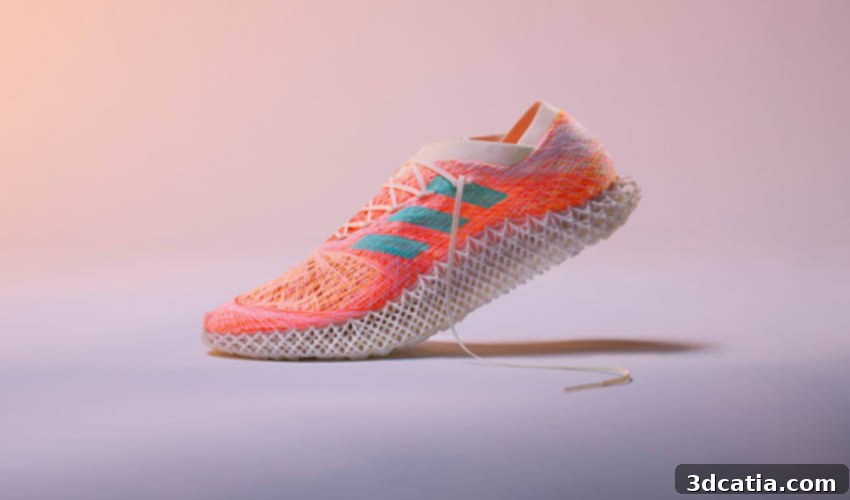
Adidas STRUNG: Revolutionizing Footwear with Robotics and 3D Printing for Unprecedented Performance
Adidas has long been at the forefront of sports innovation, consistently pushing the boundaries of athletic performance through cutting-edge design and manufacturing. For several years, the global sportswear giant has been deeply invested in advanced manufacturing technologies, particularly 3D printing, to reimagine how footwear is constructed. This commitment is best embodied by its pioneering FUTURECRAFT division, an innovation incubator dedicated to shaping the future of sports. FUTURECRAFT has explored numerous groundbreaking concepts, famously introducing the FUTURECRAFT 4D sneaker, which captivated the industry with its distinctive lattice-like 3D printed sole.
Building on this legacy of innovation, Adidas recently unveiled its latest technological marvel: STRUNG. This revolutionary textile innovation represents a significant leap forward in footwear design, promising to elevate athletic performance to unprecedented levels. Unlike the FUTURECRAFT 4D, which primarily leveraged 3D printing for its sole, STRUNG focuses on a unique process that combines invaluable athlete input, sophisticated robotics, and principles of additive manufacturing to create an exceptionally lightweight and highly functional shoe upper.
The essence of STRUNG lies in its meticulous construction process. The upper part of the shoe is manufactured with a highly precise robotic arm, which individually places each thread according to a meticulously designed pattern derived from comprehensive athlete data. This groundbreaking approach ensures that every single thread contributes to a lightweight, seamless shoe that perfectly accommodates natural foot movement. By precisely controlling the placement and tension of each filament, Adidas can engineer zones of specific performance characteristics directly into the material, creating a shoe that feels like a natural extension of the foot.
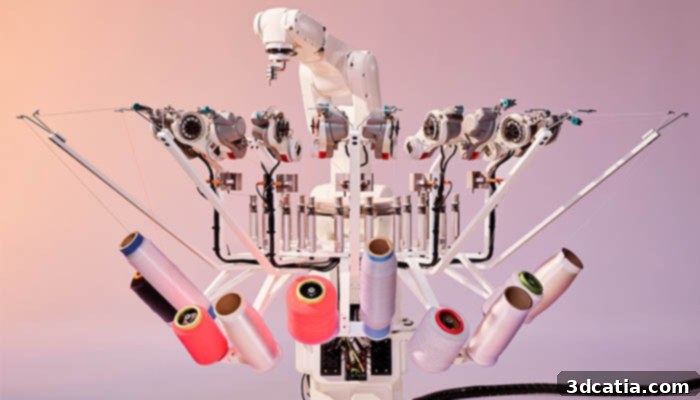
The STRUNG process: Robotic precision for engineered uppers
The Science Behind STRUNG: Targeted Performance Through Thread Placement
One of the most compelling aspects of STRUNG technology is its ability to direct each thread in any desired direction. This unparalleled control allows Adidas designers and engineers to combine various characteristics, such as specific support zones and areas requiring maximum flexibility, within a single, continuous piece of material. This eliminates the need for multiple components, overlays, or stitched reinforcements that are common in traditional shoe construction. In conventional textiles, additional layers or materials are often required to provide necessary support, which can inadvertently hinder the foot’s natural articulation and add unnecessary weight and bulk.
With STRUNG, the entire upper is a unified structure where support and flexibility are not added on but are inherently woven into the very fabric of the shoe. This means that the STRUNG shoe does not require external reinforcements that might impede the natural biomechanics of athletes. The result is an upper that is not only lighter and more comfortable but also more responsive, allowing for an uninhibited range of motion. This precision engineering minimizes energy waste during movement and maximizes comfort, enabling athletes to perform at their peak without distraction.
The Power of Personalization: Custom-Made Footwear with Additive Manufacturing
The integration of STRUNG with 3D printing technologies truly unlocks the potential for personalized footwear, a feature that stands as one of the most beneficial applications of additive manufacturing. The ability to manufacture a piece that is custom-made to fit an individual perfectly is a game-changer for athletes. The latest concept shoe from Adidas exemplifies this synergy, combining the revolutionary STRUNG technology for the upper part with the proven FUTURECRAFT technology for the midsole. This holistic approach ensures that every aspect of the shoe, from the ground up, is engineered for optimal performance tailored to the wearer.
The midsole, critical for cushioning, energy return, and stability, is manufactured using Carbon’s cutting-edge Digital Light Synthesis (DLS) technology. This advanced additive manufacturing process relies on photopolymerization, where a liquid resin is precisely hardened layer by layer by light to create intricate, complex lattice structures. These lattice designs are not merely aesthetic; they are engineered at a microscopic level to provide unparalleled cushioning, shock absorption, and energy return, all while maintaining an incredibly lightweight profile. The DLS technology allows for the creation of open structures that are impossible with traditional manufacturing methods, providing tunable performance zones that adapt to the foot’s mechanics during various phases of motion, improving both comfort and athletic output.
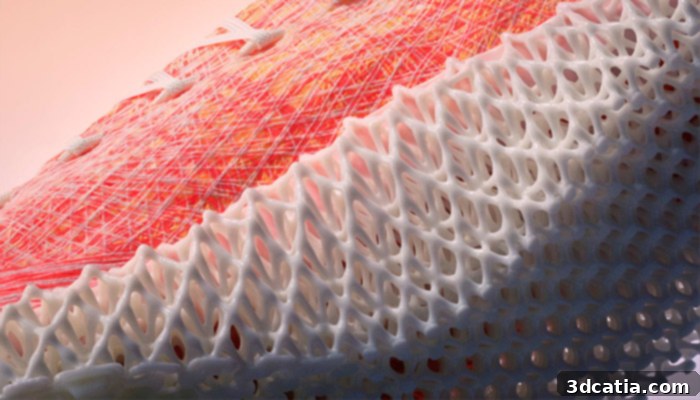
The latest concept shoe combines a STRUNG upper with a FUTURECRAFT 3D printed midsole, demonstrating innovative integration.
Synergistic Design: Uppers and Midsoles Working in Harmony
The combination of STRUNG technology for the upper and Carbon DLS for the midsole represents a truly synergistic approach to footwear engineering. While the STRUNG upper provides a lightweight, seamless, and adaptive fit that moves with the foot, the DLS midsole offers optimized cushioning and stability precisely where it’s needed most. This duality ensures that athletes benefit from a complete performance system rather than disparate components. The seamless interaction between the flexible, supportive upper and the responsive, energy-returning sole creates an experience of unparalleled comfort and efficiency, allowing athletes to focus entirely on their performance.
Consider the demands placed on an athlete’s foot during high-intensity activities like running or jumping. Traditional shoes often compromise between flexibility and support, forcing engineers to make trade-offs. However, with STRUNG, targeted flexibility can be placed in areas like the forefoot to allow for natural toe-off, while denser thread patterns can provide critical support around the arch and heel without adding restrictive materials. This level of granular control, when paired with the complex lattice structures of the DLS midsole which can also be tuned for varying densities and rebound characteristics across the footbed, leads to a shoe that dynamically adapts to the athlete’s movement, optimizing biomechanics and reducing the risk of injury.
The Future is Now: Public Launch and Broader Applications
The first STRUNG shoe destined for public release is currently undergoing rigorous development and testing. Anticipation is high for its official launch, which is projected to occur at the end of 2021 or in early 2022. This initial launch will mark a pivotal moment, bringing a truly revolutionary piece of athletic gear to consumers. However, Adidas’s vision for STRUNG extends far beyond a single product or sport. The company has ambitious plans to expand the application of the STRUNG upper technology to a wide array of other sports categories, demonstrating its versatility and potential to transform footwear across the athletic spectrum.
Imagine the possibilities for basketball shoes requiring specific ankle support and forefoot flexibility, or soccer cleats needing lightweight stability and precision touch. The adaptive nature of STRUNG’s robotic weaving process means it can be tailored to the unique demands of virtually any athletic endeavor. This expansion underscores Adidas’s long-term commitment to innovation and its belief that data-driven design and advanced manufacturing will define the next generation of performance footwear. Furthermore, the precise, on-demand nature of robotic manufacturing, combined with the efficient material use inherent in additive processes like DLS, also opens doors for more sustainable manufacturing practices, potentially reducing waste and promoting localized production.
Conclusion: Stepping into a New Era of Athletic Performance
The Adidas FUTURECRAFT.STRUNG sneaker represents a remarkable convergence of cutting-edge technologies – robotics, additive manufacturing, and advanced material science – all driven by deep insights into athlete needs. By merging the precision of robotically woven STRUNG uppers with the engineered performance of 3D printed FUTURECRAFT midsoles, Adidas is not just creating new shoes; it’s defining a new paradigm for athletic footwear. This innovation promises not only superior comfort and a natural fit but also a significant enhancement in athletic performance through optimized support, flexibility, and energy return.
As Adidas continues to push the boundaries of what’s possible, the STRUNG technology stands as a testament to the power of continuous innovation in the sportswear industry. The forthcoming public launch will undoubtedly reshape consumer expectations and set new benchmarks for performance footwear. This isn’t merely an incremental improvement; it’s a fundamental reimagining of how athletic shoes are designed, manufactured, and experienced. The future of footwear is here, and it’s woven with precision, printed with light, and engineered for the ultimate athlete.
What are your thoughts on the FUTURECRAFT.STRUNG sneaker and the integration of robotics and 3D printing in athletic footwear? We’d love to hear your perspective! Let us know in a comment down below or share your views on our Facebook and Twitter pages! Don’t forget to sign up for our free weekly Newsletter, with all the latest news in 3D printing delivered straight to your inbox.