
Oxford Brookes Racing & RPS: Driving Formula Student Success with Advanced 3D Printing
The world of competitive automotive engineering, particularly within educational frameworks, thrives on innovation, precision, and rapid development. At the forefront of this exciting domain is Formula Student, Europe’s most established and highly regarded educational engineering competition. Celebrating its 20th anniversary recently, Formula Student, often backed by influential industry leaders and high-profile engineers such as Patron Ross Brawn OBE, serves as an unparalleled platform for aspiring engineers to gain real-world experience. For the second consecutive year, Oxford Brookes Racing (OBR), a leading university team, has partnered with RPS, an innovator in additive manufacturing, to push the boundaries of their Formula Student car’s performance. This strategic collaboration has seen RPS provide invaluable assistance across a spectrum of critical components, including the intricate intake plenum and the comprehensive aerodynamic package, significantly enhancing the vehicle’s design and functionality.
RPS stands as a preeminent force in the additive manufacturing industry, particularly recognized for its expertise with state-of-the-art stereolithography (SLA) and laser sintering (SLS) equipment. Their extensive, proven experience in 3D printing technologies positions them as an ideal partner, offering profound advice and specialized expertise crucial for the development of OBR’s Formula Student car. This partnership, which began effectively during the 2018 season, has consistently leveraged RPS’s advanced industrial solutions. A prime example is the deployment of their NEO800 stereolithography system, combined with DSM Somos PerFORM resin, enabling the OBR team to precisely 3D print moulds. These moulds are specifically engineered to withstand the extreme heat and pressure environments encountered within an autoclave. The ability to create such robust tooling has dramatically transformed OBR’s manufacturing process, leading to a massive acceleration in turnaround times from initial design concepts to the production of final, highly accurate parts. This capability is paramount in the fast-paced development cycle of a Formula Student vehicle, where efficiency and precision are non-negotiable for success.
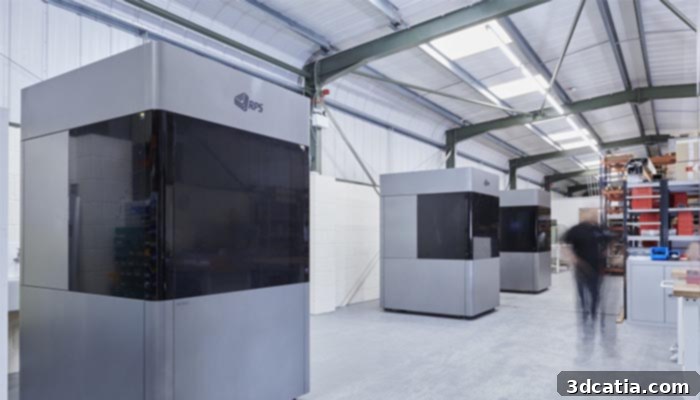
The NEO800 solution from RPS showcases advanced stereolithography capabilities.
The NEO800 is not just any stereolithography system; it is an industrial-grade, large-format additive manufacturing solution meticulously engineered by RPS’s expert team. Its design incorporates a suite of features aimed at delivering unparalleled precision and quality in 3D printed parts. Key among these features is its exceptional layer-to-layer scanning repeatability, which ensures consistent, high-quality results across every print. This repeatability is critical for producing parts with industry-leading sidewall quality, a crucial factor for functional components in motorsport applications where structural integrity and aerodynamic smoothness are vital. Furthermore, the NEO800’s dynamic laser focusing technology allows for the creation of highly accurate and intricately detailed components, essential for complex engineering designs like those found in an intake plenum or aero package. The university team, reflecting on their experience, highlighted the profound impact of this technology: “The ability to use RPS’ NEO800 stereolithography, with DSM Somos resin and complementing HP Multi Jet Fusion technology, has unequivocally proven the tangible benefits of employing the perfect combination of innovative additive manufacturing technology and sophisticated engineering design in our Formula Student project.” This statement underscores the synergy achieved when cutting-edge hardware meets advanced material science, paving the way for superior performance and design freedom.
Building on the successes and lessons learned from the previous year, the collaboration between OBR and RPS intensified this year with a focused objective: to achieve even greater reductions in weight, manufacturing time, and overall cost. RPS proactively supported the team by providing access to significantly larger print beds than those utilized in 2018. This expansion in printing capacity allowed for the production of larger, more complex components in fewer print cycles, directly contributing to time and cost efficiencies. More crucially, RPS recommended a strategic shift to their Nylon 12 based HP Multi-Jet Fusion (MJF) PA12 material. This recommendation proved transformational, particularly for components where lightweighting offers a significant competitive edge. The implementation of Nylon 12 PA12, a material known for its excellent strength-to-weight ratio and fine detail resolution, resulted in a staggering 52% weight reduction for the intake plenum alone, compared to the previous year’s component. This substantial weight saving is directly attributable to Nylon 12’s lower density, which is approximately three-quarters that of materials previously used. For a high-performance racing car, every gram counts; a lighter car translates directly into a faster car, enhancing acceleration, braking, and cornering capabilities. This strategic material choice and the advanced manufacturing capabilities provided by RPS were absolutely crucial for the OBR team in their relentless pursuit of a competitive advantage on the track.

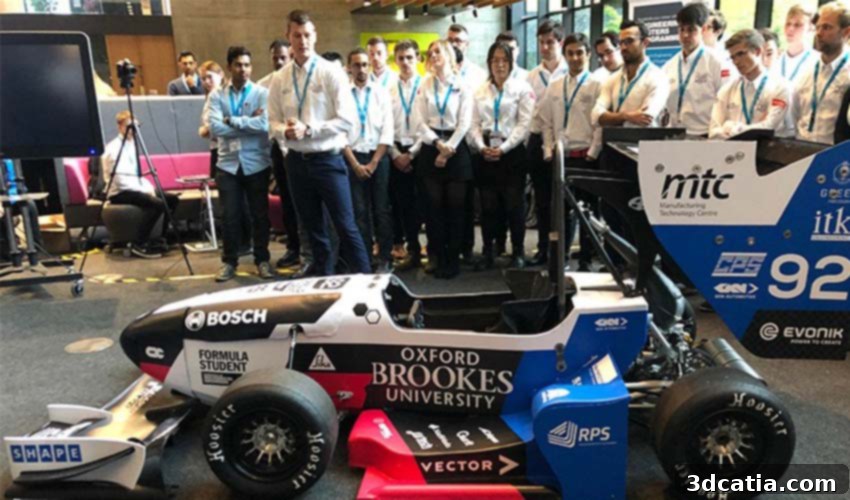
The Oxford Brookes Racing team at Formula Student 2018 showcasing their vehicle | Credits: RPS
Established in 1988, Oxford Brookes Racing has cultivated a formidable legacy within the Formula Student community, consistently demonstrating exceptional engineering prowess and competitive spirit. Their impressive performance at Formula Student 2018, securing an outstanding 2nd place overall, alongside a commendable 2nd place in Engineering Design, stands as a testament to the team’s dedication and skill. Each year, the prestigious Silverstone Circuit becomes the battleground for over 100 university teams from across the globe, all converging to compete in a series of rigorous static and dynamic events designed to thoroughly test the culmination of their year-long preparation, hard work, and innovative engineering solutions. The competition pushes teams to design, build, and race a single-seater racing car, challenging them across categories such as design, cost, manufacturing, business presentation, acceleration, skid-pad, autocross, and endurance. In such a high-stakes environment, where every tenth of a second and every gram of weight can mean the difference between victory and defeat, the role of cutting-edge technologies becomes increasingly vital. The question looms large: are advanced 3D printing technologies truly the ultimate key to unlocking success in this demanding educational engineering competition? The OBR and RPS collaboration strongly suggests that they are, providing tangible advantages in design iteration, weight reduction, and manufacturing speed, which are all critical performance determinants on the track.
The synergistic partnership between Oxford Brookes Racing and RPS exemplifies the profound impact that industry collaboration and advanced additive manufacturing can have on student engineering projects and the future of motorsport. By integrating RPS’s leading stereolithography for precision tooling and HP Multi Jet Fusion technology for lightweight structural components, OBR gains an unparalleled competitive edge. This not only empowers the students to innovate more freely and rapidly but also provides them with invaluable hands-on experience with technologies that are reshaping the automotive and aerospace industries. This real-world application of theoretical knowledge is precisely what Formula Student aims to foster. The ability to iterate designs quickly, produce complex geometries that are impossible with traditional manufacturing methods, and achieve significant weight savings directly translates into a more agile, faster, and more robust race car. This collaboration is not just about winning a competition; it’s about training the next generation of engineers to leverage disruptive technologies for practical, high-performance applications. The future of motorsport, driven by efficiency, customization, and speed of development, increasingly relies on the capabilities that advanced 3D printing provides. RPS, through its continued support, is not merely a supplier but a mentor, enabling OBR to transform bold ideas into tangible, track-ready components, proving that innovation born from collaboration is truly the engine of engineering excellence.
What are your thoughts on this inspiring and highly effective collaboration between RPS and Oxford Brookes Racing? Do you believe 3D printing is the definitive game-changer for Formula Student and future motorsport engineering? Share your insights and opinions in a comment below, or join the conversation on our Facebook and Twitter pages! Don’t miss out on the latest advancements and news in additive manufacturing – sign up for our free weekly Newsletter and get all the essential updates straight to your inbox!