

Revolutionizing Vision: 3D Printed Eye Implants for Advanced Cataract and Refractive Surgery
Cataracts represent one of the most prevalent causes for surgical intervention worldwide, making ongoing innovation in surgical techniques and the materials used absolutely critical. In a groundbreaking development set to redefine ocular device technology, researchers at the University of East Anglia (UEA) have achieved a significant breakthrough: the creation of a novel resin specifically engineered for 3D printing. This pioneering research, which has garnered substantial support from the Innovation Development Fund, Proof-of-Concept grants, the Human Research Trust, and the Engineering and Physical Sciences Research Council (EPSRC), is poised to dramatically improve the manufacturing process of eye implants. These implants are essential for both cataract and refractive surgery, offering corrective solutions not only for cataracts but also for common vision impairments such as myopia (short-sightedness), hyperopia (long-sightedness), and presbyopia. The primary focus of the developed artificial intraocular lens (IOL) is to provide superior treatment for patients afflicted by cataracts, a progressive condition characterized by the gradual clouding of the eye’s natural lens, leading to diminished vision and eventually, blindness.
The choice of material is paramount in the production of these delicate lenses. While historical methods utilized materials like glass and silicone, modern ophthalmology predominantly employs advanced acrylic materials. These acrylics, which have undergone extensive development and refinement, include both hydrophilic and hydrophobic variants. Their widespread adoption stems from their exceptional optical clarity, remarkable flexibility, and long-term stability—qualities that are indispensable for ensuring both the safety and efficacy of an implant within the human eye. Furthermore, their superior biocompatibility means that these 3D printed lenses can be easily and safely implanted into the human capsular bag, minimizing the risk of adverse reactions and promoting seamless integration. Dr. Aram Saeed, a distinguished Professor of Healthcare Technologies at UEA’s School of Pharmacy, underscored the significance of this innovation, stating, “For the first time, we have developed a resin that can be used to print ocular devices directly.” This milestone signifies a leap forward, moving beyond traditional manufacturing constraints to enable direct digital fabrication of complex ocular prostheses.
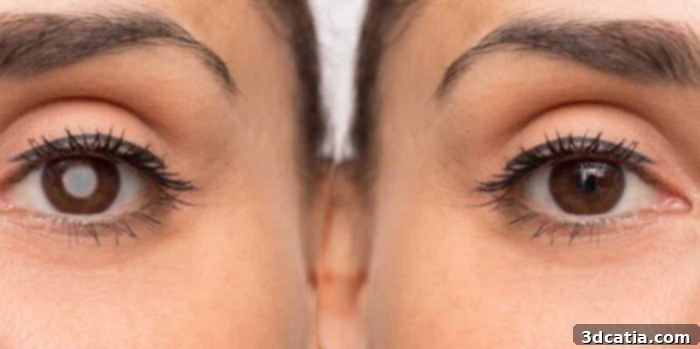
The Transformative Power of 3D Printing in Ophthalmic Care
Traditionally, intraocular lenses achieve their high optical quality through labor-intensive turning and molding techniques. However, the exact mechanisms behind the direct 3D printing process utilizing UEA’s proprietary resin remain a closely guarded aspect of the research. Dr. Saeed highlighted the multidisciplinary nature of this pioneering work, explaining, “Our work combines material science with healthcare technology and requires extensive know-how in developing these types of ocular devices.” This integration of diverse scientific disciplines is precisely what has enabled such a significant breakthrough. The advantages offered by these 3D printed lenses, compared to those produced by conventional methods, are multifaceted and profound. A primary benefit is the unprecedented ability to customize each lens precisely. This means implants can be perfectly adapted to an individual patient’s unique eye shape, anatomical features, and specific visual requirements, moving beyond the limitations of standardized sizes and prescriptions. In the foreseeable future, the sophisticated combination of advanced 3D printing with cutting-edge imaging technology promises to create lenses that adapt flawlessly to the intricate contours of each eye, thereby significantly reducing potential post-operative complications and enhancing overall patient outcomes. This level of personalized precision marks a new era in ophthalmic treatment.
Key Benefits of 3D Printed Intraocular Lenses for Cataract Patients
The advanced capabilities of 3D printing unlock the potential for creating exceptionally complex lens designs, allowing for intricate optical geometries and shapes that were previously unattainable with conventional manufacturing techniques. This expanded design freedom translates directly into the ability to provide more sophisticated and effective treatments for a broader spectrum of ocular conditions and unique visual needs, including multi-focal or toric corrections integrated seamlessly. Moreover, this innovative production method promises a substantial reduction in the manufacturing costs for high-quality intraocular lenses. This cost-efficiency is a pivotal factor, as it could make these advanced, customized implants more economically viable and, consequently, accessible to a significantly larger population of cataract patients, particularly in economically disadvantaged and remote regions where access to advanced healthcare is often limited. Michael Wormstone, a distinguished Professor in the School of Biological Sciences at UEA, articulated the wider implications of this technology: “If successful in further developments, this new technology could transform the industry by enabling portable manufacturing solutions, especially beneficial in remote and economically disadvantaged areas.” The ability to produce lenses on-demand, closer to the point of care, would revolutionize ophthalmic supply chains. Furthermore, the inherent speed of 3D printing enables much faster production cycles compared to traditional methods. This accelerated manufacturing process directly translates into a tangible reduction in the waiting time from a patient’s initial diagnosis to their surgical procedure, significantly improving patient experience and quality of life. Recognizing the profound impact and scientific rigor of this endeavor, a US patent has been officially assigned to UEA Enterprise Limited, the university’s dedicated business unit focused on fostering innovation and successfully commercializing research findings.
The Science of Innovation: Developing a Biocompatible Resin for Ocular Use
At the heart of UEA’s groundbreaking innovation lies the development of a novel resin capable of directly 3D printing ocular devices. This is not just any material; it is a meticulously engineered polymer formulated to meet the incredibly demanding specifications required for an intraocular implant. Its critical properties include unparalleled optical clarity, ensuring that light transmits unimpeded to the retina for sharp vision; precise and stable refractive indices essential for accurate vision correction; and superior mechanical stability, allowing the lens to withstand the eye’s natural movements and internal pressures over a patient’s lifetime. Crucially, the resin demonstrates exceptional biocompatibility, significantly minimizing the risk of adverse immunological responses or inflammation when permanently implanted within the delicate ocular environment. This inherent biocompatibility is non-negotiable for any material designed for long-term residence within the human body. The capability for direct 3D printing also grants unprecedented control over the microstructure and surface properties of the lens, enabling optimizations that can lead to better integration with ocular tissues and a reduction in common post-operative complications such as posterior capsular opacification (PCO), a frequent occurrence following conventional cataract surgery.
The interdisciplinary approach championed by Dr. Aram Saeed, effectively merging advanced material science with cutting-edge healthcare technology, is vividly demonstrated in the successful formulation of this specialized resin. It is the culmination of years of dedicated research and development, specifically aimed at addressing and overcoming complex challenges within ophthalmology. The robust support from various prestigious funding bodies, including the Innovation Development Fund and the EPSRC, emphatically underscores the significant potential and the rigorous scientific foundation underpinning this ambitious project. These vital investments are indispensable for facilitating the extensive testing, validation, and iterative refinement processes necessary to transition such advanced medical technologies from theoretical concepts to tangible clinical applications. The emphasis on extensive “know-how” further highlights the profound intellectual capital and specialized expertise that are absolutely essential when developing devices destined to interact directly and safely with the intricate biological systems of the human body.
Charting the Future: Scaling Production and Initiating Clinical Trials
The immediate future for this pioneering technology involves intensive research efforts focused on further enhancing and refining the manufacturing process. Primary objectives include significantly improving the accuracy and scalability of production, alongside increasing the print resolution to achieve even finer dimensional precision in the customized lenses. Dr. Saeed articulated these ambitious goals, stating: “As we continue to publish our findings and share our advancements, we aim to be at the forefront of the industry, working with industrial partners and researchers worldwide to refine and enhance the technology.” This collaborative and transparent approach is fundamental for transitioning from laboratory success to widespread clinical application and global availability. The research team expresses strong optimism about commencing clinical trials within the next few years. Clinical trials represent an absolutely critical phase, providing a comprehensive and rigorous evaluation of the safety, efficacy, and long-term performance of these innovative 3D printed lenses in human patients, a non-negotiable prerequisite for regulatory approval and broad adoption in medical practice.
The collaborative spirit extends beyond academic and industrial partnerships. Saeed and Wormstone have established a crucial and invaluable partnership with the Norwich Ophthalmology Department and Norfolk and Norwich University Hospital (NNUH). This strategic alliance is instrumental in obtaining essential clinical insights, effectively bridging the vital gap between cutting-edge scientific discovery and practical, patient-centered care. Mr. Anas Injarie, a highly respected leading consultant ophthalmologist at NNUH, bringing over two decades of extensive clinical experience, profoundly emphasized the immense importance of this partnership. He highlighted its pivotal role in accelerating ocular research and ultimately, significantly improving patient outcomes. Mr. Injarie affirmed, “This innovation has the potential to enable the production of lenses that match patient specifications in design and optical performance.” This direct and continuous input from seasoned clinicians ensures that the developed technology is not only scientifically robust but also clinically relevant, addressing real-world challenges and delivering tangible benefits for patients. Such synergistic partnerships are unequivocally vital in translating revolutionary research into concrete advancements in healthcare, particularly within specialized fields like ophthalmology where unparalleled precision and highly patient-specific solutions are paramount. The journey from the initial development of a specialized resin to a globally accessible and transformative medical solution is undeniably extensive, but the foundational work meticulously laid by UEA and its esteemed partners represents a monumental and inspiring leap forward for vision care.
The profound implications of UEA’s pioneering research extend far beyond the immediate treatment of cataracts. By enabling the creation of truly customized intraocular lenses, this advanced technology promises not only superior visual acuity for patients but also a significant reduction in post-operative complications, leading to a dramatically improved quality of life. Imagine a near future where every single intraocular lens is meticulously matched to the unique optical characteristics of an individual’s eye, capable of correcting not only cataracts but also complex astigmatism or multifocal needs with unprecedented precision and effectiveness. This is the ambitious and transformative vision that the dedicated UEA team is tirelessly working to realize, bringing the myriad benefits of advanced additive manufacturing directly to the critical and intricate field of ophthalmology. This innovation is set to redefine the global standards of care for the millions of individuals worldwide who suffer from various forms of vision impairment, offering hope for clearer sight and a brighter future.
To explore more about this exciting project and its future implications in greater detail, we invite you to click here. We warmly welcome your perspectives on the revolutionary potential of 3D printed lenses for cataract treatment and other ocular conditions. Please share your insightful comments below or engage with our community on our LinkedIn, Facebook, and Twitter pages! To stay abreast of the very latest advancements in 3D printing news delivered directly to your inbox, don’t forget to sign up for our free weekly newsletter here. Additionally, you can discover all our informative and engaging videos on our dedicated YouTube channel.
*Cover Photo Credits: University of East Anglia