
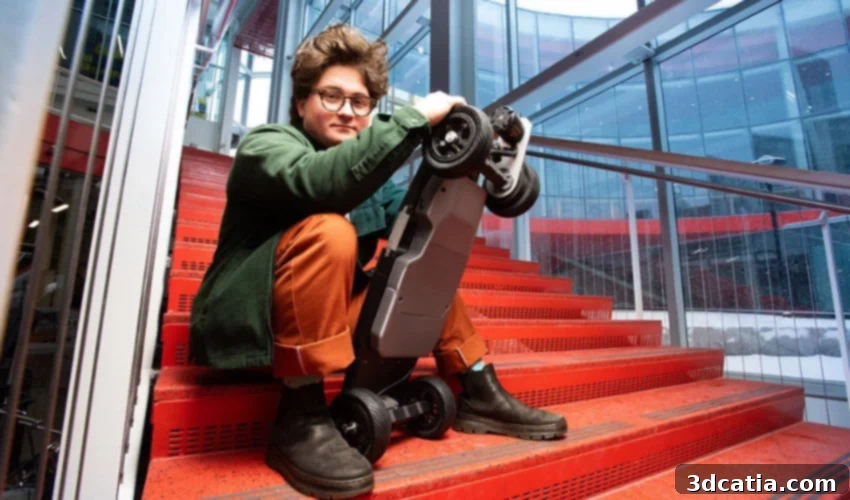
Innovating Personal Mobility: Mike Elrod’s 3D Printed Electric Skateboard Revolution
The landscape of manufacturing is undergoing a profound transformation, with additive manufacturing, commonly known as 3D printing, at the forefront of this revolution. No longer confined to prototyping or niche applications, 3D printing is now instrumental in creating highly functional, performance-driven objects across various industries. We’ve witnessed its application in everything from bespoke surfboards, engineered for optimal wave dynamics and rider comfort, to ultra-lightweight bicycle components designed to elevate athletic performance and enhance user experience. This wave of innovation showcases the immense potential of customized, on-demand fabrication.
Emerging from this vibrant ecosystem of technological advancement is Mike Elrod, a driven fifth-year mechanical engineering student at Rochester Institute of Technology (RIT). Harnessing his profound understanding of engineering principles and a keen eye for innovative design, Elrod embarked on an ambitious project: to conceptualize, design, and construct his very own electric skateboard entirely through advanced 3D printing techniques. This endeavor wasn’t merely an academic exercise; it was a passion project deeply rooted in his professional aspirations. His inspiration stemmed significantly from a formative internship experience at Tesla, the pioneering electric vehicle company. Witnessing the cutting-edge integration of technology and manufacturing in a real-world, high-stakes environment solidified his determination to leverage additive manufacturing as a tool for personal innovation, merging his innate creativity with his rigorous engineering acumen.
The Vision: Pioneering Functional Engineering with 3D Printing Materials
Elrod’s project was born from a fundamental desire to push the boundaries of what 3D printing could achieve, particularly concerning material capabilities. He recognized a gap between the common perception of 3D printing – often associated with decorative items or prototypes – and its true potential for creating robust, load-bearing components. “I’ve always wanted to use engineering-grade materials and filaments to make functional parts for 3D printing,” Elrod articulated, highlighting his forward-thinking approach. He further emphasized, “It’s not always interesting to make little trinkets; I want to use it for engineering.” This statement encapsulates his philosophy: to move beyond superficial applications and delve into the realm where additive manufacturing can genuinely solve engineering challenges and deliver tangible, high-performance results. This pursuit demanded careful selection of materials and precise design methodologies to ensure the integrity and functionality of every component in his 3D printed electric skateboard.
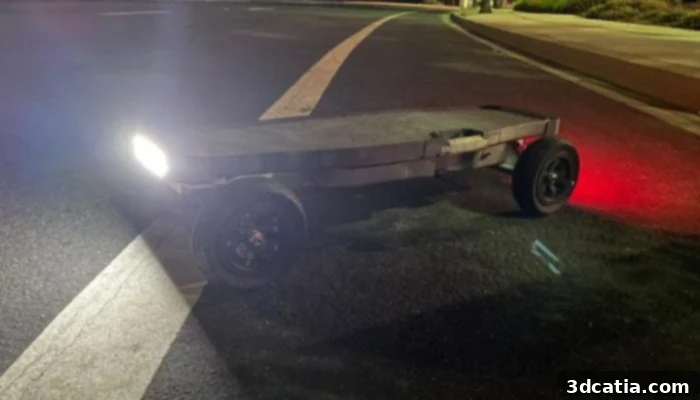
Night shot of Elrod’s fully 3D printed electric skateboard. (Photo Credits: Mike Elrod)
Engineering the Ride: A Deep Dive into Design and Additive Manufacturing
Leveraging his extensive background in mechanical engineering, Mike Elrod meticulously approached the design and fabrication of his electric skateboard. This wasn’t a simple assembly task; it involved an intricate process of CAD modeling, stress analysis, and iterative refinement, all geared towards creating a high-performance, durable, and reliable personal electric vehicle. Every critical component of the skateboard, from the broad, supportive deck to the robust axles and the protective electric housing, was carefully designed and subsequently produced using advanced 3D printing techniques. This holistic approach allowed for unprecedented levels of customization and optimization, ensuring that each part was perfectly suited for its specific function and the overall demands of the skateboard.
A cornerstone of Elrod’s innovative design was the strategic incorporation of carbon fiber-infused filaments. This choice of material was critical for ensuring that the skateboard possessed both the necessary flexibility to absorb shocks and vibrations inherent in riding, and the exceptional strength required to withstand the dynamic forces of everyday use, including impact and torque. Carbon fiber composites are renowned for their high strength-to-weight ratio, making them ideal for performance-oriented applications where both durability and lightness are paramount. By leveraging these advanced materials, Elrod was able to achieve a structural integrity that would typically be associated with more traditional manufacturing methods, proving the viability of additive manufacturing for demanding functional parts in personal transportation. This material selection not only enhanced the board’s durability but also contributed to a lighter overall weight, improving portability and battery efficiency.
Beyond structural integrity, Elrod also dedicated significant effort to refining the skateboard’s ride characteristics. He implemented specialized components specifically designed to enhance its steering responsiveness and overall maneuverability. This included custom-designed trucks and pivot points that allowed for smoother turns and more precise control, significantly improving the user experience. The integration of these custom-engineered elements meant that the board wasn’t just functional; it was optimized for an intuitive and enjoyable ride, tailored to the specific demands of an electric skateboard that needs to handle varying speeds and terrains. This attention to detail in both macro and micro components underscored Elrod’s commitment to creating a truly superior product through smart engineering and innovative 3D printing solutions.
The High-Performance Machine: Features and Capabilities of the 3D Printed Skateboard
The culmination of Elrod’s diligent design and meticulous fabrication is a truly state-of-the-art, fully customized electric skateboard that stands as a testament to the power of additive manufacturing in creating sophisticated personal mobility devices. This innovative board is equipped with a powerful 36-volt battery system, which is the heart of its propulsion. This robust power source not only provides ample energy for extended rides but also ensures consistent, high-torque delivery to the motors, translating into impressive acceleration and sustained speed. With this electrical architecture, the skateboard is capable of achieving exhilarating speeds of up to 20 miles per hour, making it a competitive option for urban commuting and recreational riding alike, offering a blend of excitement and practicality.
Beyond its powerful drivetrain, the skateboard is designed for versatility across various environments. It features rugged 6.5-inch pneumatic tires, a deliberate choice that significantly enhances its all-terrain capabilities. Unlike solid or semi-pneumatic tires, these larger, air-filled tires offer superior shock absorption, effectively dampening vibrations and impacts from uneven surfaces. This means riders can reliably navigate a diverse range of terrains, transitioning seamlessly from the smooth, predictable surfaces of urban pavements and bike paths to more challenging off-road trails, gravel paths, and even grass. The increased contact patch and softer ride provided by pneumatic tires also contribute to better grip and stability, particularly when encountering obstacles or making sharp turns, thus improving both safety and rider comfort for this 3D printed electric skateboard.
User experience and control were also central to Elrod’s design philosophy. The 3D printed electric skateboard is operated via a sleek, intuitive handheld remote controller. This ergonomic device allows riders to precisely manage speed, braking, and potentially other features, providing a seamless and engaging riding experience. The remote’s wireless connectivity ensures immediate response, giving the rider full command over their personalized electric vehicle. This combination of advanced power, all-terrain resilience, and precise control makes Elrod’s creation not just a proof-of-concept, but a highly functional and enjoyable mode of personalized transportation, showcasing the true potential of custom additive manufacturing.
Community and Collaboration: The Backbone of Innovation
Throughout the challenging yet rewarding journey of developing his 3D printed electric skateboard, Mike Elrod understood the immense value of collective knowledge and collaboration. He actively engaged with various online engineering and 3D printing communities. These digital forums and networks proved to be invaluable resources, offering a wealth of specialized information, practical advice, and constructive feedback from experienced engineers, hobbyists, and professionals alike. This collaborative approach helped him to refine his designs, troubleshoot technical hurdles, and sparked new ideas for optimizing the skateboard’s performance and aesthetics. The iterative nature of 3D printing, combined with community input, allowed for rapid prototyping and improvement cycles that would be far more time-consuming and costly in traditional manufacturing settings.
Speaking on the critical role of these communities and the broader industry ecosystem, Elrod remarked, “I knew the community, the industry, and the forums. There have been a lot of companies that have popped up over the last 10 years that make motors and motor controllers, which are the brain, battery packs, and all the little electronics.” This insight underscores a significant trend: the democratization of high-performance components. What once required custom fabrication or prohibitive costs is now readily available from a burgeoning market of specialized suppliers. This accessibility to off-the-shelf motors, advanced motor controllers (often referred to as the “brain” of electric vehicles), efficient battery packs, and a myriad of other micro-electronics has empowered individual innovators like Elrod to focus on their core strengths – design and integration – rather than having to reinvent every single component. The synergy between readily available high-tech parts and the flexibility of additive manufacturing has truly opened new frontiers for personalized innovation in fields such as electric mobility.
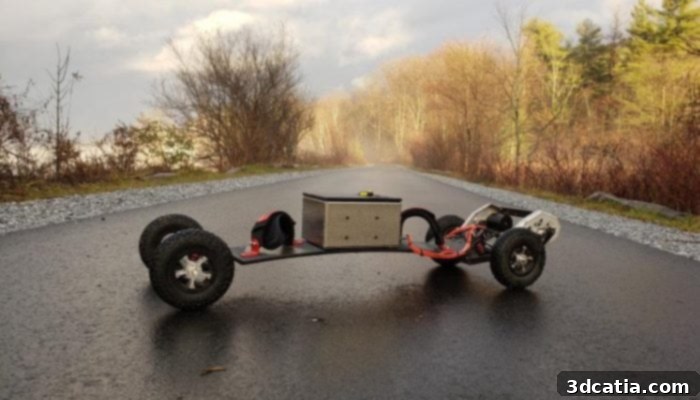
Custom-designed mountainboard by Mike Elrod. (Photo Credits: Mike Elrod)
The Future of Personalized Mobility: Paving the Way with Additive Manufacturing
Mike Elrod’s remarkable project extends far beyond the creation of a single electric skateboard; it serves as a compelling case study and a powerful harbinger of the exciting potential of 3D printing for personalized transportation. His work demonstrates how an individual, equipped with engineering knowledge and access to additive manufacturing technology, can design and produce complex, functional, and high-performance vehicles that are tailored to specific needs and preferences. This level of customization was once the exclusive domain of large-scale manufacturers or highly specialized workshops, but 3D printing is rapidly democratizing this capability, making bespoke mobility solutions accessible to a wider audience.
As additive manufacturing (AM) technology continues its rapid evolution, we can anticipate a burgeoning landscape of even more innovative and personalized transportation options. Future developments in materials science will undoubtedly introduce new engineering-grade filaments with enhanced properties – stronger, lighter, more durable, and potentially more sustainable. Concurrently, advancements in 3D printer resolution, speed, and build volume will enable the creation of larger, more intricate components with greater efficiency. This ongoing progress suggests a future where custom-designed bicycles, lightweight drone frames, personalized mobility aids, and even specialized vehicle interior components could be fabricated on demand, offering unparalleled levels of performance, comfort, and aesthetic appeal. The ability to iterate designs quickly and cost-effectively means that innovation cycles will accelerate, leading to faster development of cutting-edge solutions across various sectors, especially in personalized transport.
Elrod’s project exemplifies a shift towards a maker-driven economy where individuals can transform complex ideas into tangible, functional products. It inspires a new generation of engineers and designers to view 3D printing not just as a tool, but as a gateway to unprecedented creative freedom and problem-solving. By showcasing the practical application of advanced materials and meticulous engineering through additive manufacturing, Elrod has not only built an impressive electric skateboard but has also contributed significantly to the narrative of how technology can empower individuals to redefine personal mobility. To delve deeper into Mike Elrod’s pioneering 3D printed skateboard project and explore its technical specifics, you can find more detailed information by clicking here.
What are your thoughts on this innovative application of 3D printing in custom electric skateboards and personalized mobility? We encourage you to share your insights and opinions in the comment section below, or engage with our vibrant community on our LinkedIn, Facebook, and Twitter pages! Don’t miss out on the latest advancements and news from the world of additive manufacturing; make sure to sign up for our free weekly newsletter here, delivered straight to your inbox! Additionally, you can explore all our engaging videos and content on our dedicated YouTube channel.
*Cover Photo Credits: Rochester Institute of Technology