
Elevating Performance: Renishaw’s Metal 3D Printing Powers Atherton’s Custom Bikes
In a testament to its profound versatility, British manufacturing pioneer Renishaw has consistently demonstrated the transformative potential of additive manufacturing across an impressive array of industries. From the demanding sectors of aerospace and healthcare to the highly competitive world of professional sports, Renishaw is adeptly integrating this cutting-edge technology into diverse applications, constantly pushing the boundaries of what’s possible. Far from resting on its laurels, the company recently announced a significant extension of its successful partnership with Atherton Bikes, the acclaimed Welsh manufacturer renowned for its custom, high-performance bicycles. This collaboration further solidifies additive manufacturing’s growing influence in the cycling world, with Renishaw’s advanced 3D printing technology poised to significantly enhance and optimize Atherton’s already sophisticated production processes. This alliance marks a pivotal moment, showcasing how precision engineering and innovative manufacturing can converge to redefine the standards of bicycle design and performance.
Atherton Bikes’ strategic decision to engage Renishaw’s expertise was driven by a clear understanding of the unparalleled advantages offered by metal additive manufacturing. These benefits extend beyond mere novelty, encompassing crucial factors such as expedited production timelines, innovative manufacturing techniques, and a commitment to enhanced sustainability. Bryan Austin, the sales manager for Renishaw’s additive manufacturing group, articulates the core advantages of this partnership: “By integrating additive manufacturing processes, Atherton gains an unprecedented level of design freedom. This empowers them to engineer and develop bicycle components that are optimally suited for peak performance, a feat that proved exceptionally challenging, if not impossible, using conventional casting methods. Traditional casting, reliant on molds, inherently struggles to produce the highly bespoke and intricate components essential for Atherton’s discerning customers. Furthermore, casting typically results in heavier parts due to its inability to create the internal lattice or honeycomb structures that are a hallmark of 3D printed components, structures vital for achieving significant weight reduction without compromising structural integrity.”
The pursuit of excellence in cycling demands components that offer the perfect balance of strength, weight, and durability. For Atherton, this means constantly exploring new frontiers in material science and manufacturing. Additive manufacturing, specifically metal 3D printing, provides the ideal platform to achieve these ambitious goals, enabling the creation of custom parts that are precisely tailored to the rigorous demands of professional cycling and individual rider preferences. This partnership isn’t just about making parts; it’s about pioneering a new era of bicycle engineering where performance, customization, and innovation are seamlessly integrated.

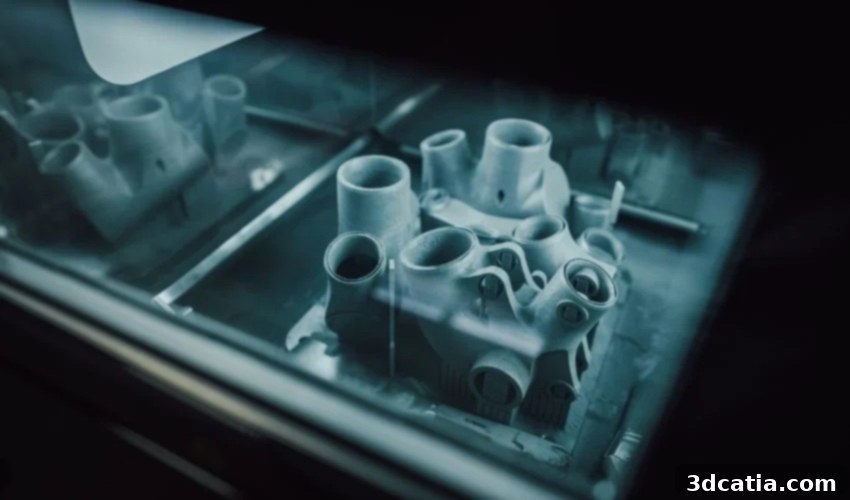
Atherton Bikes leverages the precision and speed of the Renishaw RenAM 500Q 3D printer for producing high-performance components. (Photo credit: Atherton Bikes)
The Transformative Advantages of Metal 3D Printing in Cycling
To fabricate their innovative custom parts, Atherton Bikes has strategically opted to utilize the Renishaw RenAM 500Q 3D printer. This state-of-the-art machine represents the pinnacle of metal additive manufacturing technology. Equipped with an impressive four high-power lasers and offering a generous printing volume of 250x250x350mm, the RenAM 500Q operates on the principle of Selective Laser Melting (SLM). This advanced powder bed fusion technology is meticulously engineered to produce exceptionally high-quality metal parts with unparalleled precision and repeatability. By harnessing the capabilities of this innovative technology, Atherton has been able to 3D print intricate components for their bicycle frames using titanium. Parts manufactured from this remarkable material possess an extraordinary combination of strength and robustness, yet remain remarkably light. This unique characteristic is crucial for high-performance cycling, as it contributes significantly to the overall agility and responsiveness of the bike. Furthermore, the ability to design and print complex geometries allows these titanium components to effectively distribute stresses across the bicycle frame, particularly when navigating challenging or difficult terrains, thereby enhancing rider comfort and confidence.
The RenAM 500Q’s multi-laser system significantly boosts productivity, allowing for faster build times and more efficient manufacturing of multiple components simultaneously. This efficiency is critical for meeting the demands of custom bike production, where each frame can be uniquely tailored. The SLM process melts fine metal powder layer by layer, creating fully dense, strong parts that often surpass the mechanical properties of traditionally manufactured equivalents. This level of control over the material’s microstructure is a game-changer for critical components where integrity and performance are paramount. The ability to create internal lattice structures, which are impossible with conventional methods, is key to achieving exceptional strength-to-weight ratios. These intricate designs not only reduce material usage but also enhance specific performance characteristics, such as vibration dampening or improved stiffness in targeted areas.
Beyond Frames: Expanding the Horizon of 3D Printing in Bicycle Design
While frame components are a prime application, the potential of metal additive manufacturing extends far beyond. We can anticipate seeing 3D printed handlebars offering improved ergonomics and aerodynamics, lightweight and robust pedal designs, or even custom suspension linkages tailored for specific riding styles and conditions. The flexibility of additive manufacturing allows for rapid prototyping and iteration, drastically shortening the design cycle from concept to a functional part. This agility enables bike manufacturers to quickly test new geometries and material combinations, leading to faster innovation and bringing superior products to market more rapidly. The partnership between Renishaw and Atherton exemplifies this forward-thinking approach, where manufacturing technology is not just a tool but a catalyst for groundbreaking design and enhanced rider experience.
The Growing Impact of Additive Manufacturing on the Cycling Industry
Over recent years, an increasing number of bicycle manufacturing companies have begun to integrate a variety of 3D printed parts into their models, capitalizing on the myriad benefits these advanced technologies offer. While Renishaw has consistently made headlines in this innovative sector through its partnerships and technological advancements, other prominent players, such as Mythos and Kimoa, are also actively pushing the boundaries of what’s achievable with additive manufacturing in cycling. This surge in adoption underscores a fundamental shift in how bicycles are designed, produced, and customized. The industry is moving towards a future where mass customization and optimized performance are not just ideals, but tangible realities made possible by sophisticated manufacturing techniques.
Looking ahead, it will be no surprise to witness a significant multiplication in the number of companies specializing in the synergy of additive manufacturing and bicycle production. This trend is driven by the inherent advantages of 3D printing, which include unparalleled design freedom, the ability to create lightweight yet incredibly strong components, and efficient material utilization that contributes to more sustainable manufacturing practices. As these technologies become more accessible and refined, we can expect to see even more innovative bike designs, enhanced rider performance, and greater personalization options across all segments of the cycling market, from high-end racing machines to everyday commuter bikes. This dynamic evolution promises an exciting future for both additive manufacturing and the global cycling community.
Atherton Bikes exemplifies this forward-thinking approach, utilizing additive manufacturing to create bikes that are not only aesthetically pleasing but also engineered for peak performance and durability. Their commitment to custom solutions and high-quality fabrication resonates deeply with the capabilities offered by Renishaw’s advanced metal 3D printing systems. This collaboration serves as a compelling case study for how traditional industries can be revitalized and transformed through the adoption of cutting-edge technologies. The resulting bicycles are truly a product of innovation, reflecting the meticulous design and manufacturing precision that only additive manufacturing can provide, setting new benchmarks for the entire cycling industry. To delve deeper into the innovative world of Atherton Bikes and explore their remarkable range of bicycle models, we encourage you to visit the company’s official website HERE.
What are your thoughts on the groundbreaking applications being developed by Renishaw in collaboration with industry leaders like Atherton Bikes? How do you foresee additive manufacturing continuing to reshape the future of sports equipment and beyond? We invite you to share your insights and engage with us by leaving a comment below or by connecting with our vibrant community on our LinkedIn, Facebook, and Twitter pages! Don’t miss out on the latest advancements and breaking news in the additive manufacturing world – be sure to sign up for our free weekly Newsletter here, delivering the most relevant 3D printing news directly to your inbox! Additionally, you can explore all our engaging videos and in-depth content on our dedicated YouTube channel, where we regularly feature groundbreaking applications and interviews with industry experts.
*Cover Photo Credits: Atherton Bikes