
3D Printing in Hospitals: Revolutionizing Healthcare Through Additive Manufacturing
Over the past few decades, 3D printing technology, often referred to as additive manufacturing, has steadily carved out a significant niche within the medical field. Its transformative potential is now being realized across various specialties, including orthopedics, ophthalmology, dentistry, and traumatology, where it plays a crucial role in optimizing activities and improving patient outcomes. The inherent characteristics of additive manufacturing—such as its ability to design highly complex and customized parts swiftly and at a competitive cost—make it exceptionally well-suited for healthcare applications. From patient-specific drugs and personalized insoles to custom orthotics, prostheses, and intricate surgical guides, the applications of medical 3D printing in the healthcare sector are truly extensive and continually expanding. While an increasing number of initiatives are emerging and demonstrating the power of this technology, a deeper look is warranted into the practical integration of 3D printing in hospitals. This exploration will delve into the significant advantages, the persistent challenges, and the existing limitations, addressing a topic that remains a focal point of discussion among medical professionals, patients, and the general public alike.
The journey of additive manufacturing into hospital environments began several years ago, with a remarkable acceleration in adoption observed globally. In the United States, for instance, data from Statista highlights this meteoric rise: in 2010, only 3 hospitals reported having in-house 3D printing facilities, a number that surged to an impressive 113 by 2019. This dramatic increase unequivocally testifies to the growing interest and trust of the medical profession in this innovative technology. Across the Atlantic, particularly in France, additive manufacturing is also gaining substantial traction within university hospitals, with notable advancements in institutions like those in Brest and Besançon. Here, the technology is being strategically deployed for a multitude of reasons, ranging from empowering practitioners in making more informed therapeutic choices to assisting patients in gaining a clearer and more comprehensive understanding of their diagnoses and treatment plans. This demonstrates a clear trend towards localized, patient-centric manufacturing within the healthcare system, moving beyond mere academic research into practical, daily clinical application.
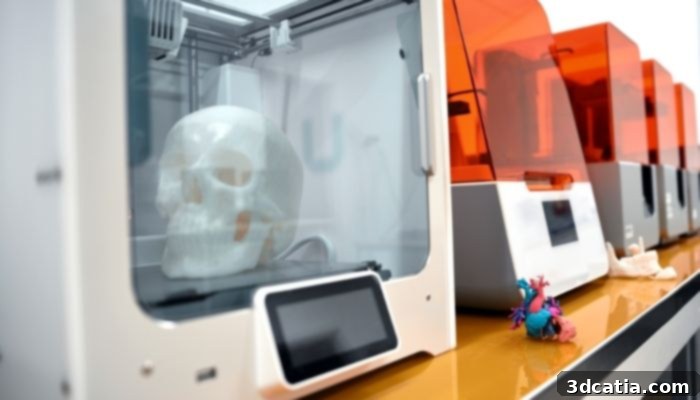
The 3D printers of the I3DM platform of the University Hospital of Besançon (photo credits: University Hospital of Besançon)
3D Printing in Hospitals: A Spectrum of Essential Uses
The utility of 3D printing in hospitals spans a broad spectrum, offering diverse applications that significantly enhance clinical practice. Samuel Guigo, a radio technician responsible for 3D printers at the University Hospital of Brest, articulates the sentiment shared by many medical professionals: “Between saving operating time, developing personalized surgery, and enabling low-cost manufacturing, I see few limits to the use of 3D printing in hospitals. That’s why I believe in it so much.” Like in numerous other industries that have embraced additive manufacturing, healthcare institutions leverage this technology for a variety of critical purposes. In the hospital environment, one of the most prominent and impactful applications is undoubtedly the creation of highly precise surgical guides.
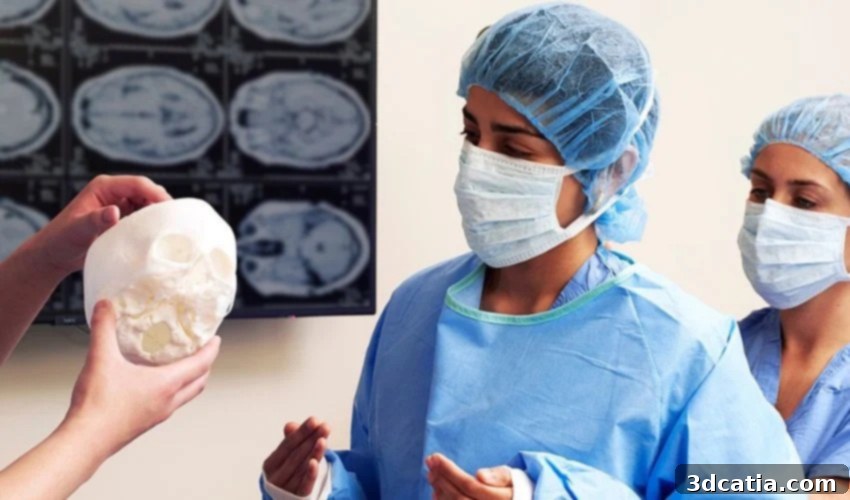
Dr. Aurélien Louvrier, a maxillofacial surgeon at the University Hospital of Besançon, elaborates on the profound impact of 3D printed surgical guides on complex procedures: “This allows us to be reassured and to consider in a more serene way surgical interventions that at first glance seem quite complex. The surgery is already performed virtually, and you arrive in the operating room with less apprehension. Thanks to the virtual surgery and the 3D printing of anatomical models, we can perfect the analysis of each case and consider different surgical strategies. Once the most suitable solution has been chosen, the procedure can be carried out with peace of mind.” This meticulously planned approach, facilitated by patient-specific 3D models, ensures greater precision and reduces the element of surprise during live operations. The success and widespread acceptance of this methodology are evident at the Besançon University Hospital, where the I3DM platform, established in January 2020, now executes approximately 150 planning and 3D printing procedures annually. This dedication to integrating advanced manufacturing into daily surgical practice highlights the tangible benefits it brings to both surgeons and patients, fostering a new era of confidence and efficacy in complex medical interventions.
Beyond surgical planning, the ability to print accurate 3D anatomical models also serves a crucial educational purpose. While these models undeniably help practitioners better comprehend intricate anatomy and pathology, they are equally invaluable in empowering patients to gain a deeper understanding of their conditions. With a tangible, physical representation of their specific pathology, nursing staff and doctors can concretely present the issues to patients, explain the implications, and clearly outline the proposed surgical or therapeutic strategies. This enhanced communication fosters greater trust and allows patients to feel more involved and informed about their own healthcare journey. A compelling example of this patient education and surgical facilitation comes from Barcelona, where the surgical team at the pediatric hospital Sant Joan de Déu successfully removed a tumor from the cheekbone of an 11-year-old boy. This inherently perilous operation was significantly facilitated by the meticulous planning and simulation of the surgical act using BCN3D solutions. This case vividly illustrates how medical 3D printing applications can reassure both surgeons by allowing them to practice and refine their approach, and patients by demystifying complex procedures, thereby profoundly improving the patient-practitioner relationship. However, to confine the immense value of additive manufacturing in the hospital environment solely to these benefits would be an oversimplification, as its advantages extend far beyond these immediate applications.
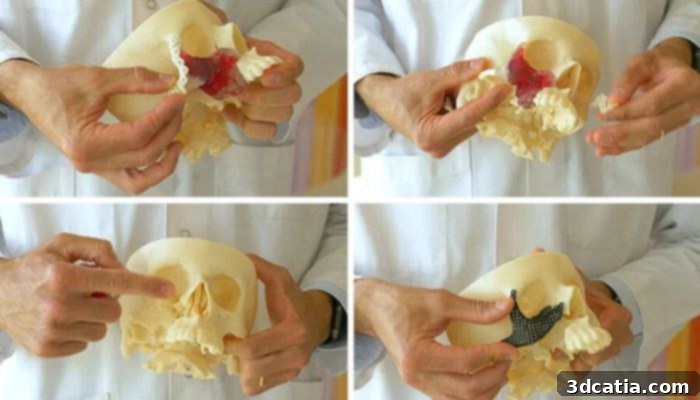
3D printed reproduction of a child’s tumor (photo credits: SJD Barcelona Hospital)
Numerous Advantages Transforming Modern Healthcare
The advantages of integrating 3D printing technology in hospitals are multifaceted and profoundly impactful. As previously highlighted, this technology offers practitioners an unparalleled opportunity to meticulously practice and refine surgical procedures before ever entering the operating room. This pre-operative rehearsal logically translates into several key benefits: lower overall costs for healthcare institutions and significantly higher success rates for surgical interventions. Surgeons who routinely utilize 3D printed surgical guides consistently report that this application allows them to dramatically reduce operating time while simultaneously improving surgical precision. This enhanced accuracy leads to a cascade of positive outcomes, including reduced bleeding, a decreased risk of infection, and even a lower incidence of repeat operations, which are often costly and distressing for patients. These efficiencies are critically important for healthcare institutions, as the operating room typically represents one of the largest expenditure centers for hospitals. Dr. Louvrier eloquently summarizes this synergy: “It’s a real win-win situation, as it improves the precision of the surgical procedure and reduces the operating time. We don’t create financial benefits, but we do save money; if we save one hour of operating time, the savings are already made.” Beyond direct savings, the reduction in complications also leads to shorter hospital stays and faster patient recovery, contributing to a more efficient and cost-effective healthcare system overall.
Furthermore, additive manufacturing in hospitals is a powerful catalyst for the development of innovative therapeutic approaches and personalized medicine. While often perceived primarily as direct patient care providers, university hospitals are also vital hubs for cutting-edge medical research and development. Thanks to the remarkable capabilities of 3D printing, which can be utilized to design and produce truly custom-made medical devices—such as highly individualized prostheses, orthoses perfectly tailored to a patient’s anatomy, and even advanced drug delivery systems—many scientists and researchers harbor a strong hope of offering vastly superior care to patients in the coming years. This includes the potential for fabricating organs on demand, designing scaffolds for tissue engineering, and developing novel pharmaceutical formulations with precise dosages and release profiles. However, realizing this ambitious future requires overcoming specific conditions and navigating complex regulatory landscapes, ensuring that these groundbreaking advancements can be safely and effectively translated from research labs to clinical practice.

During the first wave of Covid-19, the AP-HP installed no less than 60 3D printers (photo credits: LP/Olivier Arandel)
A Rapidly Expanding Ecosystem for 3D Printing in Healthcare
For 3D printing technology to be seamlessly and effectively integrated into a hospital environment, it must, as one might expect, be a meticulously planned and fully supported hospital-wide project. Genuine progress is achieved only when hospital management makes a strategic decision to invest comprehensively in this transformative technology, thereby enabling the establishment of a dedicated 3D technology department or platform. Dr. Louvrier recounts the foundational steps of 3D printing at the Besançon University Hospital: “We realized that many teams were using 3D technologies, but each one on its own. So we suggested to management that we centralize this activity and bring it up to standard from a regulatory point of view.” Following this critical insight, the hospital committed significant resources to creating purpose-built premises and equipping them with specialized 3D printing equipment that rigorously complies with the stringent standards required for designing and manufacturing medical devices. Today, reliable and versatile 3D printers, such as those from Ultimaker and Formlabs, are utilized daily to support practitioners across various departments. A full-time hospital engineer is specifically dedicated to overseeing and managing this vital activity, ensuring smooth operations, technical expertise, and adherence to quality protocols. This holistic approach, backed by institutional commitment, is key to unlocking the full potential of medical 3D printing applications.
While in-house facilities are ideal for rapid prototyping, surgical planning models, and educational tools, integrating more complex additive manufacturing technologies, such as selective laser sintering (SLS) or direct metal laser sintering (DMLS), or even traditional high-precision manufacturing methods, presents a much greater challenge for hospitals. These advanced processes often require specialized facilities that comply with a myriad of strict environmental, safety, and regulatory standards, representing a capital investment and operational cost that is often prohibitively high for most healthcare institutions. Consequently, when an implantable part is required – such as a custom bone plate, a personalized cranial implant, or a complex joint replacement – hospitals typically turn to specialized industrial partners. These third-party manufacturers possess the necessary expertise, certified infrastructure, and regulatory approvals (e.g., FDA, CE mark) to produce high-quality, biocompatible implantable devices. This hybrid workflow, combining in-house design capabilities with external certified manufacturing, significantly streamlines the process. Practitioners and the hospital engineer can model the specific medical device themselves, then securely transmit the digital 3D file to the partner company responsible for the physical fabrication. This collaborative model ensures that a customized, personalized medical device can be produced more quickly, efficiently, and, crucially, in full compliance with all medical and regulatory requirements, allowing hospitals to access advanced solutions without bearing the full burden of sophisticated manufacturing infrastructure.
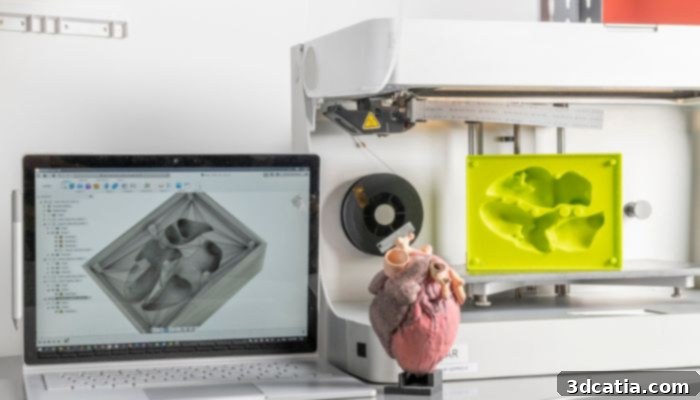
Hospitals also use outside companies (photo credits: F3DF)
Addressing Limits and Overcoming Obstacles for Hospital 3D Printing
Despite the tremendous progress and undeniable advantages, the full integration of 3D printing in all hospitals remains incomplete today, primarily due to several persistent obstacles. As briefly touched upon earlier, stringent regulation is arguably the most significant challenge confronting the broader adoption of additive manufacturing in healthcare. Samuel Guigo highlights this critical point, explaining, “The regulatory aspect and the ability of hospitals to produce their own medical devices in a certified manner is among the main limitations. We could also mention the fact that we ourselves design, print and implant a printed medical device, surely in my eyes the evolution to strive for.” The process of obtaining regulatory approval for new 3D printed medical devices is complex, time-consuming, and resource-intensive, requiring extensive testing and documentation to ensure patient safety and device efficacy. Hospitals must navigate a labyrinth of guidelines from bodies like the FDA in the United States or the EMA in Europe, making internal production of implantable devices particularly challenging without specialized expertise and infrastructure for compliance.
Concurrently, the significant lack of adequate training in 3D technologies also stands as a considerable barrier to the widespread democratization of 3D printing in healthcare. At present, too few healthcare professionals—including surgeons, nurses, and technicians—have the opportunity to undertake comprehensive training courses specifically tailored to the nuances of medical 3D printing. To actively address this critical educational gap, an innovative solution was implemented in Besançon, within the University of Burgundy Franche-Comté. In 2020, a specialized University Diploma (DU) was created, aptly named “DU I3DC,” which stands for “3D Printing in Surgery.” This pioneering course offers a balanced curriculum, combining theoretical modules that delve into the various regulatory frameworks and ethical considerations, with practical sessions where students gain hands-on experience in modeling, designing, and printing 3D parts relevant to surgical applications. Open to both engineers and caregivers, this DU aims to not only generalize the application of 3D printing technology in the hospital environment but also to foster its adoption and innovation within the wider private medical sector, thereby cultivating a skilled workforce capable of harnessing the full potential of this revolutionary technology.
Towards a Widespread Democratization of 3D Printing Technology in Hospitals?
The trajectory for additive manufacturing in hospitals points towards increasing integration and widespread acceptance. As conventional 3D printing continues to spread and mature within healthcare, another groundbreaking field, bioprinting, is also beginning to make significant inroads into university hospitals. In a notable development in Marseille, the French company Poietis, renowned for its expertise in developing advanced bioprinting solutions, announced a strategic partnership with the Laboratory of Cell Culture and Therapy (LCTC). This collaboration signifies a major leap forward, as together, the two entities aim to equip AP-HM (Assistance publique – Hôpitaux de Marseille) with a state-of-the-art platform specifically designed to engineer and produce implantable biological tissues. This initiative represents the forefront of regenerative medicine, promising to revolutionize treatments for tissue damage and organ failure.
Looking ahead, it is highly probable that 3D printing technologies will become an increasingly common and indispensable tool in hospitals worldwide. The potential for these advanced technologies within the hospital environment appears truly immense, given their compelling advantages, particularly in terms of reducing costs, accelerating production, and enabling unparalleled customization. Just a year ago, Samuel Guigo candidly expressed his perspective on this evolving landscape, confiding that he “not yet hav[ed] any idea of all the possible uses of printing in the hospital sector.” This sentiment underscores the ongoing discovery and innovation that characterize medical 3D printing. As research progresses, materials improve, and regulatory frameworks adapt, 3D printing is poised to play an even more pivotal role in the future of healthcare, driving personalized patient care, enhancing surgical precision, and accelerating medical breakthroughs on an unprecedented scale.
What are your thoughts on the expanding integration of 3D printing in hospitals and its impact on the future of healthcare? We invite you to share your perspectives in a comment below or join the conversation on our LinkedIn, Facebook, and Twitter pages! Don’t forget to sign up for our free weekly Newsletter here to receive the latest 3D printing news straight to your inbox! You can also find all our insightful videos on our YouTube channel for more in-depth content.
*Cover Photo Credits: Formlabs