
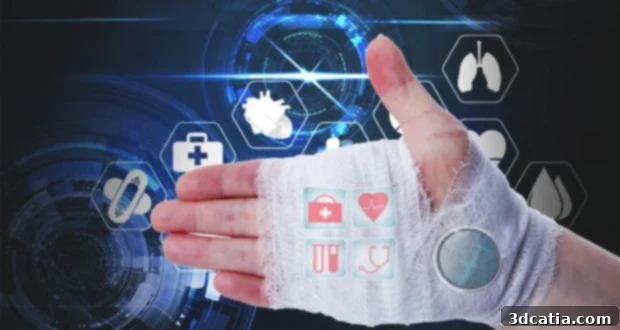
Smart Bandages: Revolutionizing Wound Care with 3D Printing and 5G Technology
The landscape of modern medicine is undergoing a profound transformation, driven by groundbreaking innovations that continuously push the boundaries of what’s possible. Among the most exciting advancements this year is the burgeoning integration of 3D printing into healthcare solutions. Yet, the pace of innovation shows no sign of slowing down. A remarkable new development, born from the collaborative efforts of 3D printing technology and a dedicated team of researchers at Swansea University in the UK, promises to redefine patient care. This pioneering medical innovation, aptly named the “Smart Bandage,” represents a significant leap forward in wound management, offering a personalized and proactive approach to healing.
Led by the esteemed Institute of Life Science (ILS) at Swansea University, this visionary research project addresses a long-standing and critical challenge in traditional wound care: the inherent uncertainty surrounding a wound’s healing progression once a conventional bandage is applied. For both patients and healthcare professionals, the inability to accurately assess a wound’s status without physically removing the dressing has often led to a “guessing game.” This lack of real-time data can result in delayed interventions, unnecessary follow-up appointments, increased risk of complications, and considerable patient anxiety. The Smart Bandage eliminates this uncertainty by leveraging sophisticated sensors and cutting-edge 5G data transfer technology. These integrated capabilities empower doctors to continuously track the healing trajectory of their patients’ wounds remotely, thereby significantly reducing the necessity for frequent, in-person check-ups and allowing for more timely and precise adjustments to treatment protocols.

Marc Clement, Chairman of ILS
The implementation of 5G technology is a cornerstone of this revolutionary design, as highlighted by Marc Clement, Chairman of ILS. He explains, “5G is an opportunity to produce resilient, robust bandwidth that is always there for the purpose of healthcare.” This statement underscores the critical need for a reliable, high-speed network infrastructure to support the continuous, real-time data flow required by smart medical devices. The Smart Bandage project exemplifies a truly multi-technology approach, seamlessly integrating various advanced scientific disciplines. Nanotechnology contributes to the miniaturization and sensitivity of the embedded sensors, while nano-electronics provide the intelligence and processing power within an incredibly small footprint. Printing and coating biochemistry enable the precise application of these advanced components onto flexible bandage materials, creating functional and biocompatible interfaces. All these intricate elements interconnect through the robust and low-latency 5G infrastructure, forming a cohesive system designed to deliver superior healthcare outcomes for wound patients. This synergistic integration promises not only more effective healing but also a significantly enhanced quality of life for individuals grappling with chronic or complex wounds, shifting from reactive to proactive and personalized care.
A pivotal aspect of the Smart Bandage’s development lies in the strategic application of 3D printing technology. Researchers harnessed 3D printing to achieve a level of customization and cost-effectiveness previously unattainable with traditional manufacturing methods. This additive manufacturing technique allows for the precise fabrication of intricate designs and the seamless integration of miniaturized components directly into the bandage structure. By packing the bandage with tiny, advanced sensors developed by nanotechnology experts, the device gains the unparalleled ability to continuously monitor critical wound parameters. These parameters can include pH levels, temperature fluctuations, moisture content, and even bio-impedance, all of which are vital indicators of the wound’s healing progress or the onset of infection. This granular data, transmitted wirelessly via 5G, empowers medical professionals to “tailor the treatment protocol to the individual wound in question.” Such personalized medicine ensures that patients receive the most appropriate and timely care, optimizing healing and minimizing complications. Furthermore, 3D printing facilitates rapid prototyping and iterative design, accelerating the development cycle and making it more feasible to produce customized bandages for diverse wound types and patient anatomies, thereby broadening accessibility to this groundbreaking technology.
The transformative potential of 3D printing extends beyond just embedding sensors. It also enables the creation of bandages with specific topographical features, porous structures, or even embedded drug delivery systems that can release medication directly to the wound site based on sensor readings. This level of intelligent, on-demand treatment represents a paradigm shift in wound care. Imagine a bandage that not only tells you a wound is infected but also releases an antimicrobial agent precisely when and where it’s needed. This integration of diagnostics and therapeutics into a single, smart device is what makes the 3D-printed Smart Bandage truly revolutionary. It moves away from generic, one-size-fits-all solutions towards highly specific, data-driven interventions, promising more efficient healing, reduced healthcare costs by preventing complications, and improved patient comfort. The flexibility and precision of 3D printing are essential for fabricating these multi-functional devices, ensuring each component works in harmony to provide comprehensive wound monitoring and management.
The sophisticated sensors within the Smart Bandage collect a vast array of biometric data points. These micro-sensors are designed to be highly sensitive and robust, capable of functioning effectively in the challenging environment of a healing wound. Once collected, this data is securely transmitted over the 5G network to a centralized medical database or directly to the healthcare provider’s device. The speed and reliability of 5G are paramount here; it ensures that critical information, such as a sudden change in wound temperature or an unexpected spike in inflammatory markers, reaches clinicians almost instantaneously. This real-time alert system allows doctors to make immediate, informed decisions, potentially preventing severe infections, accelerating recovery, and significantly improving patient outcomes. The ability to monitor patients remotely also alleviates the burden on healthcare infrastructure, particularly beneficial for individuals in rural areas or those with mobility issues, enabling seamless telemedical consultations and reducing travel time and costs associated with frequent hospital visits.
The Smart Bandages’ clinical trial phase has already commenced, marking a crucial step towards widespread adoption. These vital trials are being conducted through Swansea University’s ARCH (A Regional Collaboration For Health) in the Southwest Wales region, a testament to the collaborative spirit driving medical innovation. The trials are expected to continue throughout the remainder of the year, with high anticipation for positive results that will validate the efficacy and safety of this advanced medical device. Success in these trials could fundamentally alter the future of medicine, paving the way for a new era of personalized, predictive, and preventive healthcare. For patients, this translates into innovative, next-level treatment that offers greater comfort, faster recovery times, and ultimately, a better quality of life. For healthcare systems, it promises enhanced efficiency, optimized resource allocation, and a reduction in long-term care costs associated with chronic wound management. The data gathered from these trials will be instrumental in refining the technology and establishing best practices for its widespread application.
Beyond the immediate benefits to wound care, the Smart Bandage concept foreshadows a broader revolution in medical technology. The integration of advanced sensors, additive manufacturing, and high-speed communication networks lays the groundwork for a future where smart medical devices are commonplace. From diagnostic patches that detect early signs of disease to prosthetic limbs that adapt to user needs, the potential applications are virtually limitless. This pioneering work by Swansea University reinforces the UK’s position at the forefront of medical research and development. It highlights how interdisciplinary collaboration, combining expertise in materials science, electronics, biomedical engineering, and telecommunications, can yield truly transformative solutions. As we look ahead, the continuous evolution of 3D printing technology, coupled with advancements in AI for data analysis and even more sophisticated sensor designs, promises an exciting future where healthcare is not just reactive but profoundly proactive and personalized for every individual.

The advent of the Smart Bandage represents more than just an improvement in wound dressings; it symbolizes a paradigm shift in how we approach patient monitoring and treatment. It transforms a passive medical device into an active, intelligent health companion that provides continuous feedback, enabling clinicians to intervene precisely when needed. This level of integrated care optimizes the healing process, significantly reduces the risk of complications, and empowers patients with a greater sense of control and understanding of their own recovery journey. The fusion of 3D printing’s customization capabilities with 5G’s robust data transfer potential positions this innovation as a cornerstone for the next generation of smart healthcare solutions, ensuring that every patient receives tailored, optimal care.
What are your thoughts on this incredible new innovation in 3D printing and health? Do you believe 3D printing and smart sensor technology could truly be the future for advanced bandage care and broader medical applications? Share your insights and opinions in the comments section below, or engage with us on our Facebook and Twitter pages!