
Exploring the Future: Top 5 Revolutionary 3D Printing Videos You Must See This Week
Welcome to an enthralling journey through the latest advancements in additive manufacturing! Our curated selection of the week’s top five 3D printing videos showcases the extraordinary versatility and transformative power of this technology across diverse industries. From groundbreaking architectural endeavors and critical aerospace applications to the delicate art of fashion curation and the robust demands of automotive manufacturing, these videos offer a captivating glimpse into a future being shaped by innovative digital fabrication. Whether you’re an industry professional, a technology enthusiast, or simply curious about the frontiers of innovation, prepare to be inspired by the ingenious ways 3D printing is redefining possibilities and solving complex challenges. Join us as we explore how designers, engineers, and curators are leveraging additive manufacturing to push boundaries and create the unimaginable.
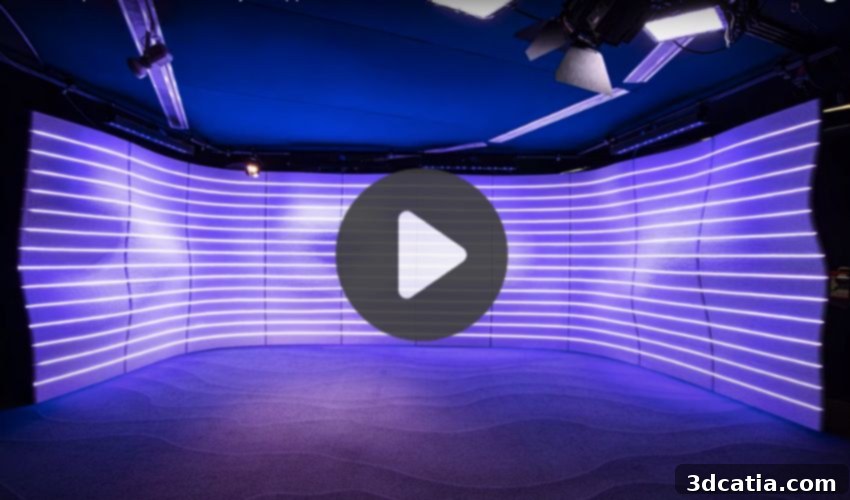
Top 1: A Visionary 3D Printed Film Studio Is a Dazzling LED Experience
Our first spotlight illuminates a truly pioneering project by renowned designer Philipp Aduatz, who was commissioned by The Casinos Austria and Austrian Lotteries Group to conceptualize and construct an innovative film studio using cutting-edge additive manufacturing techniques. This ambitious undertaking leverages the immense potential of concrete 3D printing, executed in close collaboration with Dominik Freynschlag and the specialized 3D concrete printing manufacturer, incremental3d. The studio’s striking aesthetic is not merely superficial; it’s intricately woven into its very structure through the integration of 14 LED strips precisely inserted into prefabricated joints, creating a dynamic and immersive experience. The video masterfully captures the sheer scale and intricate detail of the finished product, which boasts an impressive weight of 3,500kg and expansive external dimensions of 630cm in width, 330cm in depth, and a height of 230cm. This project exemplifies how concrete 3D printing can revolutionize architectural design, offering unparalleled freedom in form, material efficiency, and rapid construction. Traditional construction methods would struggle to achieve such complex geometries and integrated features with similar speed and precision. The ability to directly embed functional elements like LED lighting during the printing process significantly reduces post-production work and enhances the overall design integrity. This studio isn’t just a structure; it’s a testament to the future of bespoke, digitally fabricated architecture, demonstrating how additive manufacturing can merge art, technology, and functionality to create truly unique and high-performance spaces.
Top 2: Advancing Aerospace: Additive Manufacturing for General Atomics
We have consistently highlighted the critical and expanding role of 3D printing across the space and aerospace sectors, where the demand for high-performance, lightweight, and complex components is paramount. For those keen to visualize the tangible potential of this technology, this video from General Atomics Aeronautical Systems provides an invaluable insight. As a key subsection of General Atomics, the company specializes in designing advanced unmanned aircraft for both military and commercial applications, areas where precision, reliability, and efficiency are non-negotiable. Faced with the challenges of conventional manufacturing, General Atomics has strategically adopted 3D printing to fabricate these sophisticated aircraft components. The video meticulously explains the compelling rationale behind this transition, emphasizing the technology’s remarkable ability to produce intricate and complex designs that would be prohibitively expensive or even impossible to achieve with traditional methods, all at a relatively lower cost. Furthermore, viewers gain access to specific, real-world examples illustrating how additive manufacturing has empowered the General Atomics team, significantly improving their workflows and the performance of their unmanned systems. For anyone interested in the broader business implications and operational strategies of a global corporation, this feature offers a fascinating look at how additive manufacturing is not just a tool, but a transformative force affecting General Atomics’ operations on a worldwide scale. By leveraging 3D printing, they can rapidly iterate designs, reduce lead times for critical parts, and optimize components for enhanced aerodynamic performance and reduced weight, which are crucial advantages in the highly competitive and demanding aerospace industry. This shift represents a strategic investment in the future of aerospace manufacturing, enabling greater innovation and operational agility.
Top 3: Weaving the Future: 3D Printing’s Integral Place in Fashion Curation and Heritage
The advent of 3D printing has revolutionized countless industries, and its impact on the fashion sector is nothing short of remarkable. This innovative technology empowers designers to transcend traditional manufacturing limitations, enabling them to conceive and produce highly complex, truly unique, and wonderfully quirky designs that would be painstakingly difficult or even impossible to create by hand. Beyond avant-garde runway pieces, 3D printing is also making significant inroads into museological practice, particularly in the delicate art of fashion curation and the preservation of cultural heritage. In this insightful video from the EU, we witness the profound importance of additive manufacturing in the context of historical textile interpretation, specifically through the recreation of intricate lace. We hear directly from Romy Cockx, a distinguished Curator at MoMu Fashion Museum Antwerp in Belgium, as she discusses her groundbreaking work for an exhibition dedicated to the rich history of lace in the city. Her team ingeniously utilized advanced 3D technologies for this exhibition to meticulously interpret delicate 17th-century handkerchiefs and faithfully recreate these intricate pieces using sophisticated 3D modeling and printing techniques. The video beautifully showcases the breathtaking end result: a stunning, intricate lace product that precisely replicates the historical handkerchief depicted in an ancient painting. As Cockx eloquently states, this project brilliantly “brought the past into the future,” demonstrating how digital fabrication can not only preserve but also bring historical artifacts to life for contemporary audiences. This innovative approach allows museums to handle fragile items less, create accurate replicas for tactile experiences, and develop educational tools that engage visitors in unprecedented ways, bridging centuries with cutting-edge technology.
Top 4: Beyond Human Intuition: Generative Design Facilitates Advanced CNC Machine Creation
In the rapidly evolving landscape of engineering and manufacturing, generative design stands out as a revolutionary paradigm. At its core, generative design involves the automated generation of countless design outputs that rigorously adhere to a specified set of constraints and performance criteria. In the realm of manufacturing, these parameters can encompass critical aspects such as size, weight, material properties, structural integrity, and overall performance. As the informative video elucidates, Generative Design is not merely a theoretical concept; it is also embodied in powerful software platforms, such as the renowned Autodesk suite. These sophisticated tools employ artificial intelligence and advanced algorithms to explore a vast array of possible design permutations, allowing engineers to discover optimal solutions that might be beyond human intuition, ultimately enabling customers to achieve their precise manufacturing goals with unprecedented efficiency. In this compelling feature, we gain valuable insights from Toshulin, a prominent manufacturer of high-precision CNC machines. They share their practical application of generative design methods to produce highly optimized parts that seamlessly integrate into diverse industrial fields. By leveraging generative design, Toshulin empowers its customers to develop and manufacture products that are perfectly tailored to their specific needs, ensuring maximum performance, material efficiency, and cost-effectiveness. This approach not only shortens design cycles but also leads to lighter, stronger, and more innovative components, showcasing a powerful synergy between intelligent design software and advanced manufacturing techniques like CNC machining. Generative design is proving indispensable for addressing complex engineering challenges in an increasingly competitive industrial environment.
Top 5: Toyota Drives Innovation: Adopting Additive Manufacturing for Enhanced Car Production
Toyota, the globally recognized Japanese automotive giant, stands as one of the most prominent and respected automotive manufacturers in the world, synonymous with innovation and reliability. This insightful video reveals how Toyota is strategically embracing additive manufacturing to overcome traditional production challenges, specifically in the fabrication of critical car air-conditioning compressors. Historically, these components have been produced using conventional aluminum die casting. However, this method often leads to undesirable defects in the final product, primarily due to the formation of ‘hot spots’ during the cooling process of the melted aluminum, compromising both quality and performance. Additive manufacturing emerges as a groundbreaking and highly effective alternative for the company. By utilizing advanced EOS 3D printers, Toyota can now precisely print intricate cooling channels directly into the compressor components. This revolutionary capability effectively prevents the occurrence of ‘hot spots’ and the associated defects, leading to superior quality, enhanced durability, and improved thermal performance of the compressors. The integration of 3D printing not only resolves a persistent manufacturing flaw but also opens doors to further design optimizations, allowing for lighter, more efficient, and potentially more compact components. This strategic adoption by a major automotive player like Toyota underscores the growing importance of additive manufacturing beyond just prototyping, positioning it as a vital technology for producing high-quality, end-use parts in demanding industrial applications. It signifies a significant shift towards more advanced, efficient, and defect-free manufacturing processes within the automotive sector, promising a future of higher performing and more reliable vehicles.
What are your thoughts on this week’s remarkable selection of top 5 3D printing videos, especially the visionary 3D printed film studio and Toyota’s cutting-edge adoption of AM? The projects highlighted demonstrate the incredible breadth and depth of additive manufacturing’s capabilities, from revolutionizing construction and aerospace to preserving fashion heritage and enhancing automotive engineering. We invite you to share your insights and opinions in the comments section below, or engage with us on our social media platforms. You can find us on LinkedIn, Facebook, and Twitter! Don’t miss out on the latest advancements and breaking news in the additive manufacturing world; make sure to sign up for our free weekly Newsletter here, delivering the freshest 3D printing news directly to your inbox. For even more compelling visual content, explore our extensive library of videos available on our dedicated YouTube channel. Stay connected and stay informed about the dynamic future of 3D printing!