
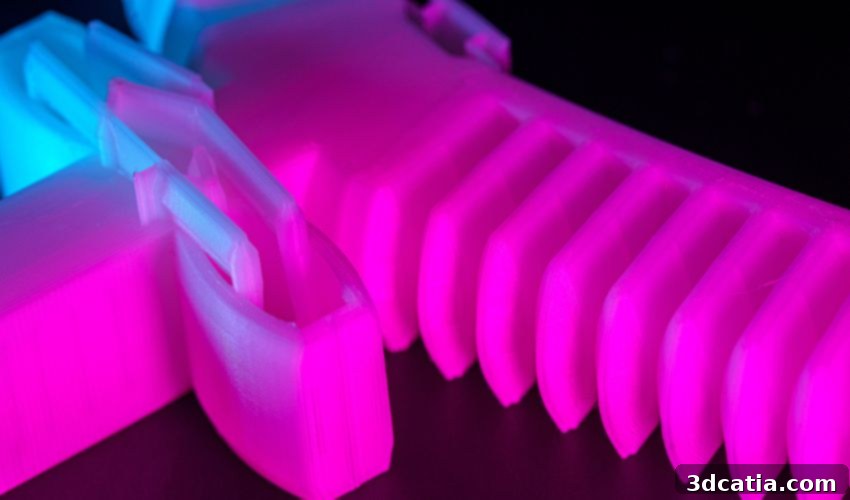
Revolutionizing Robotics: UCSD Unveils Electronics-Free 3D Printed Soft Gripper
The dynamic landscape of robotics is undergoing a significant evolution, with additive manufacturing emerging as a pivotal technology driving this transformation, particularly within the realm of soft robotics. The inherent capabilities of 3D printing allow for the design and rapid fabrication of incredibly complex and innovative robotic structures at a considerably lower cost than traditional methods, making it an increasingly attractive and indispensable tool in the field. In a recent breakthrough that promises to reshape expectations, researchers from the University of California San Diego (UCSD) have unveiled a remarkable 3D printed soft robotic gripper. What makes this innovation stand out is its dual achievement: not only is the gripper fully functional and ready for immediate use straight off the printer, eliminating the need for any assembly, but it also operates entirely without the reliance on electronic components. This development signifies a major leap forward, pointing towards a future of simpler, more robust, and highly adaptable robotic solutions.
For those new to the concept, soft robotics constitutes a specialized subfield of robotics where robots are constructed from highly flexible, compliant, and deformable materials, a stark contrast to the rigid metal and plastic components found in conventional industrial robots. Since gaining widespread recognition and popularization around 2010, this innovative field has experienced exponential growth, finding particular utility in applications that demand exceptional adaptability, safe human-robot interaction, or derive inspiration from natural biological systems, a design philosophy known as biomimicry. Its applications are diverse, spanning from intricate medical devices and prosthetics to delicate handling tasks in manufacturing and even exploration in challenging environments. The core strengths of these soft robots lie in their inherent properties: they are typically lightweight, easily portable, and exhibit a level of adaptability that far surpasses the capabilities of their traditional, rigid counterparts. Furthermore, their compliant nature makes them uniquely suited for scenarios where robots must interact safely and gently with human operators or handle extremely delicate, irregularly shaped objects without causing damage. Robotic grippers, which are designed to grasp, manipulate, and release various items, represent one of the most prominent areas experiencing rapid growth and innovation within soft robotics. The latest project from UCSD brilliantly showcases how 3D printing is enabling increasingly innovative designs in this specific application, with this particular gripper demonstrating potential for immediate use in demanding environments such as industrial manufacturing and food production lines, where precision and gentle handling are paramount.
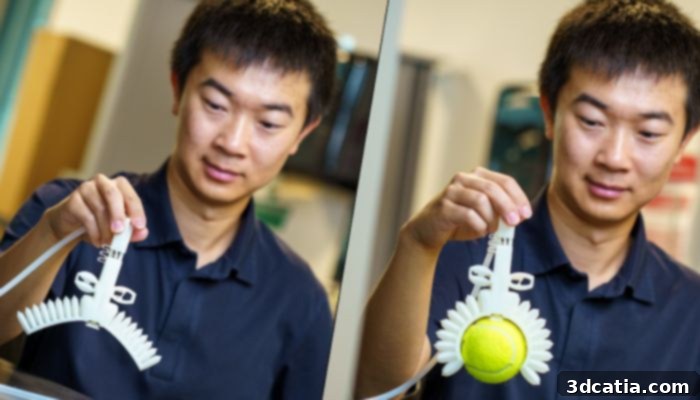
The groundbreaking gripper was entirely 3D printed in a single, continuous process and operates without the need for electronics, significantly enhancing its robustness and simplicity (photo credits: University of California San Diego).
The UCSD Breakthrough: Crafting an Electronics-Free 3D Printed Soft Gripper
This pioneering research, which culminated in the creation of the electronics-free soft robotic gripper, was recently detailed in a leading issue of Science Robotics, underscoring its significant contribution to the field. The project was a collaborative endeavor, bringing together the expertise of roboticists from the University of California San Diego (UCSD) and the chemical giant BASF. The dedicated research team comprised Yichen Zhai, Jioayao Yan, Benjamin Shih, and Michael T. Tolley from UCSD, working alongside Albert De Boer, Martin Faber, Joshua Speros, and Rohini Gupta from BASF. Their collective goal was to engineer a soft robotic gripper that could be immediately deployed after being 3D printed, bypassing the traditional need for post-fabrication assembly. Beyond this, the gripper was designed with integrated, purely mechanical sensing capabilities. It is ingeniously equipped with built-in gravity and touch sensors that operate on fluidic principles, allowing it to autonomously detect, grasp, securely hold, and then precisely release objects without any external electronic intervention. A key element underpinning the functionality of this 3D printed gripper is its sophisticated internal fluidic logic system. This intricate network of channels and valves effectively enables the robot to “remember” when it has successfully grasped an object. Subsequently, through a clever interplay of fluid pressure and weight detection, the system registers when the object’s weight shifts or pushes against its internal structure. This detection then triggers a pre-programmed fluidic sequence, prompting the gripper to release its hold. This elegant, entirely mechanical and pneumatic approach bypasses the complexities, costs, and potential vulnerabilities often associated with electronic control systems, marking a significant stride in autonomous soft robotics.
Ingenious Mechanical Design: The Fluidic Logic Behind Gripping and Releasing
Yichen Zhai, a postdoctoral researcher affiliated with the Bioinspired Robotics and Design Lab at the University of California San Diego and the lead author of the pivotal paper, provided deeper insights into the gripper’s sophisticated operational mechanism. “Our design focused on meticulously engineering a series of internal valves that precisely control the airflow, allowing the gripper to both secure a grip upon contact and then release the object at the appropriate moment,” Zhai elaborated. “This represents a significant milestone, as it’s the first time such a soft gripper demonstrates intrinsic gripping and releasing capabilities without needing external electronic commands or actuators. The brilliance lies in its simplicity: a user merely needs to turn the gripper horizontally to activate the release sequence. This seemingly simple action instigates a calculated shift in the internal airflow within the integrated fluidic valves, which in turn causes the two flexible fingers of the gripper to gently and effectively release their hold.” This fluidic intelligence is the very heart of the gripper’s autonomy. When the gripper encounters an object and senses sufficient contact pressure, internal fluidic channels redirect air pressure, causing the flexible fingers to inflate and conform around the object, securing the grip. Conversely, when the gripper is intentionally rotated to a horizontal position, the change in gravitational orientation subtly alters the pressure distribution within these channels. This triggers a mechanical response in the internal valves, causing them to open or close in a specific sequence, leading to the controlled deflation of the fingers and the subsequent release of the object. This entirely passive yet remarkably effective mechanism highlights an advanced understanding of pneumatics and integrated mechanical design, setting it apart from more complex, electronically controlled robotic systems.
Pioneering a Novel 3D Printing Method for Advanced Soft Robotics
To successfully materialize such an inventive and complex object, an equally innovative manufacturing process was absolutely essential. While 3D printing was the obvious choice for its unparalleled ability to create intricate geometries and integrated components, the research team faced well-known hurdles often associated with 3D printed soft robots, particularly issues concerning material stiffness and the unwelcome propensity for leaks in internal fluidic channels. To surmount these significant challenges, the UCSD team developed and implemented their own groundbreaking 3D printing methodology. As detailed in a comprehensive press release from UCSD, this custom printing technique involved meticulously programming the printer nozzle to follow a continuous, uninterrupted path throughout the entire pattern of each printed layer. This approach is analogous to drawing an elaborate picture without ever lifting the pencil from the page, ensuring an absolute seamlessness in the printed structure. This innovative “continuous path” method yielded several crucial advantages. Firstly, it enabled the complete fabrication of the entire 3D printed gripper in a single, uninterrupted printing operation, drastically streamlining the manufacturing process and completely eliminating the need for any post-print assembly or bonding. Secondly, and critically for the functionality of soft robots, this continuous extrusion technique substantially reduced the likelihood of creating weak points, minimizing both potential leaks and other structural defects, thereby ensuring the gripper’s long-term integrity and reliable operation. Furthermore, this method provided the team with the capability to print exceptionally thin walls and intricately complex, curved shapes with remarkable precision and consistency – geometric features that are indispensable for achieving the required flexibility and compliance characteristic of effective soft robots. This bespoke 3D printing method represents a significant leap in additive manufacturing, offering a robust and scalable pathway for fabricating sophisticated soft robotic structures with fully integrated functionalities directly from the printer. For a deeper dive into this groundbreaking project, including visual demonstrations, you can view the video below or access the full research paper HERE.
The Broader Impact: Why Electronics-Free Soft Robotics is a Game-Changer
The successful development of an electronics-free soft robotic gripper is far more than just an engineering feat; it carries profound implications that could fundamentally alter the future trajectory of robotics and additive manufacturing. By completely eliminating electronic components, this innovation drastically reduces both the overall cost and the inherent complexity of these robotic devices, thereby making them significantly more accessible and viable for a much wider array of applications and markets. Moreover, the absence of sensitive and delicate electronics substantially enhances the gripper’s robustness and durability. This allows it to function reliably and effectively in challenging environments that would typically prove hostile or damaging to conventional, electronically-driven robots – consider extremely wet, dusty, chemically active, electromagnetically noisy, or high-radiation settings. This inherent resilience positions these grippers as ideal candidates for critical tasks in hazardous environments, such as deep-sea exploration, nuclear decommissioning, or specialized industrial chemical processing plants. The simplified design also translates directly into easier maintenance protocols and, crucially, a longer operational lifespan, as there are fewer points of failure associated with complex electronic systems. In the context of industrial manufacturing, these compliant grippers offer a safer, more adaptable, and less intrusive alternative to rigid robotic arms, especially when handling delicate products or when operating in close proximity to human co-workers on collaborative assembly lines. Similarly, within the food production industry, their gentle yet firm grasp can precisely manipulate fragile items like fruits, vegetables, or baked goods without causing bruising or damage, thereby boosting efficiency, reducing waste, and ensuring product quality.
Expanding Horizons: The Synergy of 3D Printing and Soft Robotics
This groundbreaking UCSD project serves as a compelling testament to how 3D printing has evolved beyond merely a rapid prototyping tool to become a fundamental enabling technology for the next generation of robotic systems. The intrinsic capabilities of additive manufacturing – specifically, its ability to create intricate internal channels, seamlessly integrate multiple materials within a single print, and fabricate organic, biomimetic forms with unparalleled precision – are perfectly aligned with the core design principles and functional requirements of soft robotics. Traditional manufacturing methods often struggle immensely with the inherent complexity and compliance demands of soft robots, typically necessitating extensive, multi-step assembly of numerous discrete parts, which can be time-consuming and prone to error. In stark contrast, 3D printing facilitates monolithic fabrication, where essential functional components such as actuators, sensors (as ingeniously demonstrated in this gripper), and even rudimentary control mechanisms can be directly integrated into the robot’s overall structure during a single, continuous printing process. This seamless, ‘print-and-go’ integration significantly enhances overall performance, drastically reduces the number of manufacturing steps, and opens up unprecedented possibilities for highly customized, on-demand robotic solutions. Imagine the potential for medical grippers precisely tailored to a patient’s unique anatomy for minimally invasive surgical procedures, or accessible educational kits that empower students to print and intuitively assemble their own functional soft robots exhibiting complex, adaptive behaviors. Furthermore, the burgeoning flexibility in material selection for 3D printing, ranging from highly deformable silicone-like elastomers to advanced composite polymers, dramatically expands the design space. This material versatility enables the creation of soft robots that can mimic the extraordinary dexterity of an octopus’s tentacles or replicate the nuanced movements of human muscles, pushing the boundaries of what is possible in robotics.
What are your thoughts on this truly groundbreaking 3D printed gripper, operating entirely without electronics? Do you envision other compelling and innovative applications for 3D printing in the rapidly evolving world of soft robotics, particularly those benefiting from electronics-free designs? We eagerly invite you to share your valuable insights and comments below, or engage with our vibrant community on our LinkedIn,Facebook, andTwitter pages! To ensure you never miss out on the very latest breaking news, developments, and innovations in additive manufacturing, don’t forget to sign up for our free weeklyNewsletter here, delivered directly to your inbox. You can also explore all our informative and engaging videos on our dedicatedYouTube channel.
*Cover Photo Credits: University of California San Diego