
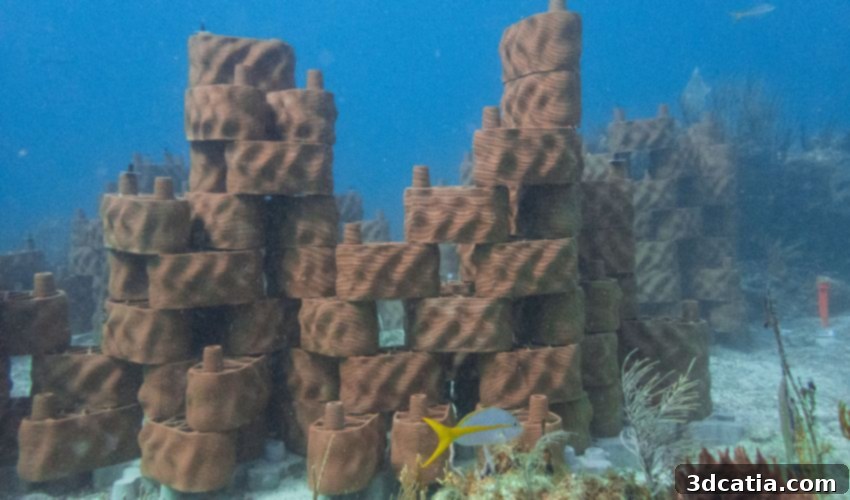
Revolutionizing Coral Reef Restoration: 3D Printing Revitalizes British Virgin Islands’ Marine Ecosystems
Over the past few decades, the devastating impact of climate change on our planet has become increasingly evident. Among the most visible and concerning consequences is the widespread destruction of coral reefs, vital ecosystems that support a quarter of all marine life. Experts, including NASA scientists, estimate that a staggering 90% of the world’s coral reefs, including iconic formations like the Great Barrier Reef, are at severe risk of being wiped out by 2050. This alarming prognosis has spurred researchers and conservationists worldwide to not only devise strategies to halt this destruction but also to actively rebuild and restore affected reefs. In a promising turn of events, numerous countries are now exploring innovative technologies such as 3D printing as a cutting-edge method to revive their coral reefs. The British Virgin Islands (BVI) stands out as a pioneering example, with its government collaborating with leading organizations like the Association of Reef Keepers (ARK) and Rethink Rebuild Regenerating “rrreefs” to implement ambitious 3D printed coral reef projects aimed at marine biodiversity restoration.
The British Virgin Islands: A Critical Battleground for Coral Health
Nestled in the heart of the Caribbean, just east of Puerto Rico and adjacent to the US Virgin Islands, the British Virgin Islands comprise a stunning archipelago where every single island is encircled by vibrant coral reefs. These reefs are not merely picturesque; they are indispensable natural assets, serving as critical habitats for marine species, offering vital coastal protection, and fueling the BVI’s tourism-dependent economy. Among these ecological treasures is the Anegada Horseshoe Reef, a colossal formation stretching an impressive 18 miles, making it one of the largest continuous coral reefs not just in the Caribbean but globally. Its immense size and biodiversity underscore its significance.
However, even these magnificent reefs have not been immune to environmental pressures. Since 2005, over 90% of the BVI’s coral reefs have faced severe endangerment due to a confluence of factors, including devastating hurricanes, recurrent coral bleaching events exacerbated by rising ocean temperatures, the broader impacts of climate change, and various forms of human activity. This dire situation has made coral reef preservation and active revival an urgent and paramount priority for the BVI government, recognizing that the health of its reefs is inextricably linked to the prosperity and resilience of its communities and natural heritage.
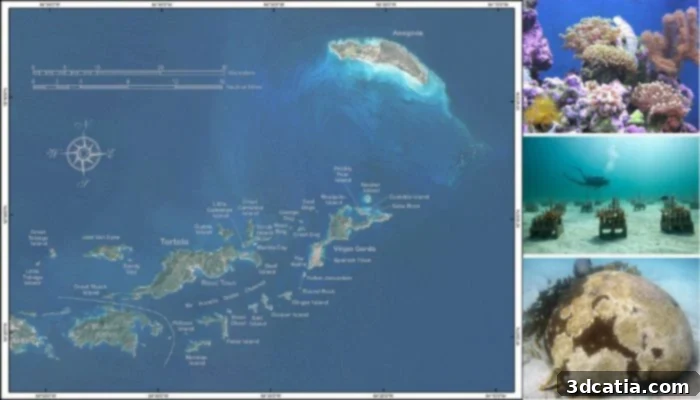
The British Virgin Islands in the Caribbean is composed of a number of islands, many of them surrounded by coral (photo credits: Government of the Virgin Islands)
The Promise of 3D Printing in Coral Conservation and Coastal Defense
Amidst these challenges, Ms. Argel Horton, a distinguished Marine Biologist and Environmental Officer at the Ministry of Environment, Natural Resources and Climate Change, expresses profound optimism regarding the transformative role that 3D printing technology will play in the BVI’s efforts to bring its coral reefs back to life. Her vision extends beyond mere restoration; she sees 3D printed reefs as a powerful tool for enhancing the territory’s resilience against future environmental threats.
As Ms. Horton explains, “Once it starts thriving, it can be replicated and integrated into our existing reef system so the Territory’s coastal defense can protect us from intense hurricanes, storms, and flooding in our critical low lining communities. We would be the second in the Caribbean to test this system, and I’m eager to see how well it will work within our region.” This statement highlights a dual benefit: not only do these artificial structures provide a foundation for new coral growth and marine habitat, but they also serve as vital natural barriers, mitigating the destructive forces of increasingly severe weather events. The BVI’s initiative positions it at the forefront of innovative marine conservation in the Caribbean, setting a precedent for other vulnerable island nations.
Crafting New Reefs: The Science Behind 3D Printed Coral Structures
The methodology employed by ARK and rrreefs in the British Virgin Islands mirrors successful strategies deployed in similar coral reef restoration projects across the globe. The core innovation lies in the use of clay 3D printing to fabricate these intricate artificial coral reef structures. The selection of clay as the primary material is a deliberate and strategic choice. Clay is a natural, inert, and environmentally-friendly material, ensuring that the artificial reefs introduce no harmful pollutants into the delicate marine ecosystem. Furthermore, its inherent sturdiness ensures the durability and stability required for an underwater installation, allowing the structures to withstand strong currents and marine conditions for decades.
While the specific 3D printing process used was not explicitly detailed, the nature of the material strongly suggests an extrusion-based method. This technique involves forcing a malleable material, such as clay paste, through a nozzle to build up layers, forming complex geometries. This allows for the creation of highly detailed and biologically inspired designs that mimic the natural complexity of living coral, providing ideal nooks, crannies, and surfaces for coral polyps to attach and grow, as well as offering shelter for various marine organisms.
A Deep Dive into the BVI Project’s Design and Implementation
The initial 3D printed reef structure deployed in the BVI is a substantial installation, spanning 20 cubic meters and comprising 254 individual modular bricks. These advanced ceramic bricks were meticulously produced in Switzerland, leveraging state-of-the-art 3D printing facilities to ensure precision and quality. Once fabricated, the components were transported to the British Virgin Islands, where they were expertly assembled on-site. The chosen location for this pioneering project is Cistern Rock, a popular snorkeling and dive site off Cooper Island, which offered an accessible and ecologically relevant area for the installation.
The commitment to natural principles extends beyond the choice of material to the very design of these underwater modular clay reefs. Dr. Shannon Gore, the Managing Director for ARK, elaborated on this thoughtful approach: “The design of these 3D printed bricks can be seamlessly integrated within deteriorating reefs to rebuild areas that are no longer able to protect shorelines from erosion.” This emphasis on seamless integration is crucial. The artificial structures are not intended to replace natural reefs entirely but rather to augment and support existing damaged ecosystems. By providing stable substrates and complex habitats, they aim to kickstart natural recovery processes, offering protection to vulnerable shorelines and fostering the return of marine biodiversity. The modularity also allows for scalability and adaptability, making it possible to expand or modify the reef system as needed.
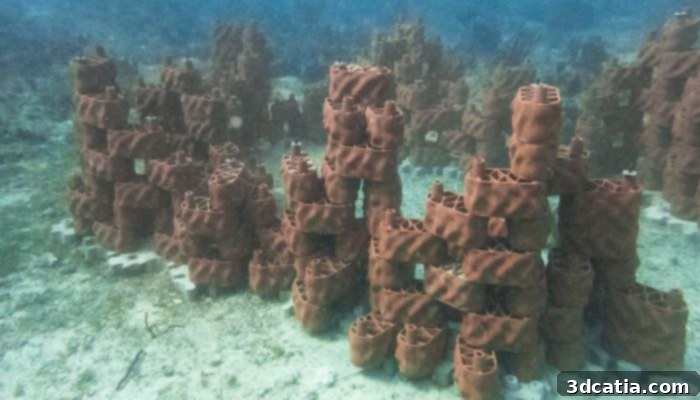
The 3D printed coral at the bottom of the sea, where it is hoped to help revitalize the coral reefs in the region (photo credits: Berta McKelly Adam/Government of the Virgin Islands)
Monitoring Success and Charting the Future of Marine Regeneration
The British Virgin Islands 3D printed coral reef project is not a one-time installation but rather the beginning of a long-term scientific endeavor. Over the next two years, ARK will diligently monitor the structure, meticulously recording its impact on enhancing marine diversity. This comprehensive monitoring will involve tracking several key metrics, including the recruitment of new coral polyps, the aggregation of various fish species, and the colonization by other crucial marine life such as invertebrates and algae. The data collected will be invaluable in assessing the efficacy of 3D printing as a coral restoration tool and informing future conservation strategies.
The ambition of this initiative extends far beyond the BVI’s shores. The success and learnings from this project are expected to catalyze similar efforts globally. Indeed, two more 3D printed reefs are already slated for installation later this year, demonstrating the growing international recognition of this technology’s potential. These upcoming projects include a significant installation in the Philippines, a nation renowned for its immense marine biodiversity but also highly vulnerable to coral degradation, and another in Ecuador, highlighting the diverse geographical application of this innovative approach. Marie Griesmar, Co-Founder of ARK, expressed her team’s enthusiasm and forward-looking perspective: “We look forward to seeing how this reef evolves over the coming years and how we can implement more of these types of reefs in the BVI.” Her statement underscores the commitment to ongoing research, adaptation, and scaling up these vital restoration efforts.
The BVI government’s proactive stance and collaboration with expert organizations like ARK and rrreefs represent a significant step forward in the global fight to save our coral reefs. By embracing cutting-edge 3D printing technology, they are not only working to restore the ecological balance of their own precious marine environment but also providing a powerful model and source of hope for other regions grappling with similar environmental challenges. This pioneering work offers a tangible path towards a future where technology and conservation converge to create thriving, resilient ocean ecosystems.
You can find out more on the Website of the Government of the Virgin Islands HERE.
What do you think of the use of 3D printing to revive coral reefs in the British Virgin Islands? Where do you think we will see the next project utilizing this innovative technology? Let us know your thoughts in a comment below or connect with us on our LinkedIn, Facebook, and Twitter pages! Don’t forget to sign up for our free weekly Newsletter here, for the latest 3D printing news delivered straight to your inbox! You can also find all our compelling videos on our YouTube channel.
*Cover Photo Credits: Berta McKelly Adam/Government of the Virgin Islands