
Exploring the Frontiers of Additive Manufacturing: From Terrestrial Construction to Interstellar Innovation
Welcome to our latest deep dive into the dynamic world of 3D printing, a technology continuously pushing the boundaries of what’s possible. This week, we bring you an inspiring collection of stories and insights, highlighting the incredible versatility and transformative power of additive manufacturing across various sectors. From groundbreaking work in space colonization to critical advancements in defense, and from the intricate details of model hobbies to cutting-edge engineering design, these five features underscore how 3D printing is revolutionizing industries and sparking innovation worldwide. We kick off with an exclusive #3DInterview featuring Ahmed Mahil, the visionary CEO and Global President of Luyten, a company boldly venturing into 3D concrete printing in extraterrestrial environments. We’ll also explore how Spectra Group leverages 3D printing for robust communication devices, witness a stunning 3D printed model aircraft in flight, discover the intricate art of 3D printing train terrain for hobbyists, and learn how to achieve peak performance in 3D printed parts through advanced software applications. Prepare to be amazed by the innovation and potential that these developments showcase.
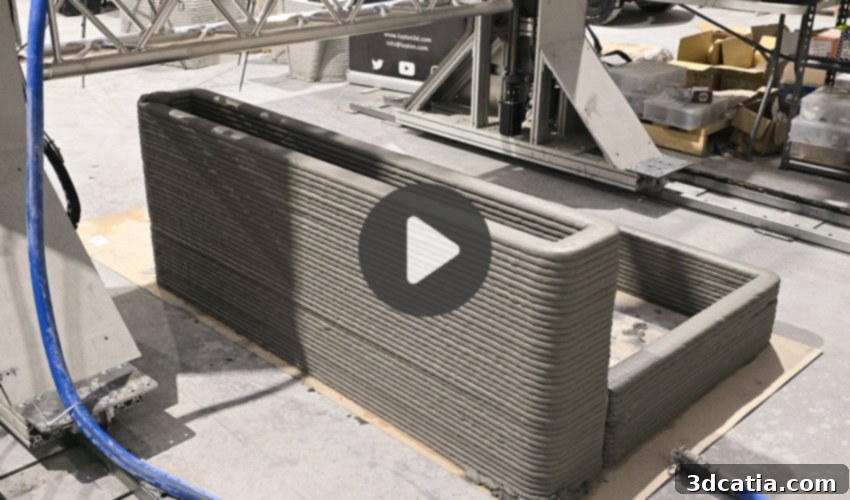
Top 1: Luyten Pioneers Concrete 3D Printing for Earth and Space Applications
The realm of construction has been significantly transformed by 3D concrete printing (3DCP), offering unprecedented speed, efficiency, and design flexibility for structures right here on Earth. However, the Australian company Luyten is not content with terrestrial achievements alone. They are fearlessly pushing the frontiers of 3DCP into space, envisioning a future where human habitats on the Moon and Mars are constructed autonomously using local resources. This ambitious endeavor represents a monumental leap in humanity’s quest for interstellar habitation. In our exclusive interview, Ahmed Mahil, CEO and Global President of Luyten, shares profound insights into the complex physics and engineering marvels involved in printing structures in zero gravity or low-gravity environments. He discusses the unique challenges posed by radiation, vacuum, and regolith-based materials, as well as the innovative solutions Luyten is developing to overcome these hurdles. Mahil elaborates on how the company’s advanced robotic systems and proprietary material formulations are being adapted to perform reliably in extreme extraterrestrial conditions. This vision extends beyond mere shelters; it encompasses self-sustaining ecosystems and infrastructure critical for long-duration space missions. Luyten’s groundbreaking work is not just about building structures; it’s about laying the foundation for future off-world civilizations, demonstrating how additive manufacturing can be a cornerstone of sustainable space exploration and permanent human presence beyond Earth. Their commitment to developing robust, scalable, and autonomous 3DCP technologies for space applications positions them at the forefront of a new era of architectural innovation, proving that the sky is no longer the limit for construction. The implications for reducing the cost and complexity of space missions are enormous, as building materials would no longer need to be launched from Earth, opening up possibilities for more expansive and ambitious extraterrestrial settlements.
Top 2: 3D Printing Critical Parts for Defense Communications with Spectra Group
In the demanding world of tactical and strategic communications, reliability and adaptability are paramount. Spectra Group, a leading global provider in this critical field, has discovered an invaluable ally in 3D printing for producing high-performance parts on demand. This illuminating video from Stratasys showcases how Spectra Group utilizes the advanced capabilities of the Stratasys Origin One printer to fabricate components that meet the stringent requirements of defense applications. The ability to rapidly design, iterate, and produce specialized parts in-house significantly enhances operational efficiency and responsiveness. The team at Spectra Group emphasizes that their 3D printed parts are not merely functional; they are engineered for exceptional durability, capable of withstanding extreme environmental conditions, from scorching deserts to freezing arctic terrains. These components are also aesthetically refined, ensuring they integrate seamlessly into existing communication devices without compromising performance or appearance. For defense and security forces, the capacity to quickly replace or customize parts in the field, without relying on lengthy supply chains, can be a game-changer. It ensures uninterrupted communication, which is vital for mission success and troop safety. The Stratasys Origin One’s ability to print with engineering-grade resins allows Spectra Group to achieve isotropic properties and fine feature detail, resulting in parts that perform comparably to traditionally manufactured components. This strategic adoption of additive manufacturing empowers Spectra Group to maintain a competitive edge, innovate rapidly, and provide superior, resilient communication solutions to its global clientele, demonstrating the critical role 3D printing plays in modern military and security infrastructure.
Top 3: Witness a 3D Printed Model Aircraft Achieve Flight!
The Mach Initiative is an ambitious non-profit organization driven by a singular, exhilarating goal: to shatter the Guinness World Record for the fastest sub-25kg jet-powered model aircraft. The current record stands at an impressive 465 mph (Mach 0.62), a benchmark the Mach Initiative is determined to surpass through innovative engineering and design. This captivating video provides a front-row seat to the maiden flight of their 3D printed Kingfisher prototype, a testament to the power of additive manufacturing in aerospace prototyping. For a project focused on extreme speed and aerodynamic efficiency, 3D printing offers unparalleled advantages. It allows the Mach Initiative team to rapidly iterate on complex designs, optimize for minimal drag and maximum lift, and precisely control the weight distribution of the aircraft. Traditional manufacturing methods would be prohibitively expensive and time-consuming for the constant design revisions necessary to achieve such a record-breaking performance. By 3D printing the prototype, the team can quickly identify and analyze specific elements of the aircraft’s construction, evaluating structural integrity, aerodynamic performance, and component fit. This agile development cycle enables them to make immediate revisions and improvements, accelerating the path to their ultimate goal. The Kingfisher prototype’s successful flight not only demonstrates the feasibility of using 3D printing for high-performance aerospace applications but also inspires the next generation of engineers and aviators. It’s a compelling example of how advanced manufacturing techniques are pushing the boundaries of what small, dedicated teams can achieve in competitive scientific and sporting endeavors, offering a glimpse into the future of aircraft design and rapid prototyping.
Top 4: Unleashing Creativity: 3D Printing Custom Train Terrain
For dedicated model train enthusiasts, the pursuit of creating incredibly realistic and intricate layouts is a passion that knows no bounds. If you’ve ever spent countless hours meticulously crafting landscapes, tracks, and miniature buildings, then the advent of 3D printing offers a revolutionary alternative to traditional methods. Moving beyond conventional materials like wood or foam, 3D printing provides an innovative pathway to produce highly detailed, customized, and unique train tracks and terrain elements. This video from Steve of “Steve’s Trains” is a must-watch for anyone looking to elevate their model railway hobby. Steve masterfully demonstrates how 3D printing enables him to design and produce custom bridges, tunnels, rock formations, buildings, and even miniature flora with astounding precision and realism. The technology allows for the creation of complex geometries and intricate textures that would be incredibly difficult, if not impossible, to achieve with hand-carving or molding. Furthermore, 3D printing offers immense flexibility; enthusiasts can replicate specific historical structures, design fantastical elements, or create modular pieces that can be easily rearranged or expanded. This not only saves significant time and effort but also opens up a new universe of creative possibilities, allowing hobbyists to bring their unique visions to life with unprecedented detail and accuracy. Whether you’re a seasoned modeler seeking new techniques or a newcomer eager to jump into the hobby with cutting-edge tools, Steve’s detailed guide to building his layout using 3D printing is sure to inspire your next project, proving that personal fabrication technology is transforming beloved pastimes.
Top 5: Mastering High-Performance Parts with Advanced Design Apps
In modern engineering, achieving the highest possible performance from manufactured parts is not just an advantage; it’s often a necessity, especially in fields like aerospace, automotive, and medical devices. This comprehensive tutorial delves into how advanced software applications are revolutionizing part design and optimization. Specifically, it guides you through the process of utilizing the Topology Optimization Post-Process and Simulation-Driven Design apps to engineer components that are lighter, stronger, and more efficient. Topology Optimization is a generative design method where algorithms automatically create optimal part geometries based on specified loads, constraints, and target performance criteria, often resulting in organic, bionic forms that minimize material usage while maximizing structural integrity. Simulation-Driven Design, on the other hand, involves using virtual simulations to predict how a part will behave under various real-world conditions – stress, heat, vibration, fluid flow – before any physical prototypes are made. This video demonstrates the synergy between these two powerful approaches by showcasing a real-world case study from the GrabCAD Challenge, focusing on an aeronautical part. It illustrates how engineers can iterate quickly, validate designs virtually, and refine component performance without costly physical testing cycles. By integrating these apps into their workflow, designers and engineers can unlock new levels of innovation, leading to parts that not only meet but exceed performance expectations, reduce manufacturing costs through material efficiency, and accelerate product development timelines. This tutorial is invaluable for anyone looking to leverage the full potential of digital design tools to create next-generation, high-performance components across any industry, providing a clear pathway to engineering excellence.
The diverse applications of 3D printing showcased in this week’s features truly highlight its potential to reshape our world, from designing for extreme environments in space to refining the intricate details of a hobbyist’s model train layout. We’ve seen how additive manufacturing is not just a technology for rapid prototyping but a fundamental tool for innovation, enabling breakthroughs in construction, defense, aerospace, and advanced engineering. What are your thoughts on the incredible possibilities, particularly the prospect of 3D printing in space and its implications for future human settlements? Share your insights and comments below, or engage with us on our LinkedIn, Facebook, and Twitter pages! Don’t miss out on the latest advancements and news in the 3D printing world; be sure to sign up for our free weekly Newsletter here, delivering fresh content straight to your inbox. You can also explore all our video content and interviews by visiting our YouTube channel. Stay connected and stay informed as we continue to explore the exciting future of 3D printing!